View methods side by side.
Choose up to four methods. Add them using the search and share the comparison by copying its link.
| Criterion | 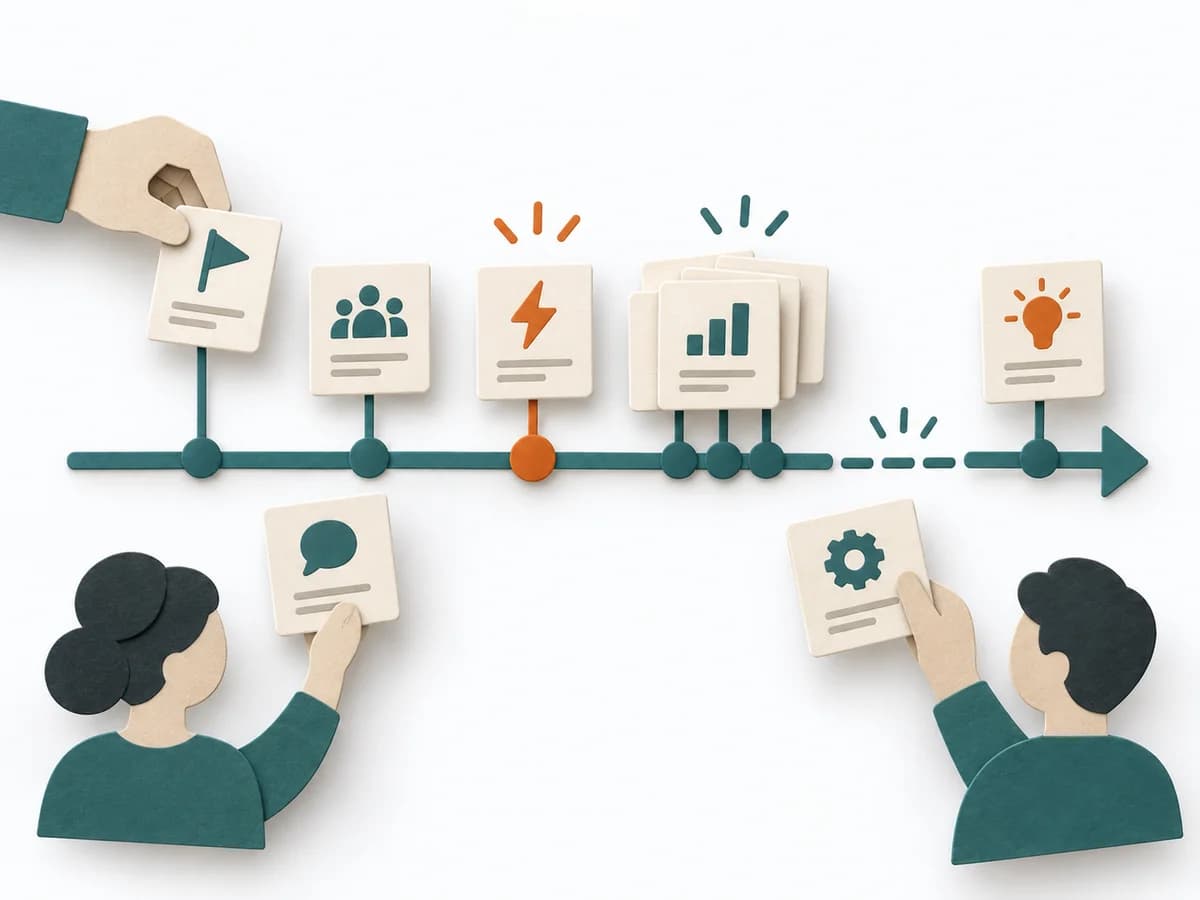 Facilitation Timeline |  Growth Flywheel |  Facilitation Power Interest Grid |
|---|---|---|---|
Purposedifferent | When a project, incident, or change process is only remembered in fragments, Timeline brings the sequence back into a readable form. It makes turning points, precursors, and after-effects recognizable over the course of time. | Growth often breaks down where a reinforcing mechanism builds up too much friction. A Flywheel shows the cycle of value, repetition, and reinforcement meant to sustain growth. | When many stakeholders compete for attention at once, the Power Interest Grid sorts them by influence and stake. It turns individual contributions into a visible selection. The result is captured as a Power Interest Grid and a stakeholder-specific strategy. |
Complexitydifferent | Low | Medium | Low |
Timedifferent | 30-90 min | 60-120 min | 30-60 min |
Participantsdifferent | 2-12 | 3-8 | 2-8 |
Formatdifferent | Workshop + async | Workshop | Workshop |
Outputdifferent | Timeline, Milestones, Insight Notes | Flywheel Map, Friction Points, Growth Levers, Experiment Backlog | Power Interest Grid, Strategy per Stakeholder |
Tagsno overlap | TimelineFacilitationSequence | GrowthRetentionConversion | StakeholdersFacilitationAlignmentPlanning |
Often compared together
Methods with strong topical overlap with the current selection, not yet in the comparison.