View methods side by side.
Choose up to four methods. Add them using the search and share the comparison by copying its link.
| Criterion |  UX Research Surveys |  Innovation Design Thinking |  Product Strategy ICE Scoring |
|---|---|---|---|
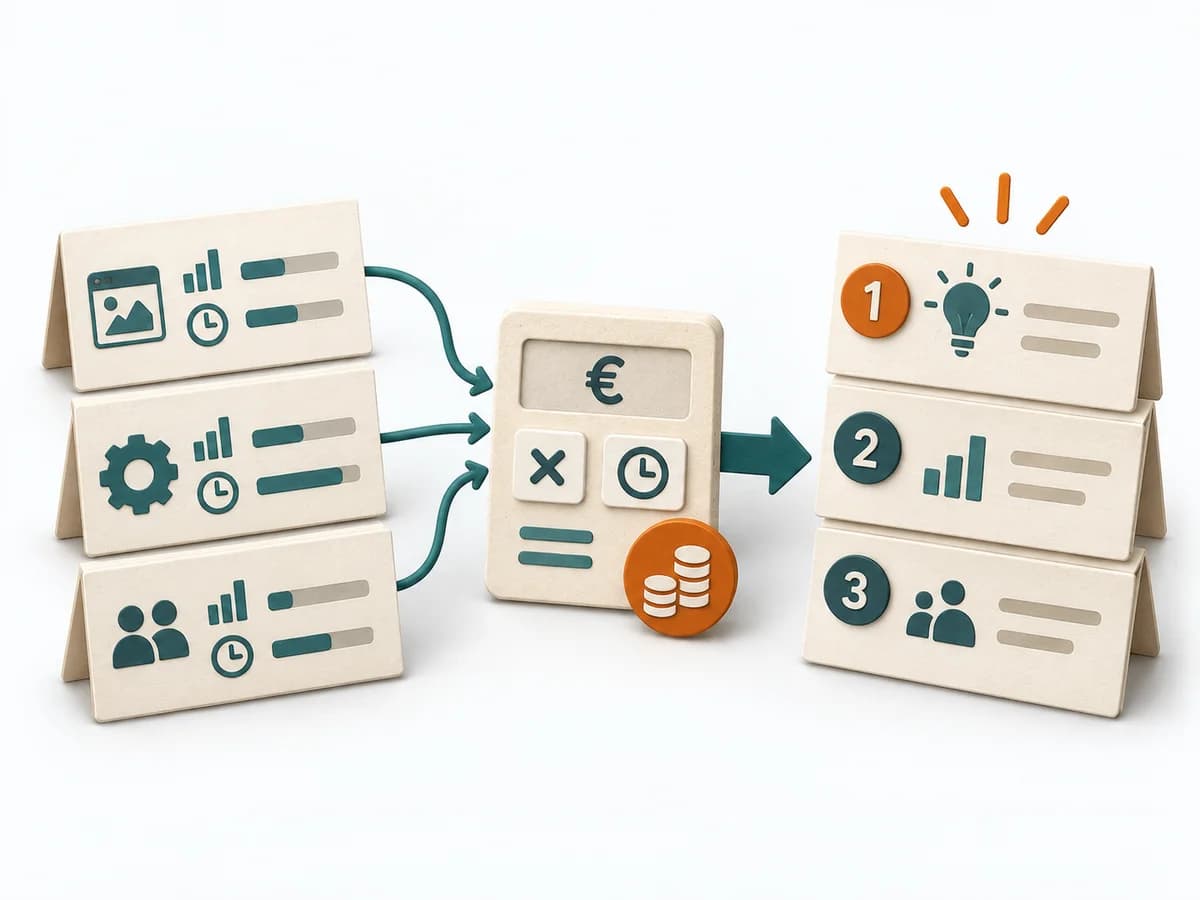
Purposedifferent | When a topic needs to be validated broadly and many people can answer the same question, surveys gather structured feedback in a scalable form. Answers become comparable and segmentable instead of remaining merely anecdotal. | For complex user problems with an uncertain cause, the method connects observation, interpretation, and experiment into a learning cycle. It keeps the focus on real needs and avoids premature solution language. This produces robust decisions for product and service. | When ideas need sorting quickly, it condenses impact, confidence, and effort into one compact score. It connects customer value, product logic, and decision priorities. The result is captured as an ICE table and top-ideas list. |
Complexitydifferent | Medium | High | Low |
Timedifferent | 3-14 Tage | 1 Tag bis mehrere Wochen | 30-60 min |
Participantsdifferent | 50+ | 4-10 | 2-8 |
Formatdifferent | Async | Workshop | Workshop + async |
Outputdifferent | Survey Results, Charts, Segment Insights | Problem Statement, Prototype, Test Learnings | ICE Table, Top Idea List |
Tagsno overlap | QuantitativeResearchValidation | InnovationPrototypeResearch | PrioritizationScoringGrowthDecision |
Often compared together
Methods with strong topical overlap with the current selection, not yet in the comparison.