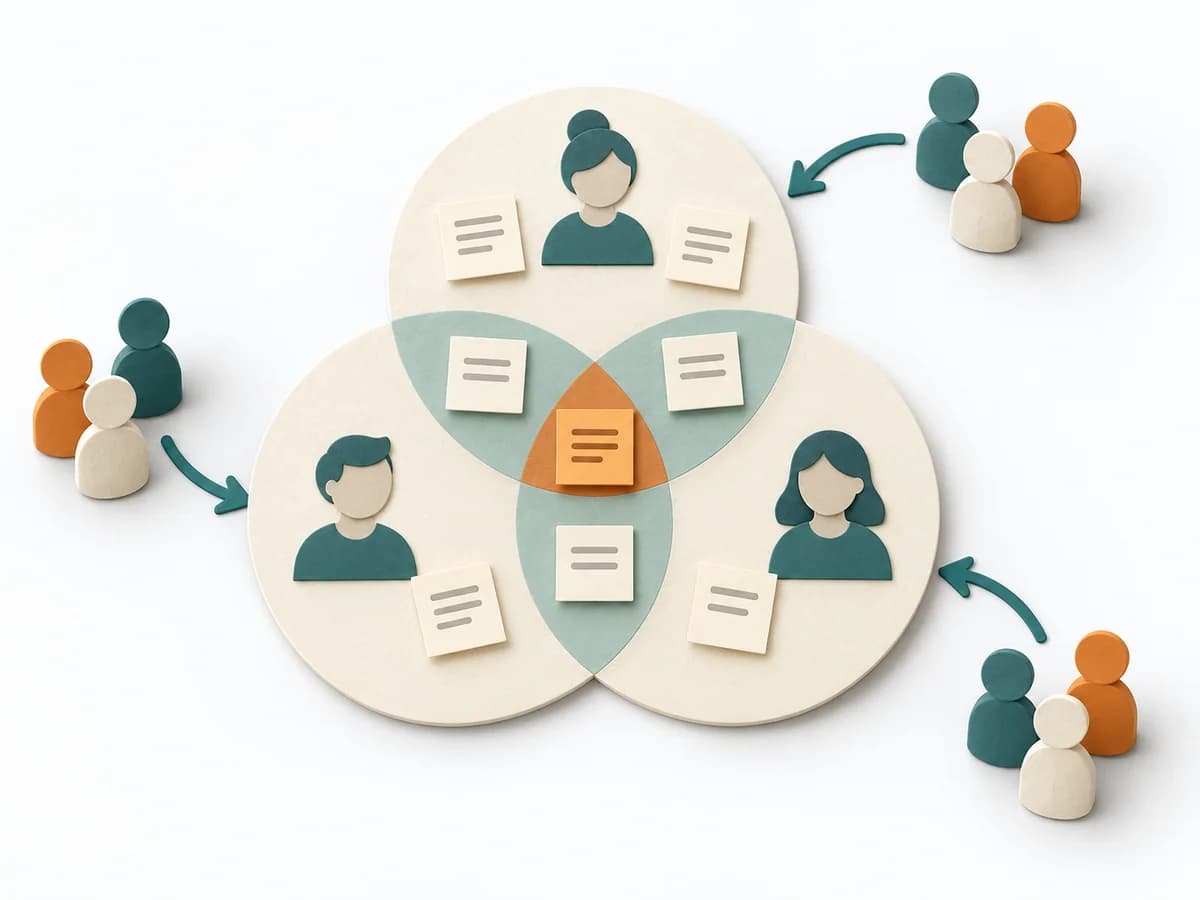
View methods side by side.
Choose up to four methods. Add them using the search and share the comparison by copying its link.
| Criterion |  Facilitation Stakeholder Salience Model |  Domain Modeling Context Map |  Facilitation Power Interest Grid |
|---|---|---|---|
Purposedifferent | When stakeholders appear to matter very differently, the Stakeholder Salience Model rates their actual priority through power, legitimacy, and urgency. It turns individual contributions into a visible selection. The result is captured as a Salience diagram and a class-based strategy. | When several contexts need to talk to each other, it makes their relationships and dependencies legible. It helps sort integration pressure and responsibilities across system boundaries. | When many stakeholders compete for attention at once, the Power Interest Grid sorts them by influence and stake. It turns individual contributions into a visible selection. The result is captured as a Power Interest Grid and a stakeholder-specific strategy. |
Complexitydifferent | Medium | Medium | Low |
Timedifferent | 60-90 min | 1-3 h | 30-60 min |
Participantsdifferent | 3-6 | 2-8 | 2-8 |
Formatdifferent | Workshop | Workshop + async | Workshop |
Outputdifferent | Salience Diagram, Strategy per Class | Context Map, Integration Patterns, Boundary Notes | Power Interest Grid, Strategy per Stakeholder |
Tagsno overlap | StakeholdersFacilitationAlignmentGovernance | Domain-Driven DesignBoundariesStrategy | StakeholdersFacilitationAlignmentPlanning |
Often compared together
Methods with strong topical overlap with the current selection, not yet in the comparison.