View methods side by side.
Choose up to four methods. Add them using the search and share the comparison by copying its link.
Selected:SAAM (Software Architecture Analysis Method)Hypothesis-Driven TroubleshootingFault Isolation
| Criterion |  Architecture SAAM (Software Architecture Analysis Method) |  Engineering Hypothesis-Driven Troubleshooting | 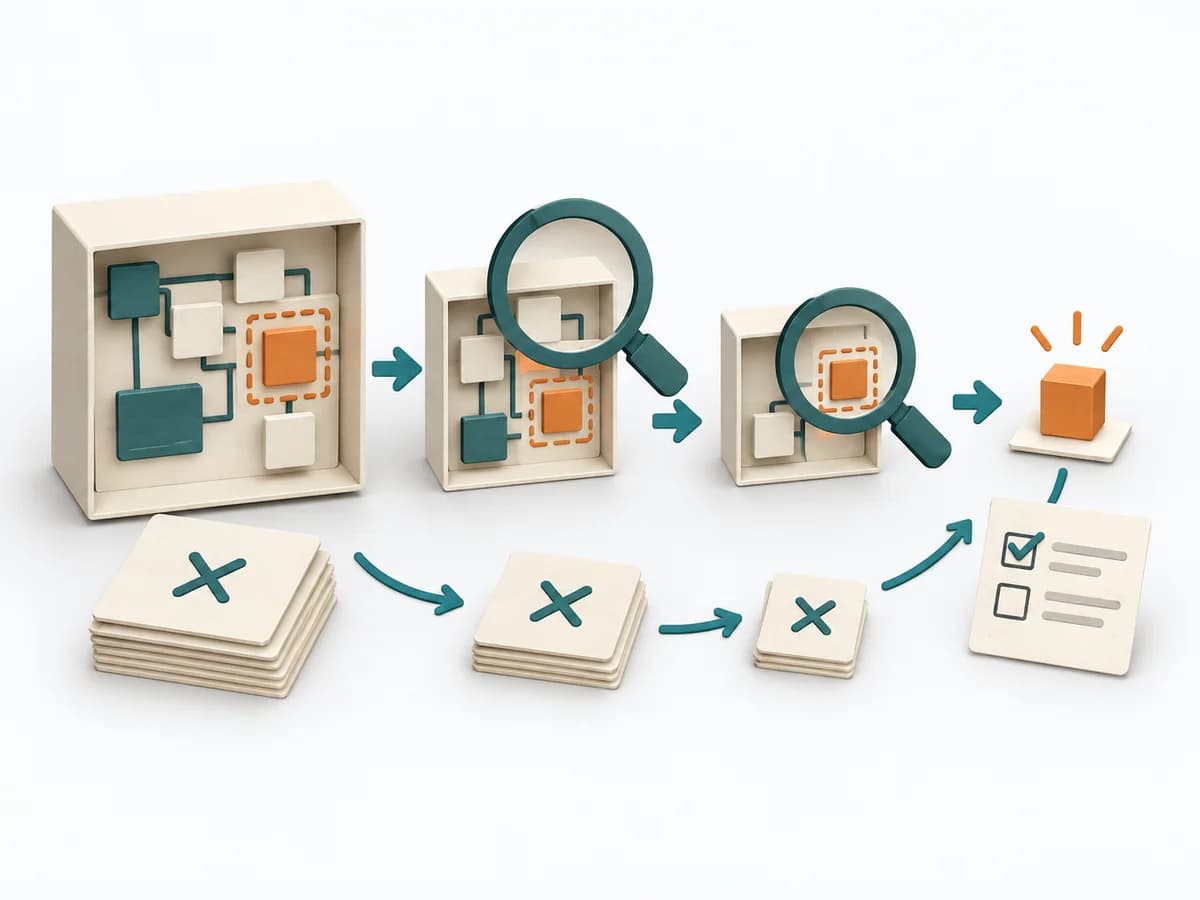 Engineering Fault Isolation |
|---|---|---|---|
Purposedifferent | SAAM helps teams judge an architecture’s suitability for selected tasks and changes. It is particularly useful for examining modifiability and comparing architecture alternatives with clear reasoning. | When systems fail unexpectedly, spontaneous attempts often produce more noise than insight. Hypothesis-driven Troubleshooting translates symptoms into testable assumptions and makes troubleshooting learnable. | In technical failures, the visible symptom often gets mixed up with the actual cause. Fault Isolation narrows the fault space and progressively reduces which part of the system is truly affected. |
Complexitydifferent | High | Medium | Medium |
Timedifferent | Preparation, scenario analysis, and findings review; effort depends on scope | 30-240 min | 30-180 min |
Participantsdifferent | Architecture experts and stakeholders for scenarios and weighting | 1-6 | 1-6 |
Formatsame | Workshop + async | Workshop + async | Workshop + async |
Outputdifferent | Domain functions mapped to components and connections, Quality attributes and evaluation criteria, Typical tasks and their effects on the architecture, Reasoned evaluation or comparison of alternatives | Hypothesis Log, Test Plan, Evidence Notes, Diagnosis Summary | Fault Isolation Map, Test Log, Excluded Hypotheses, Narrowed Fault Area |
Tagsno overlap | ArchitectureChangeAnalysisComparisonQuality | TroubleshootingProblem solvingDiagnosis | TroubleshootingDiagnosisEngineering |
Often compared together
Methods with strong topical overlap with the current selection, not yet in the comparison.



