View methods side by side.
Choose up to four methods. Add them using the search and share the comparison by copying its link.
| Criterion | 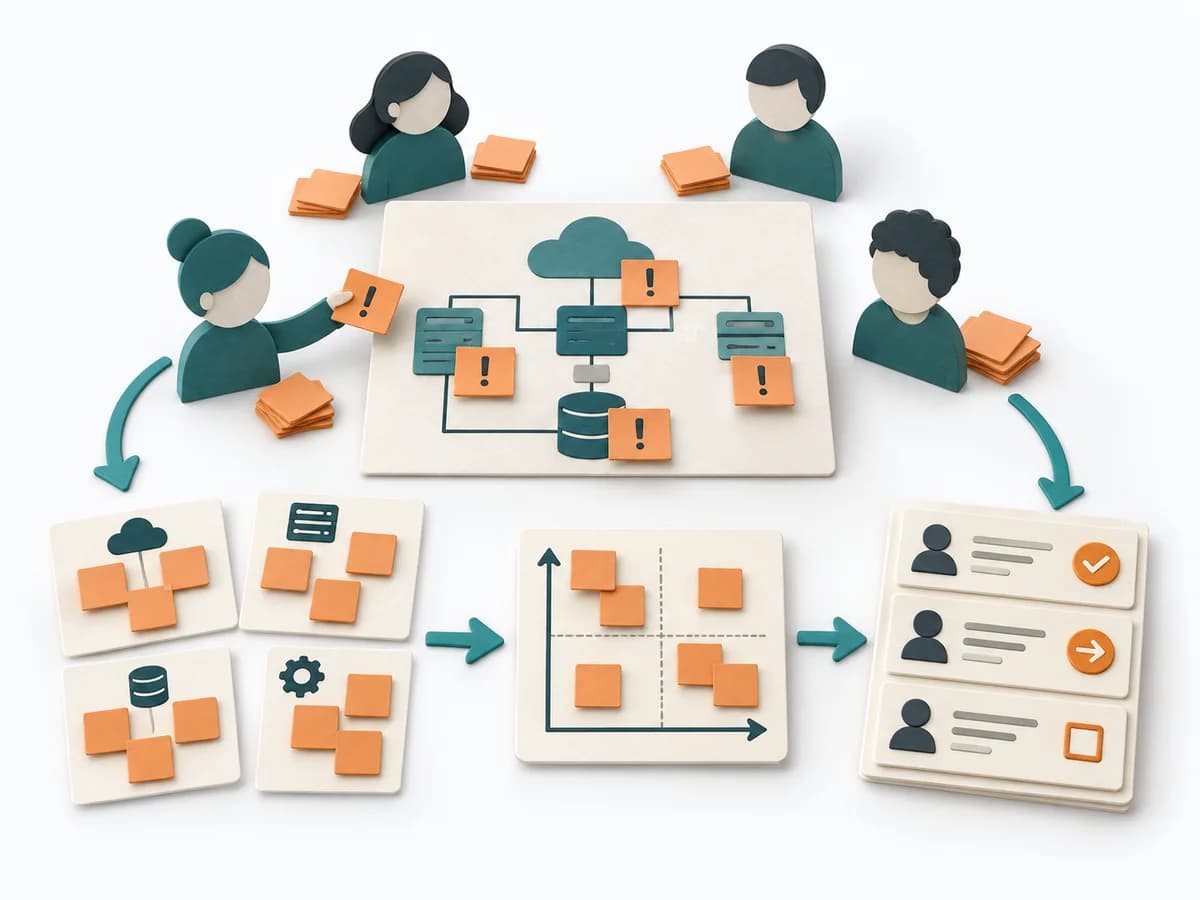 Architecture Risk Storming |  UX Research Surveys |  Innovation Design Sprint |
|---|---|---|---|
Purposedifferent | Helps clarify architecture context, options, and consequences in concrete terms. It organizes technical context, alternatives, and consequences. The result is captured as an Annotated Diagram, a Prioritized Risk List, and an Action Backlog. | When a topic needs to be validated broadly and many people can answer the same question, surveys gather structured feedback in a scalable form. Answers become comparable and segmentable instead of remaining merely anecdotal. | When the product question is unclear and time pressure is high, the method takes a team from an open idea to a testable solution. It connects problem understanding, decision, and learning in one compact format, lowering the risk of spending a lot of energy on a mere guess. |
Complexitydifferent | Low | Medium | High |
Timedifferent | 60-90 min | 3-14 Tage | 4-5 Tage |
Participantsdifferent | 4-12 | 50+ | 5-8 |
Formatdifferent | Workshop | Async | Workshop |
Outputdifferent | Annotated Diagram, Prioritized Risk List, Action Backlog | Survey Results, Charts, Segment Insights | Prototype, Test Findings, Decision Rationale |
Tags1 shared | RiskArchitectureWorkshopValidation | QuantitativeResearchValidation | Design sprintPrototypeValidationInnovation |
Often compared together
Methods with strong topical overlap with the current selection, not yet in the comparison.



