View methods side by side.
Choose up to four methods. Add them using the search and share the comparison by copying its link.
| Criterion |  Product Strategy OKRs | 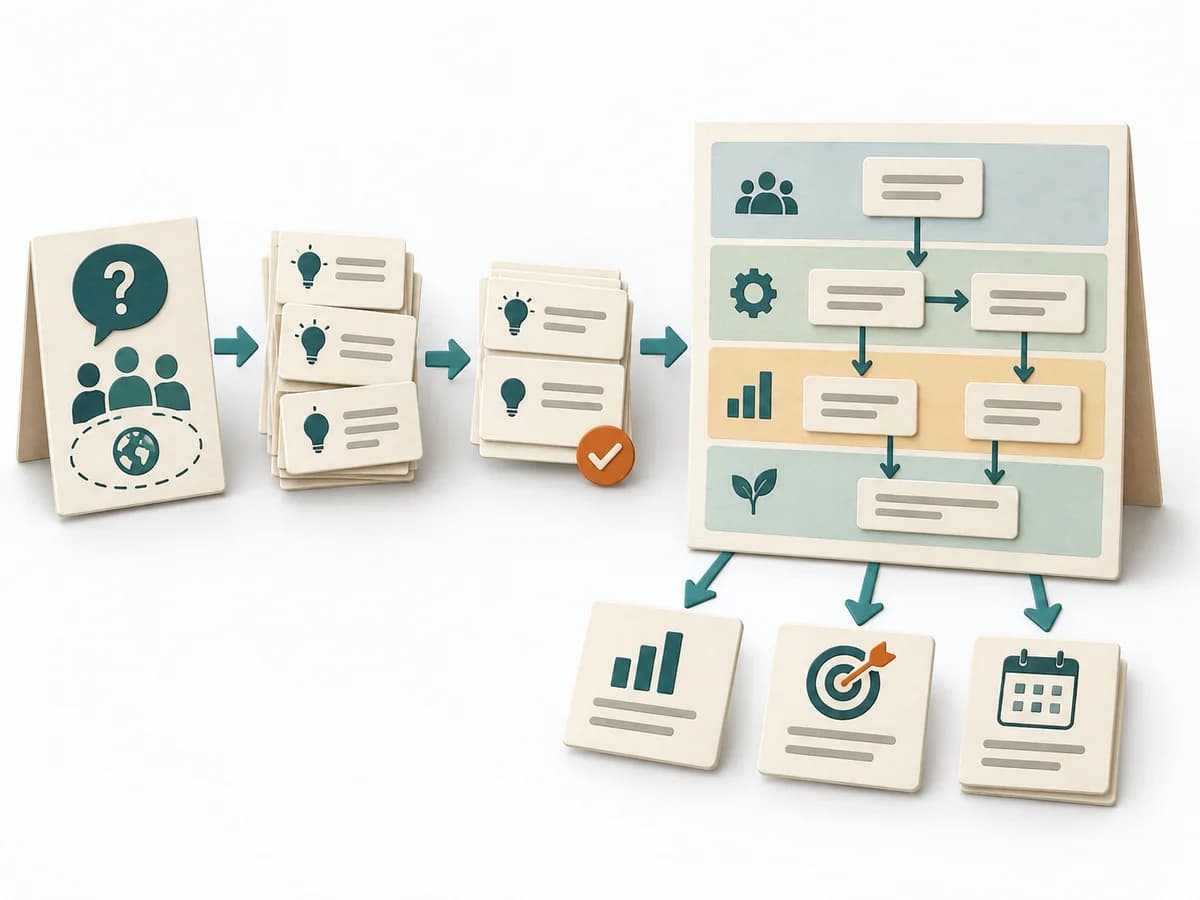 Business Strategy Strategy Map |  Facilitation Stakeholder Salience Model |
|---|---|---|---|
Purposedifferent | When strategic direction needs to become measurable, it connects ambition with checkable results. It makes goals connectable to focus and review. | A Strategy Map translates strategy into a few connected objectives across perspectives such as finance, customers, processes, and learning. This makes visible which capabilities and activities are meant to drive which results. | When stakeholders appear to matter very differently, the Stakeholder Salience Model rates their actual priority through power, legitimacy, and urgency. It turns individual contributions into a visible selection. The result is captured as a Salience diagram and a class-based strategy. |
Complexitysame | Medium | Medium | Medium |
Timedifferent | 1-2 h Setup | 2-4 h workshop plus review | 60-90 min |
Participantsdifferent | 2-20 | 4-10 | 3-6 |
Formatdifferent | Workshop + async | Workshop | Workshop |
Outputdifferent | OKR set, Measurement plan, Review cadence | Strategy Map, Objective Set, Cause-Effect Hypotheses | Salience Diagram, Strategy per Class |
Tags1 shared | GoalsAlignmentOutcomesMeasurement | AlignmentExecutionGoalsCausality | StakeholdersFacilitationAlignmentGovernance |
Often compared together
Methods with strong topical overlap with the current selection, not yet in the comparison.