View methods side by side.
Choose up to four methods. Add them using the search and share the comparison by copying its link.
| Criterion | 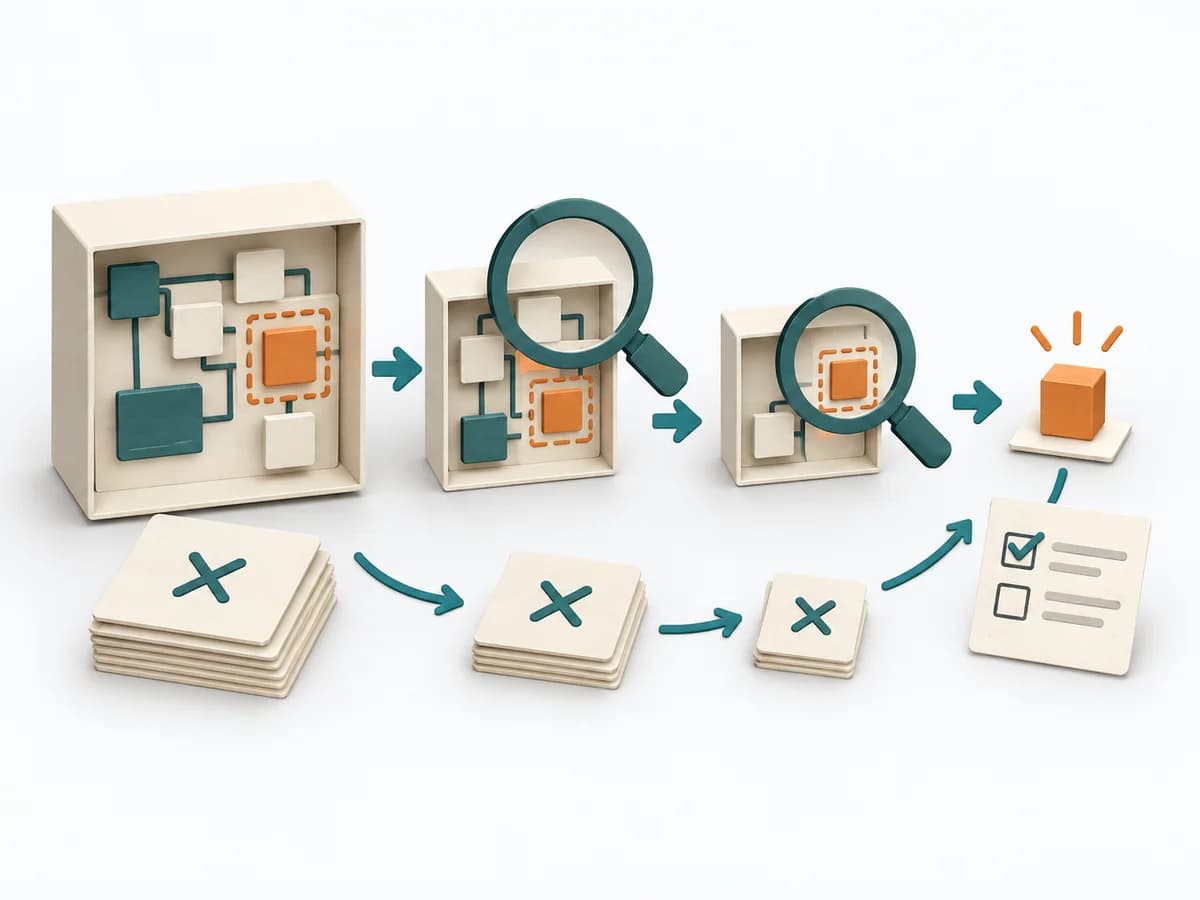 Engineering Fault Isolation |  Growth A/B Testing |  Architecture ATAM (Architecture Tradeoff Analysis Method) |
|---|---|---|---|
Purposedifferent | In technical failures, the visible symptom often gets mixed up with the actual cause. Fault Isolation narrows the fault space and progressively reduces which part of the system is truly affected. | When two variants compete, discussions quickly decide by taste rather than effect. A/B Testing checks behavior under controlled conditions and separates real improvement from chance or expectation effects. | ATAM helps teams weigh architecture decisions when quality goals compete. The team considers business goals, stakeholder expectations, and technical decisions together. The evaluation shows which risks need further investigation. |
Complexitydifferent | Medium | High | High |
Timedifferent | 30-180 min | 1-4 Wochen | Several meetings plus preparation and analysis; total effort depends on scope |
Participantsdifferent | 1-6 | 1-6 | Evaluation team, architects, and relevant stakeholders |
Formatdifferent | Workshop + async | Async | Workshop + async |
Outputdifferent | Fault Isolation Map, Test Log, Excluded Hypotheses, Narrowed Fault Area | Experiment results, Decision log, Learning summary | Prioritized quality scenarios in a utility tree, Architecture risks with reasoning and assumptions, Sensitivity and trade-off points, Findings report with open investigations |
Tagsno overlap | TroubleshootingDiagnosisEngineering | ExperimentsGrowthAnalyticsValidation | ArchitectureQualityRiskTradeoffsStakeholders |
Often compared together
Methods with strong topical overlap with the current selection, not yet in the comparison.