View methods side by side.
Choose up to four methods. Add them using the search and share the comparison by copying its link.
| Criterion |  UX Research Diary Study |  Business Strategy 5-Minuten VC-Check | 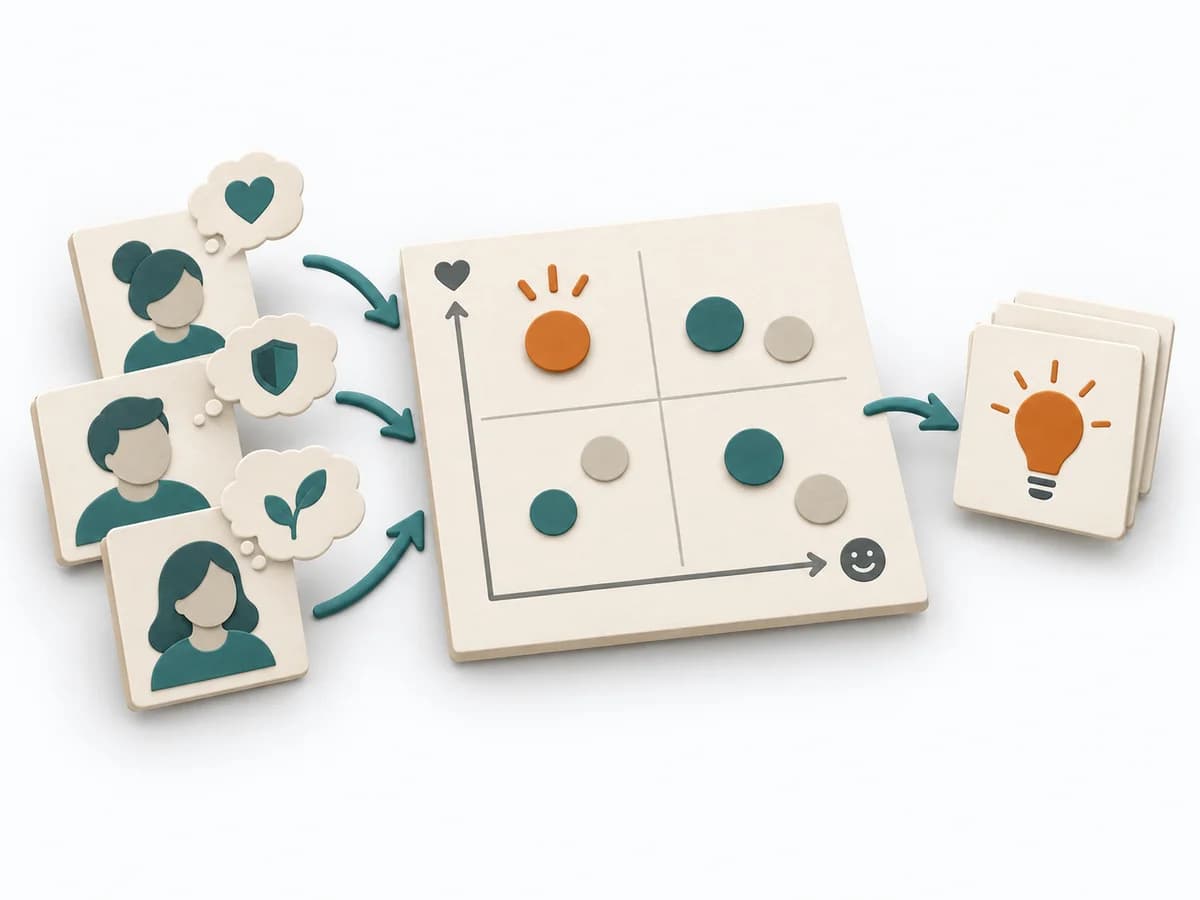 Product Discovery Outcome-Driven Innovation |
|---|---|---|---|
Purposedifferent | When experiences build up over days or weeks and a single session cannot capture them, Diary Study records the course of everyday life. Recurring triggers, moods, and habits become visible this way, beyond the sharpness of memory. | The 5-Minute VC Check clarifies opportunities and strategic options at the earliest idea stage. It compares problem quality, customer willingness to pay, alternatives, differentiation, and market potential, and captures the result as a VC-check note, go/sharpen/park decision, and risk list. | Outcome-Driven Innovation clarifies customer problems, solution opportunities, and evidence. It separates jobs, desired outcomes, importance, satisfaction, and opportunity, and captures results as desired outcome statements, an opportunity landscape, and segments by underserved needs. |
Complexitydifferent | Medium | Low | High |
Timedifferent | 1-4 Wochen | 5-15 min | Mehrere Wochen |
Participantsdifferent | 5-20 | 1-5 | 2-6 researchers plus sample |
Formatdifferent | Async | Workshop + async | Workshop + async |
Outputdifferent | Diary Entries, Longitudinal Patterns, Experience Timeline | VC-check note, Go/sharpen/park decision, Risk and assumption list, Next validation step | Desired outcome statements, Opportunity landscape, Segmentation by underserved needs, Innovation hypotheses |
Tagsno overlap | UX researchTrackingBehavior | StartupValidationCompetition | OutcomesInnovationResearchQuantitative |
Often compared together
Methods with strong topical overlap with the current selection, not yet in the comparison.