View methods side by side.
Choose up to four methods. Add them using the search and share the comparison by copying its link.
| Criterion |  Innovation Design Thinking | 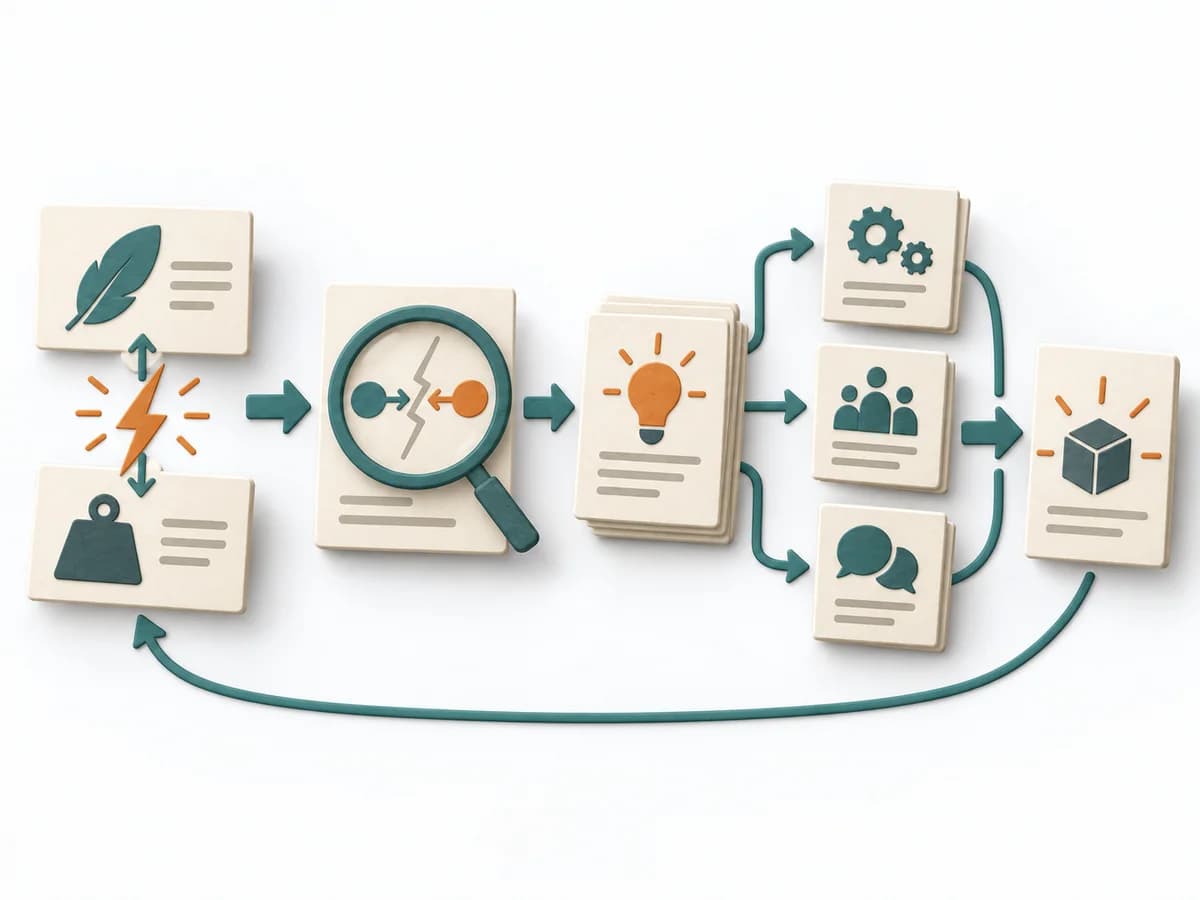 Innovation Contradiction Analysis |  Facilitation Stakeholder Salience Model |
|---|---|---|---|
Purposedifferent | For complex user problems with an uncertain cause, the method connects observation, interpretation, and experiment into a learning cycle. It keeps the focus on real needs and avoids premature solution language. This produces robust decisions for product and service. | When a system should improve while another measure suffers as a result, the method makes the underlying conflict precisely formulable. It separates the desired effect from its side effect. This makes solutions possible that address the contradiction deliberately instead of half-heartedly. | When stakeholders appear to matter very differently, the Stakeholder Salience Model rates their actual priority through power, legitimacy, and urgency. It turns individual contributions into a visible selection. The result is captured as a Salience diagram and a class-based strategy. |
Complexitydifferent | High | Medium | Medium |
Timedifferent | 1 Tag bis mehrere Wochen | 60-120 min | 60-90 min |
Participantsdifferent | 4-10 | 2-8 | 3-6 |
Formatsame | Workshop | Workshop | Workshop |
Outputdifferent | Problem Statement, Prototype, Test Learnings | Contradiction Statement, Abstraction Notes, Solution Principles, Concept Ideas | Salience Diagram, Strategy per Class |
Tagsno overlap | InnovationPrototypeResearch | ContradictionsInnovationProblem solving | StakeholdersFacilitationAlignmentGovernance |
Often compared together
Methods with strong topical overlap with the current selection, not yet in the comparison.