View methods side by side.
Choose up to four methods. Add them using the search and share the comparison by copying its link.
| Criterion |  Decision Making Decision Matrix |  Decision Making Constraint Analysis |  Product Discovery MVP Test Matrix |
|---|---|---|---|
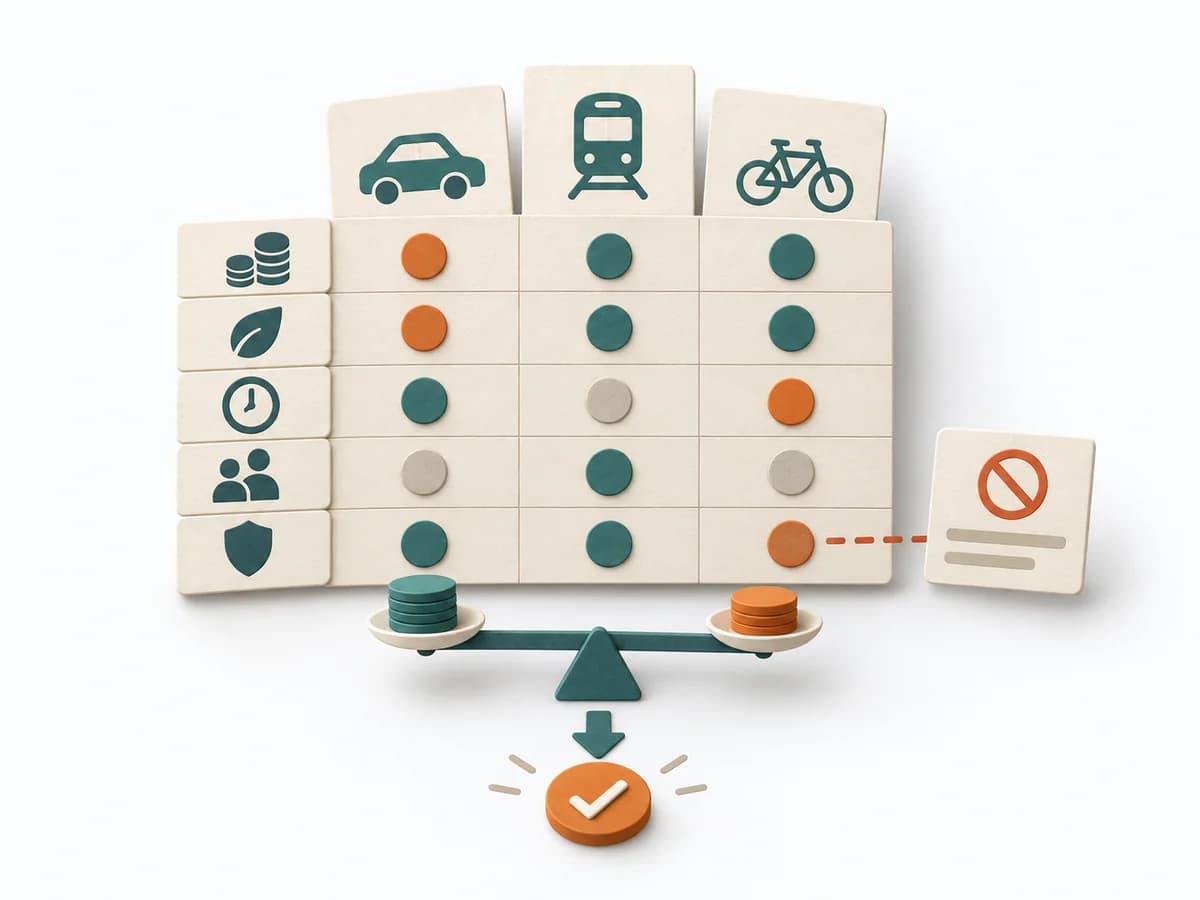
Purposedifferent | When several options collide with several criteria, comparison quickly becomes subjective. A Decision Matrix makes the trade-off visible and brings weighting, criteria, and options into a shared logic. | When an initiative stalls, the limit often lies not in the idea but in hard or soft boundary conditions. Constraint Analysis separates these limits and shows which of them can actually be shaped. | When several minimal variants compete to answer the same question, it makes comparing and choosing between them cleaner. It separates problem, assumption, solution, and evidence. The result is captured as a Test Matrix and a Test Plan. |
Complexitydifferent | Medium | Low | Medium |
Timedifferent | 45-90 min | 30-90 min | 45-75 min |
Participantssame | 2-8 | 2-8 | 2-8 |
Formatdifferent | Workshop + async | Workshop + async | Workshop |
Outputdifferent | Decision Matrix, Scoring Rationale, Selected Option | Constraint List, Hard/Soft Classification, Option Impact Notes, Decision Boundaries | Test Matrix, Test Plan |
Tagsno overlap | DecisionCriteriaScoringTradeoffs | ConstraintsDecisionPlanningOptions | ExperimentsValidationDiscoveryOptions |
Often compared together
Methods with strong topical overlap with the current selection, not yet in the comparison.