View methods side by side.
Choose up to four methods. Add them using the search and share the comparison by copying its link.
| Criterion | 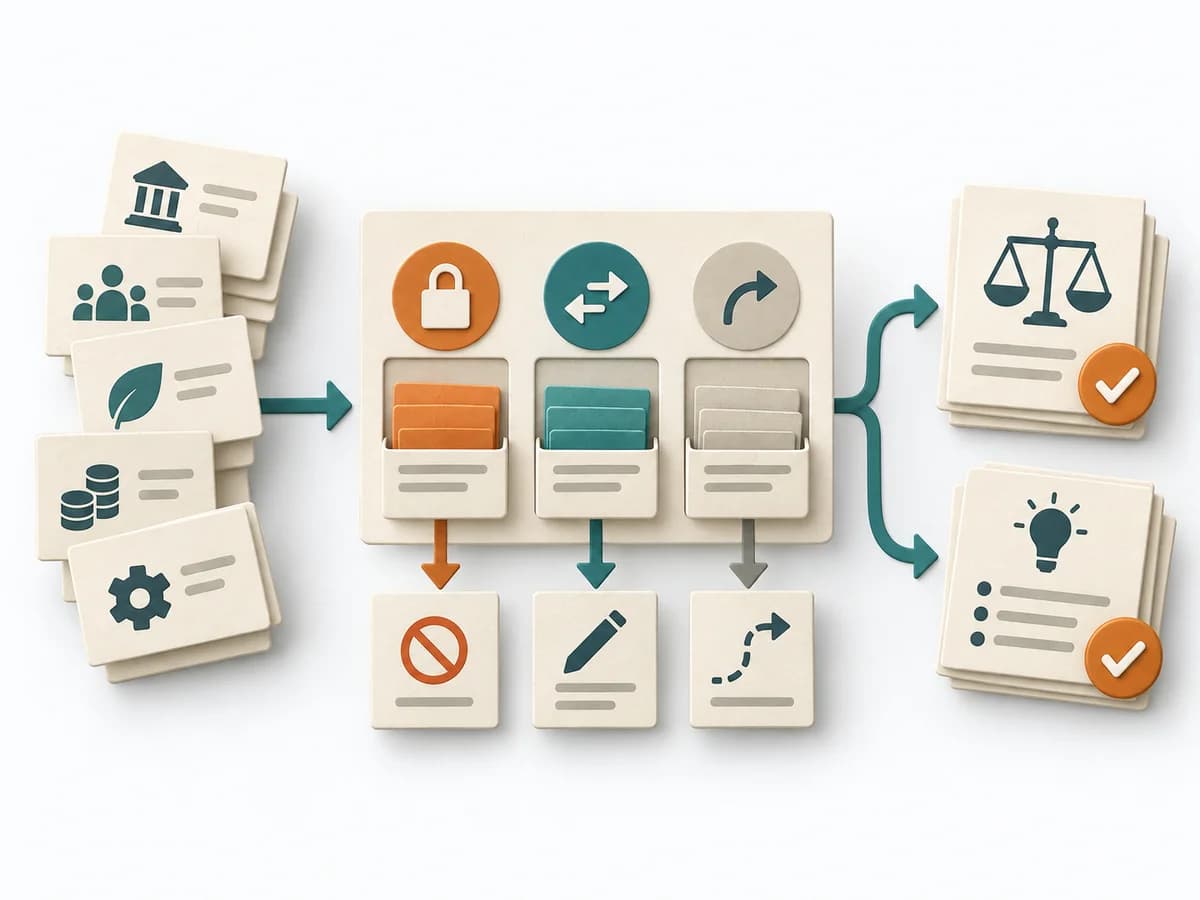 Decision Making Constraint Analysis |  Business Strategy Ansoff Matrix |  Decision Making Delphi Method |
|---|---|---|---|
Purposedifferent | When an initiative stalls, the limit often lies not in the idea but in hard or soft boundary conditions. Constraint Analysis separates these limits and shows which of them can actually be shaped. | The Ansoff Matrix organizes growth options by market and product relation. It helps weigh expansion, diversification, and adaptation cleanly against each other. | When knowledge is distributed and direct dominance should be avoided, groups quickly fall under the sway of their opinion leaders. The Delphi Method gathers assessments iteratively and gradually brings expert judgments closer together. |
Complexitydifferent | Low | Low | High |
Timedifferent | 30-90 min | 45-90 min | 1-4 Wochen |
Participantsdifferent | 2-8 | 2-8 | 6-30 Experten |
Formatdifferent | Workshop + async | Workshop + async | Async |
Outputdifferent | Constraint List, Hard/Soft Classification, Option Impact Notes, Decision Boundaries | Ansoff Matrix, Growth Options, Risk Notes | Expert Forecast, Consensus Range, Assumption Notes |
Tagsno overlap | ConstraintsDecisionPlanningOptions | GrowthStrategyMarketPortfolio | ForecastingExpertsDecisionStrategy |
Often compared together
Methods with strong topical overlap with the current selection, not yet in the comparison.