Complete firstShared challenge
Audience, need and design space are known.
Without a need there is no basis for judging usefulness.
A practical method guide: clarify prerequisites and materials, understand the complete process, and look up outputs, pitfalls, and stop criteria.
What needs to be finished first
Audience, need and design space are known.
What needs to be ready before start
Design question, paper or board, fields for bad property and constructive transformation.
People with different perspectives and facilitator.
Choose a concrete design question and audience; frame bad ideas as a playful thought experiment.
30–45 minutes
First provide space for absurd ideas, then for properties and transformations.
The one question this method answers
Which deliberately bad idea reveals a useful design assumption?
Phases with goal, actions, output and pitfall
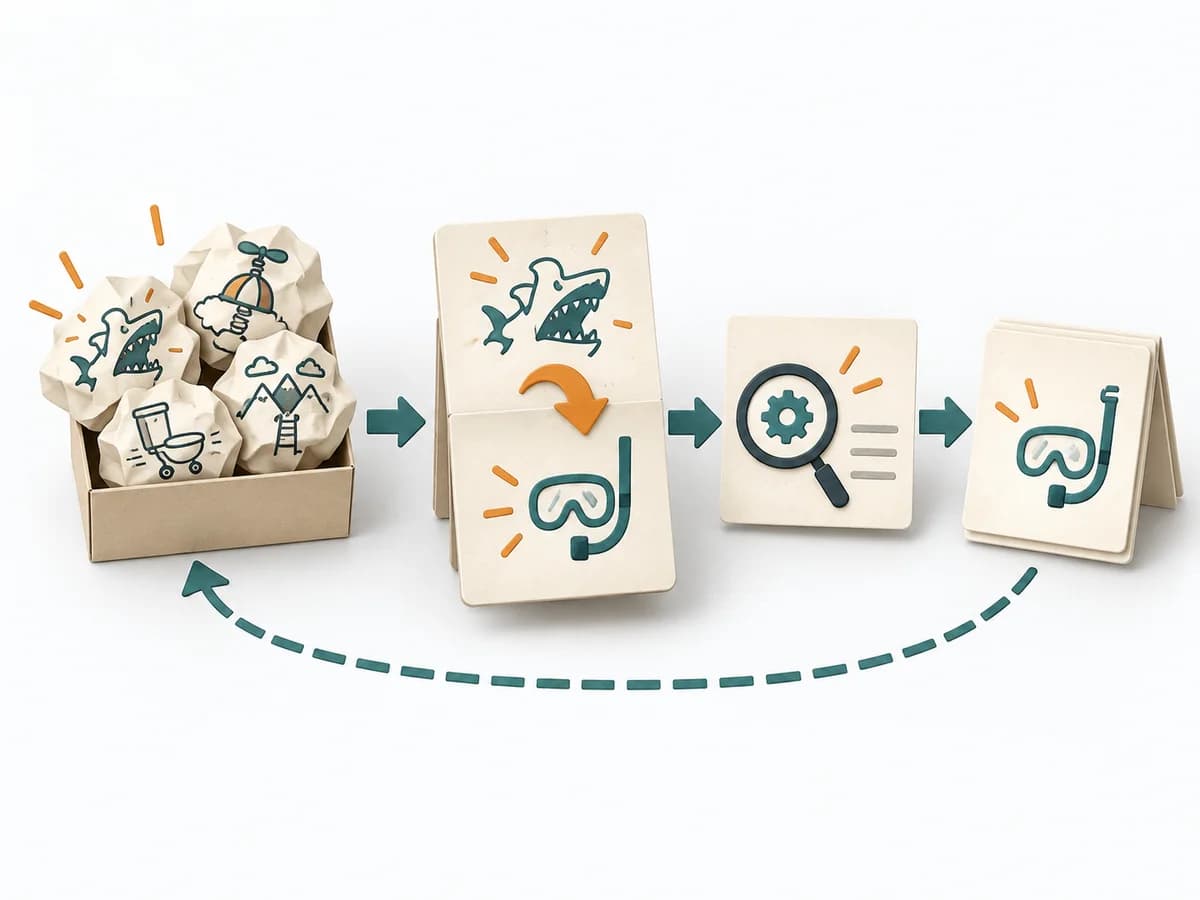
Deliberately unusable ideas reduce the pressure to produce a good solution immediately. The team examines what makes them bad and transforms selected properties into useful approaches.
Fictional example
Deliberately unusable ideas reduce the pressure to produce a good solution immediately. The team examines what makes them bad and transforms selected properties into useful approaches.
For whom should which experience improve?
Fictional: new course participants should quickly understand the process.
What deliberately unusable solution can we imagine?
Require memorising an 80-page manual before initial registration.
Which property causes the failure?
All information arrives before it is needed, overloading entry.
What is reversed, reduced or transferred?
Show only the next action and reveal details when needed.
Which concrete variant do we test against which benefit?
Prototype three short onboarding cards; observe whether new participants find the next step without explanation.
All example details are fictional and illustrate the application.
Play space
Goal
Shared challenge
Inputs for this step
Actions
Output
Shared challenge
Is the design space clear?
Quality check
Is the design space clear?
Pitfall
The task is mistaken for a competition for good ideas. Begin with an obviously absurd, harmless product idea.
Timing: 5–10 minutes
Bad ideas
Goal
Unusual raw ideas
Inputs for this step
Actions
Output
Unusual raw ideas
Did several different bad mechanisms emerge?
Quality check
Did several different bad mechanisms emerge?
Pitfall
The group stays with slightly worse standard solutions. Exaggerate one property or deliberately violate a usual assumption.
Timing: 8–12 minutes
Transformation
Goal
Useful transformation
Inputs for this step
Actions
Output
Useful transformation
Is the link from raw idea to concept traceable?
Quality check
Is the link from raw idea to concept traceable?
Pitfall
The bad idea is discarded without learning. Record at least one property and its possible transformation.
Timing: 10–15 minutes
User value
Goal
Concept test
Inputs for this step
Actions
Output
Concept test
Is value tested rather than only originality?
Quality check
Is value tested rather than only originality?
Pitfall
A funny idea is immediately implemented. Put a small prototype before implementation.
Timing: 5–10 minutes
What comes out at the end
Sketch: what the artifact looks like
Bad ideas with explained mechanisms and useful concepts derived from them, plus a test question.
Record date and scope; retain the previous version and reason when changing it.
Choose a concrete design question and audience; frame bad ideas as a playful thought experiment.
To be confirmed
To be confirmed
Complete cycle Time: 30–45 minutes
Complete this worksheet on paper or in your own document during the work.
For whom should which experience improve?
...
What deliberately unusable solution can we imagine?
...
Which property causes the failure?
...
What is reversed, reduced or transferred?
...
Which concrete variant do we test against which benefit?
...
Answer the prompts with your own information. Explicitly mark unknowns and assumptions.
Expected artifact: Shared challenge
Is the design space clear?
Entry:
...
Expected artifact: Unusual raw ideas
Did several different bad mechanisms emerge?
Entry:
...
Expected artifact: Useful transformation
Is the link from raw idea to concept traceable?
Entry:
...
Expected artifact: Concept test
Is value tested rather than only originality?
Entry:
...
...
Method guide: https://methodatlas.meierhoff-systems.de/en/methods/worst-possible-idea/run-sheet
Concrete filled scenario, fictional example
Fictional example for orientation. Counts and timings describe this case and are not universal requirements.
Concrete filled scenario, fictional example
Design question: Fictional: new course participants should quickly understand the process.
Worst idea: Require memorising an 80-page manual before initial registration.
Bad property: All information arrives before it is needed, overloading entry.
Transformation: Show only the next action and reveal details when needed.
Concept and test: Prototype three short onboarding cards; observe whether new participants find the next step without explanation.
Recognize symptoms and steer against them
Quick overview, the full text is in the matching phase in the flow
The task is mistaken for a competition for good ideas.
Begin with an obviously absurd, harmless product idea.
The group stays with slightly worse standard solutions.
Exaggerate one property or deliberately violate a usual assumption.
The bad idea is discarded without learning.
Record at least one property and its possible transformation.
A funny idea is immediately implemented.
Put a small prototype before implementation.
When to pause, resolve prerequisites, or choose another approach
Go to the profile for purpose, similar methods, and sources or continue to the next method in the catalog.