Complete firstDecision subject
Set the system boundary, goal, and one throughput measure before examining local utilisation.
Without a clear boundary, cases and signals become mixed.
A practical method guide: clarify prerequisites and materials, understand the complete process, and look up outputs, pitfalls, and stop criteria.
What needs to be finished first
Set the system boundary, goal, and one throughput measure before examining local utilisation.
System goal, throughput measure, process flow, demand and capacity data, constraint log, and action board
What needs to be ready before start
System goal, throughput measure, process flow, demand and capacity data, constraint log, and action board
System owner · process participants before and after the constraint · data owner · action owners
Set the system boundary, goal, and one throughput measure before examining local utilisation.
90–180 minutes for analysis and action plan; verify effect across several operating cycles.
Divide the workspace into System goal · Identify constraint · Exploit · Subordinate · Elevate and repeat; keep sources, assumptions, and decisions separate.
The one question this method answers
Which constraint currently limits the system goal, and how will we exploit, subordinate, and elevate it?
Phases with goal, actions, output and pitfall
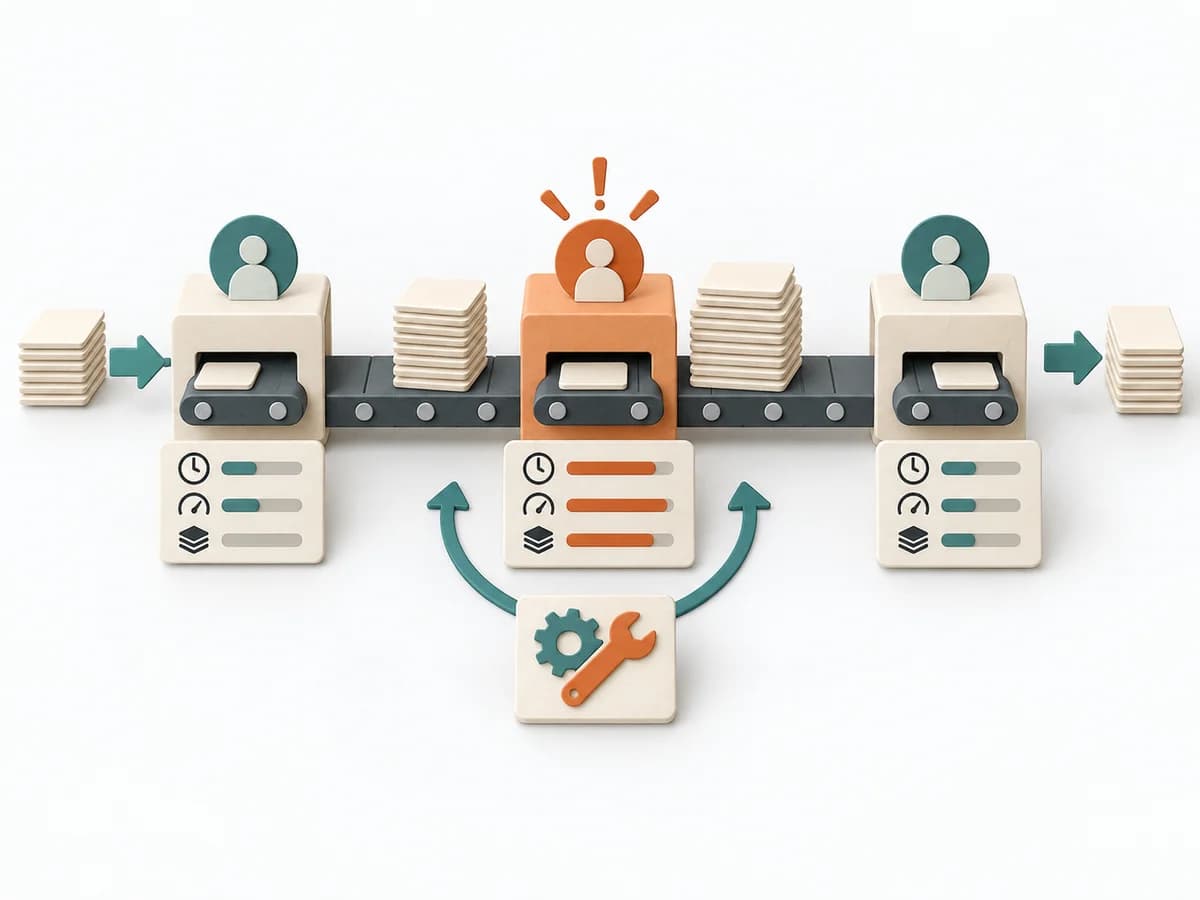
The flow is examined from the perspective of its weakest point. This shows where additional capacity can create real effect and where it would only increase WIP. After each improvement, attention shifts to the next limiting factor.
Fictional example
Fictional values demonstrate the method-specific fields.
Define system boundary, customer value, and throughput measure; subordinate local metrics to the system goal.
Goal: on-time equipment handoffs; measure: complete handoffs per Saturday with complaints below 3%.
Measure flow and queues; identify the one factor currently limiting total throughput.
Handoff handles 8 units/hour, preparation 14, payment 18; 11 units queue before handoff.
Protect available constraint time without major investment and focus it on throughput-producing work.
Units arrive fully prepared; break cover exists; questions leave the handoff station.
Align release, priorities, and other areas to the constraint cadence; define buffer boundaries.
Release at most eight ready units per hour; preparation helps when buffer falls below three.
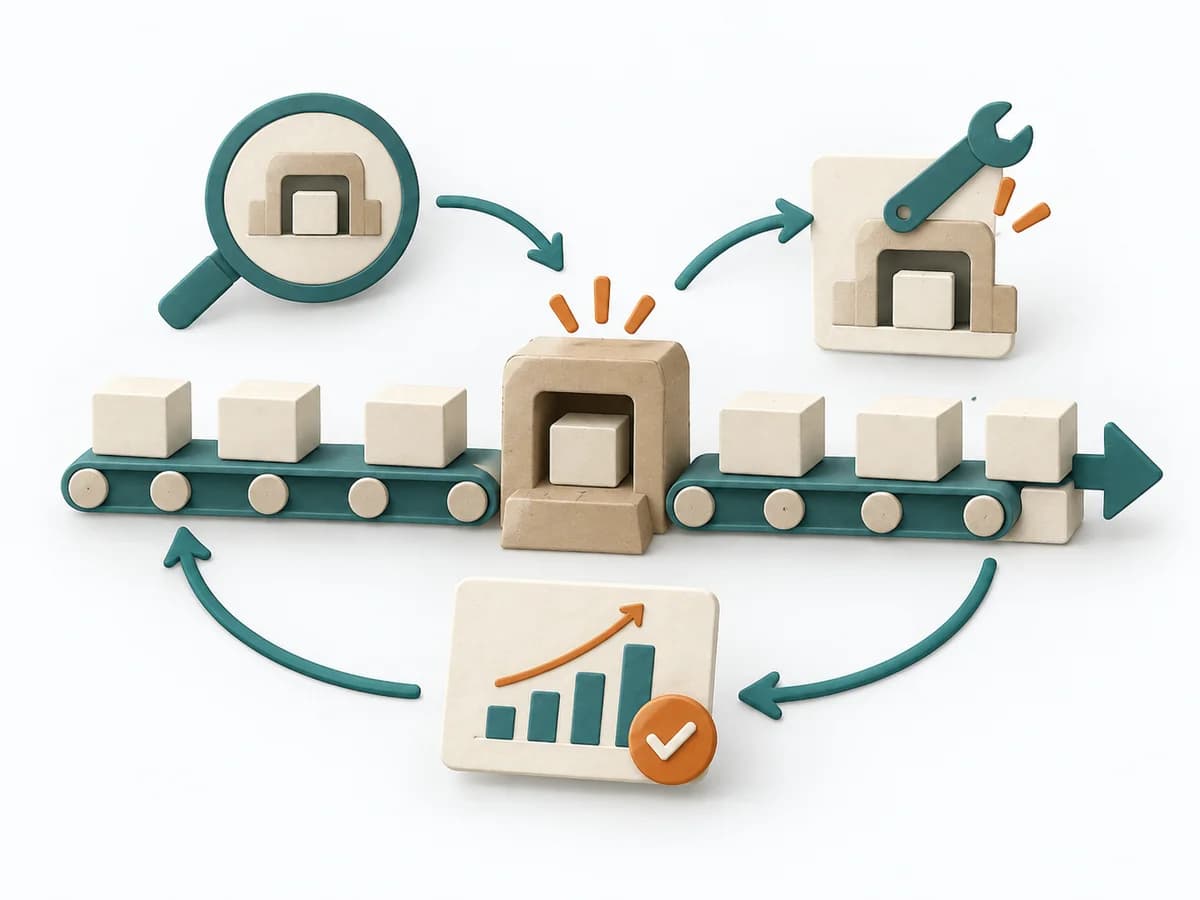
If exploit and subordinate are insufficient, add capacity deliberately; then identify the constraint again and avoid inertia.
A second handoff raises handoff capacity to 16/hour; preparation remains at 14 and becomes the new constraint.
All values are fictional.
System goal
Goal
Measurable system goal: Define system boundary, customer value, and throughput measure; subordinate local metrics to the system goal.
Inputs for this step
Actions
Output
Measurable system goal
Define system boundary, customer value, and throughput measure; subordinate local metrics to the system goal.
Quality check
Are boundary, goal, and throughput measure explicit and agreed?
Pitfall
Each station optimises utilisation without one system goal. Agree an end-to-end goal, throughput measure, and protective measure.
Timing: 15–25 minutes
Constraint
Goal
Evidenced constraint: Measure flow and queues; identify the one factor currently limiting total throughput.
Inputs for this step
Actions
Output
Evidenced constraint
Measure flow and queues; identify the one factor currently limiting total throughput.
Quality check
Do data show that more capacity at the candidate could raise system throughput?
Pitfall
The loudest complaint is labelled the constraint without flow data. Compare capacity, demand, and queue at each step and test the constraint hypothesis.
Timing: 25–40 minutes
Exploit
Goal
Exploit rules: Protect available constraint time without major investment and focus it on throughput-producing work.
Inputs for this step
Actions
Output
Exploit rules
Protect available constraint time without major investment and focus it on throughput-producing work.
Quality check
Do rules measurably reduce idle time, disruption, and wrong work at the constraint?
Pitfall
More work is pushed to the constraint although missing inputs still block it. Observe constraint time and remove interruptions, rework, and missing inputs first.
Timing: 20–30 minutes
Subordinate
Goal
Aligned system flow: Align release, priorities, and other areas to the constraint cadence; define buffer boundaries.
Inputs for this step
Actions
Output
Aligned system flow
Align release, priorities, and other areas to the constraint cadence; define buffer boundaries.
Quality check
Do upstream and downstream rules support the constraint rather than local utilisation?
Pitfall
Upstream keeps producing, increasing inventory and search work. Tie release and priorities to constraint pace and buffer.
Timing: 20–35 minutes
Elevate
Goal
Next improvement cycle: If exploit and subordinate are insufficient, add capacity deliberately; then identify the constraint again and avoid inertia.
Inputs for this step
Actions
Output
Next improvement cycle
If exploit and subordinate are insufficient, add capacity deliberately; then identify the constraint again and avoid inertia.
Quality check
Is elevation justified by the remaining throughput gap, and was the new constraint checked?
Pitfall
After investment the former constraint remains the focus although it moved. Measure total flow again and restart step 1 with the current constraint.
Timing: One to four operating cycles
What comes out at the end
Sketch: what the artifact looks like
TOC improvement log with evidenced constraint, exploit, subordinate, and elevate actions, plus renewed constraint check.
Record date, owner, evidence state, decision, and review; preserve earlier cycles.
Set subject, evidence, roles, flow, and review.
To be confirmed
To be confirmed
Complete run Time: 90–180 minutes for analysis and action plan; verify effect across several operating cycles.
Complete this worksheet on paper or in your own document during the work.
Define system boundary, customer value, and throughput measure; subordinate local metrics to the system goal.
...
Measure flow and queues; identify the one factor currently limiting total throughput.
...
Protect available constraint time without major investment and focus it on throughput-producing work.
...
Align release, priorities, and other areas to the constraint cadence; define buffer boundaries.
...
If exploit and subordinate are insufficient, add capacity deliberately; then identify the constraint again and avoid inertia.
...
The blank worksheet contains prompts only.
Reference · original teaching example
Expected artifact: Measurable system goal
Define system boundary, customer value, and throughput measure; subordinate local metrics to the system goal.
Entry:
...
Expected artifact: Evidenced constraint
Measure flow and queues; identify the one factor currently limiting total throughput.
Entry:
...
Expected artifact: Exploit rules
Protect available constraint time without major investment and focus it on throughput-producing work.
Entry:
...
Expected artifact: Aligned system flow
Align release, priorities, and other areas to the constraint cadence; define buffer boundaries.
Entry:
...
Expected artifact: Next improvement cycle
If exploit and subordinate are insufficient, add capacity deliberately; then identify the constraint again and avoid inertia.
Entry:
...
...
Method guide: https://methodatlas.meierhoff-systems.de/en/methods/theory-of-constraints/run-sheet
Concrete filled scenario, fictional example
Fictional example for orientation. Counts and timings describe this case and are not universal requirements.
Concrete filled scenario, fictional example
Goal: on-time equipment handoffs; measure: complete handoffs per Saturday with complaints below 3%.
Handoff handles 8 units/hour, preparation 14, payment 18; 11 units queue before handoff.
Units arrive fully prepared; break cover exists; questions leave the handoff station.
Release at most eight ready units per hour; preparation helps when buffer falls below three.
A second handoff raises handoff capacity to 16/hour; preparation remains at 14 and becomes the new constraint.
Recognize symptoms and steer against them
Quick overview, the full text is in the matching phase in the flow
Each station optimises utilisation without one system goal.
Agree an end-to-end goal, throughput measure, and protective measure.
The loudest complaint is labelled the constraint without flow data.
Compare capacity, demand, and queue at each step and test the constraint hypothesis.
More work is pushed to the constraint although missing inputs still block it.
Observe constraint time and remove interruptions, rework, and missing inputs first.
Upstream keeps producing, increasing inventory and search work.
Tie release and priorities to constraint pace and buffer.
After investment the former constraint remains the focus although it moved.
Measure total flow again and restart step 1 with the current constraint.
When to pause, resolve prerequisites, or choose another approach
Go to the profile for purpose, similar methods, and sources or continue to the next method in the catalog.