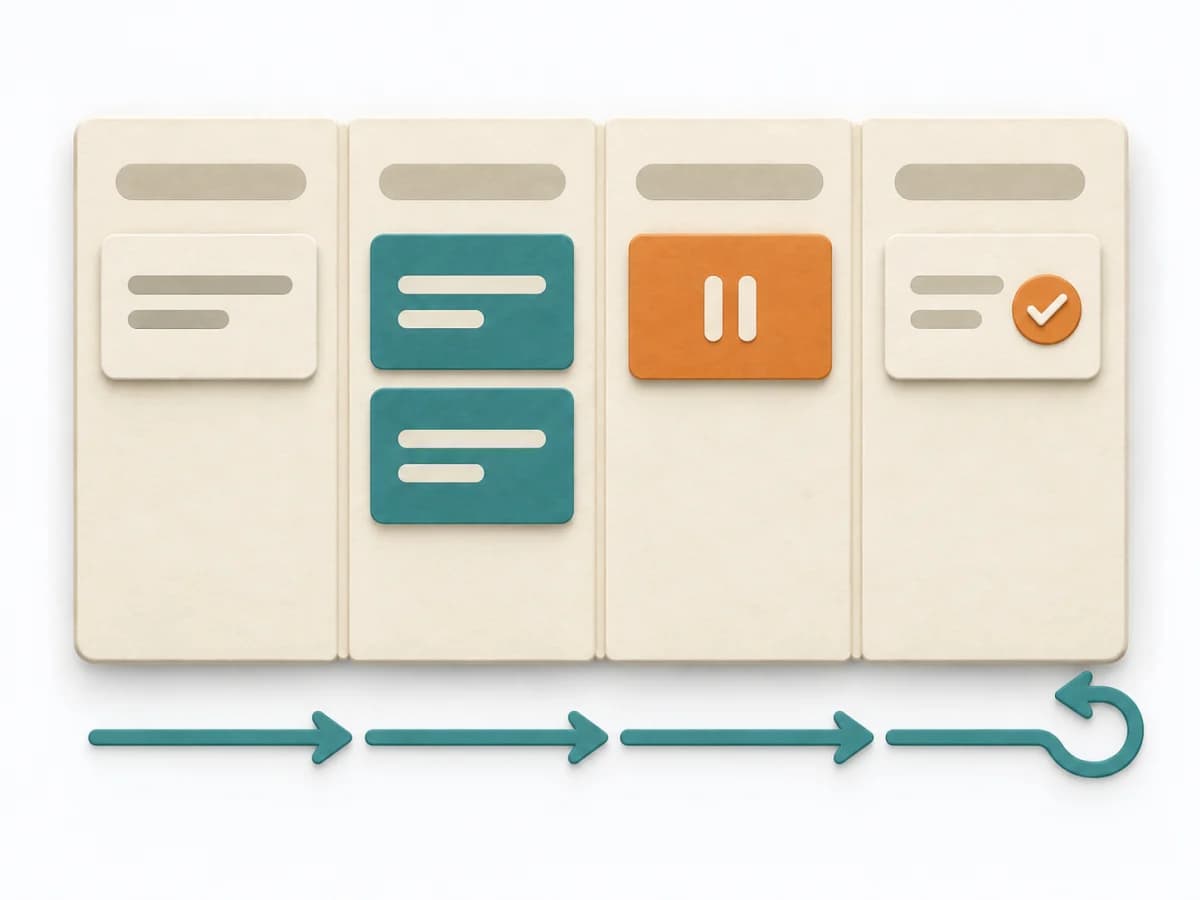
Establish practice
Define cadence, owner, participation, and success signals for a recurring team practice.
Establish the practice
Define cadence, owner, participation, and success signals so the method works as a recurring team practice.
Variant for Operating practice. The plan is derived from method form, method steps, and runsheet.
RunsheetAn operating practice works through repetition. The cadence should be small enough to hold reliably.
The steps describe one repetition and are adjusted after review.
- 1
Phase 1: Identify the constraint
45-60 minMake throughput, WIP, and waiting time visible for each process step. The constraint is the step with the highest WIP before it and throughput below demand. Agree on the one constraint.
OwnerCommon mistake: political constraint (the step with the loudest complaints) instead of data-based constraint. Data wins, not perception. With several candidates, use Little's Law as test. - 2
Phase 2: Exploit the constraint
45-60 minDetermine how the constraint step is used maximally: no interruption through defects, no idle time, no duplicate work. Define concrete measures for the next 2 weeks.
TeamExploit does not mean overload. The constraint must not wait for missing inputs, but must also not be blocked by defective work. Quality control before the constraint, not after it. - 3
Phase 3: Subordinate the rest
30-45 minTune all non-constraint steps to the constraint rhythm. Upstream steps provide only as much as the constraint can take. Downstream steps are faster than the constraint and may wait occasionally.
TeamLocal optimization of non-constraints harms the system. Making engineering faster when code review is the constraint builds WIP, not throughput. Subordination is often the hardest step. - 4
Phase 4: Elevate the constraint
30-45 minIf the constraint still limits after phases 2 and 3, increase capacity (investment, people, tool). Define measures with cost and expected benefit, decide on investment.
TeamElevating is the most expensive level and should come last. Often phases 2 and 3 reveal that the constraint moves before investment is needed. - 5
Phase 5: Review and movement
30 min, then every 2-4 weeksAfter 2-4 weeks, check whether the constraint is still the same or has moved. If it moved, identify the new constraint and repeat steps 2-4. If it did not move, check why.
TeamConstraints often move faster than expected. Anyone knowing the same constraint for 3 months has either not run phase 4 or has an organizational constraint (policy, contract), not an operational one.
Practice Charter
Copyable charter with purpose, cadence, owner, participation, flow, success signals, and review.
practice-charter.md
Practice Charter: Theory of Constraints
Purpose
The method helps clarify workflows, data, causes, and improvements in a concrete way. It looks for patterns, causes, weak points, or bottlenecks and derives measures from them. The result is captured as a constraint map, improvement plan, and flow metrics.
Cadence
weekly
Owner and Participation
- Owner: open
- Participants: 3-12
- Mode: synchronous
Flow per Iteration
- Phase 1: Identify the constraint (45-60 min) Make throughput, WIP, and waiting time visible for each process step. The constraint is the step with the highest WIP before it and throughput below demand. Agree on the one constraint.
- Phase 2: Exploit the constraint (45-60 min) Determine how the constraint step is used maximally: no interruption through defects, no idle time, no duplicate work. Define concrete measures for the next 2 weeks.
- Phase 3: Subordinate the rest (30-45 min) Tune all non-constraint steps to the constraint rhythm. Upstream steps provide only as much as the constraint can take. Downstream steps are faster than the constraint and may wait occasionally.
- Phase 4: Elevate the constraint (30-45 min) If the constraint still limits after phases 2 and 3, increase capacity (investment, people, tool). Define measures with cost and expected benefit, decide on investment.
- Phase 5: Review and movement (30 min, then every 2-4 weeks) After 2-4 weeks, check whether the constraint is still the same or has moved. If it moved, identify the new constraint and repeat steps 2-4. If it did not move, check why.
Success Signals
Constraint Map, Improvement Plan, Flow Metrics
Review
4 weeks