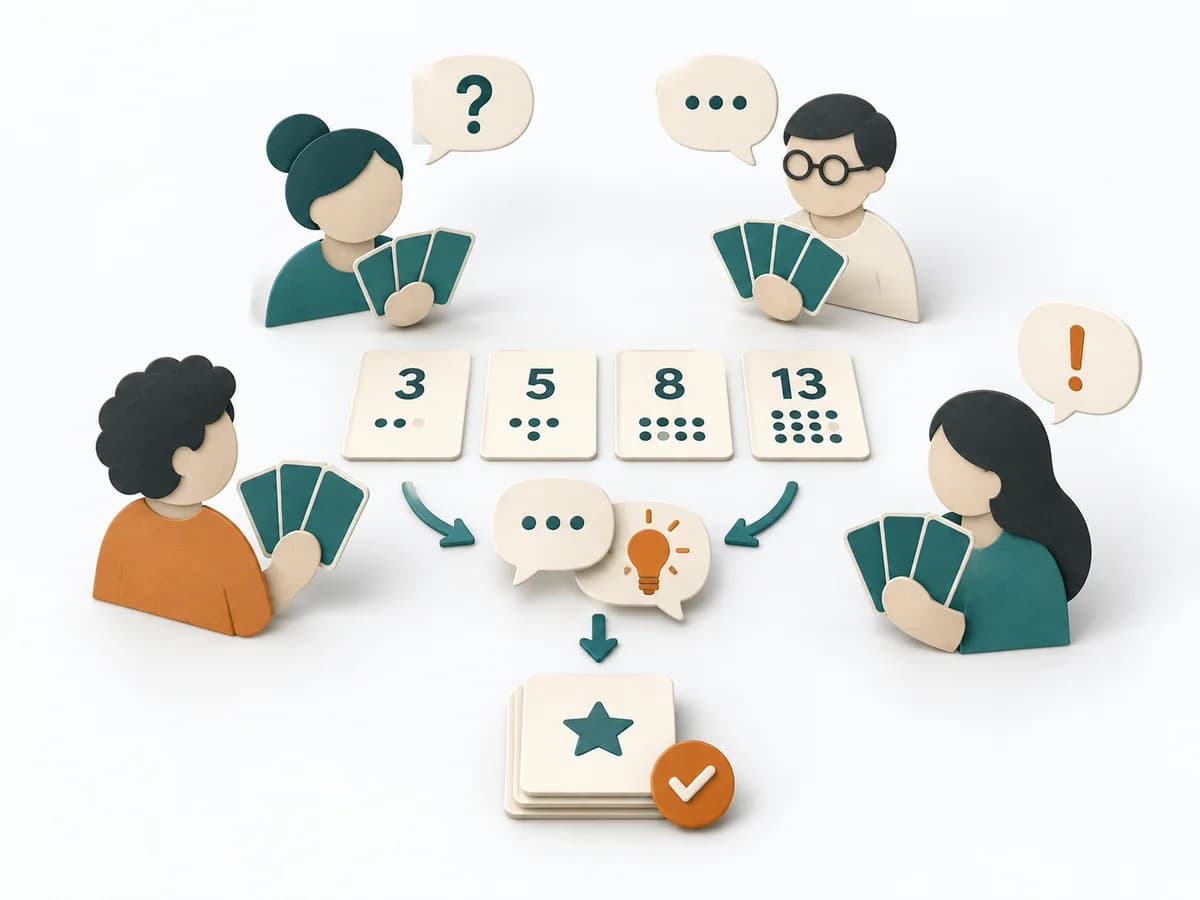
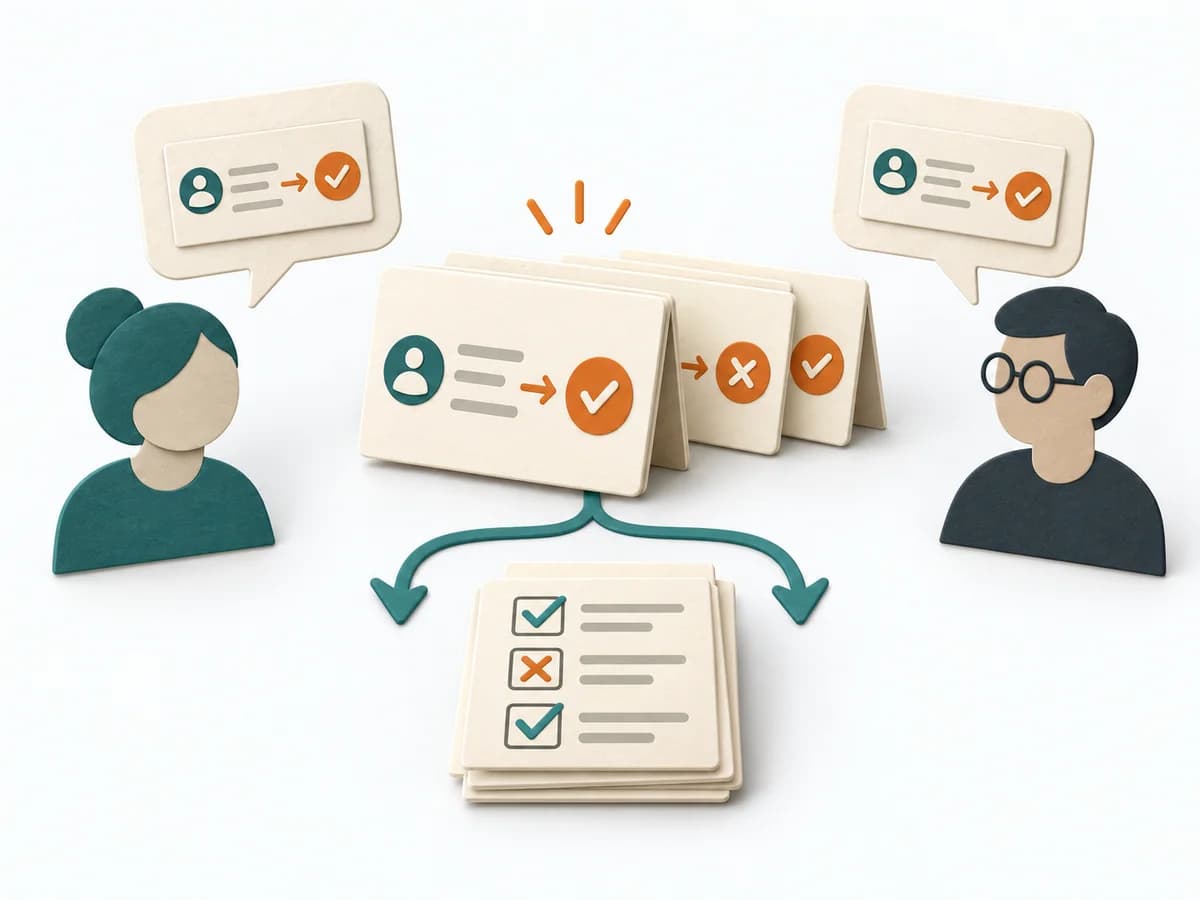
Plan my session
Plan a concrete work block with agenda, roles, preparation, and a copyable result artifact.
Session: Story Splitting
The plan translates the method into a concrete facilitated work block. Your inputs flow directly into the session brief and work artifact.
Method session with 2-6. The plan uses the existing method logic and the runsheet.
RunsheetUse the session for shared understanding. Contributions are collected visibly, assumptions are aligned, and open differences remain traceable in the artifact.
The session works directly toward Smaller Stories. After the session, the artifact should be shareable, reviewable, or reusable.
- 1
Phase 1: Clarify story
5-10 minBriefly refresh story outcome, acceptance criteria and Definition of Done. Formulate main benefit in one sentence. Hint: If outcome cannot be formulated in one sentence, several outcomes are mixed. Splitting starts here with outcome separation.
FacilitatorSmaller Stories - 2
Phase 2: Choose splitting pattern
10 minWalk through patterns (Workflow Steps, Variations, Data Variants, Operations, Interface, Defer Performance, Defer Quality, Major Effort, Spike). Several patterns possible, choose best fit. Hint: Workflow Steps and Variations are most common patterns. If none fits, story may be spike or needs a new cut.
FacilitatorAcceptance Criteria - 3
Phase 3: Create slices
15-20 minFormulate slices as own stories. Each slice has outcome, acceptance criteria, sub-Definition of Done. Prioritize order by value-learning mix. Hint: Slices should be independently deployable. If a slice only delivers value as package with others, split is too technical.
FacilitatorSplit Rationale - 4
Phase 4: Estimate and backlog
10-15 minEstimate slices (Story Points, T-Shirt, rough hours). Close original story as parent or epic. Put slices into backlog in order. Hint: If each slice is same size as original story, splitting was unsuccessful. Hard maximum per slice as sprint share.
OwnerSmaller Stories - 5
Publish artifact
10 minCheck the artifact for completeness, define location, set version or status, and name review recipients.
OwnerSmaller Stories
Session Brief
For invitations, boards, tickets, PR descriptions, or workshop notes.
session-brief.md
Session Brief: Story Splitting
Goal
Artifact: Smaller Stories
Working Question
How can the story be split into 2-5 slices, each delivering value or learning, without losing overall benefit?
Context
Story draft with acceptance criteria; known technical constraints; Definition of Done; sprint capacity as reference for slice size.
Setup
- Format: Method session
- Duration: 20-45 min per story
- Mode: Workshop or async
- Participants: One PO or product-adjacent role holder; one to two engineers; optionally QA; one facilitator if team is new to splitting.
- Owner: One PO or product-adjacent role holder
- Participation mode: Team round, shared work and alignment
- Outcome logic: Finish artifact
Participation Logic
Use the session for shared understanding. Contributions are collected visibly, assumptions are aligned, and open differences remain traceable in the artifact.
Outcome Logic
The session works directly toward Smaller Stories. After the session, the artifact should be shareable, reviewable, or reusable.
Input
Story description; whiteboard or Miro with splitting patterns as checklist (Workflow Steps, Variations, Data Variants, Operations, Interface, Defer Performance, Defer Quality, Major Effort, Spike); backlog tool for new stories.
Preparation
Make story visible. Splitting patterns as checklist on side. Rule: every slice delivers independent value or learning, no "backend slice" without outcome.
Agenda
-
Phase 1: Clarify story (5-10 min) Owner: Facilitator Action: Briefly refresh story outcome, acceptance criteria and Definition of Done. Formulate main benefit in one sentence. Hint: If outcome cannot be formulated in one sentence, several outcomes are mixed. Splitting starts here with outcome separation. Output: Smaller Stories
-
Phase 2: Choose splitting pattern (10 min) Owner: Facilitator Action: Walk through patterns (Workflow Steps, Variations, Data Variants, Operations, Interface, Defer Performance, Defer Quality, Major Effort, Spike). Several patterns possible, choose best fit. Hint: Workflow Steps and Variations are most common patterns. If none fits, story may be spike or needs a new cut. Output: Acceptance Criteria
-
Phase 3: Create slices (15-20 min) Owner: Facilitator Action: Formulate slices as own stories. Each slice has outcome, acceptance criteria, sub-Definition of Done. Prioritize order by value-learning mix. Hint: Slices should be independently deployable. If a slice only delivers value as package with others, split is too technical. Output: Split Rationale
-
Phase 4: Estimate and backlog (10-15 min) Owner: Owner Action: Estimate slices (Story Points, T-Shirt, rough hours). Close original story as parent or epic. Put slices into backlog in order. Hint: If each slice is same size as original story, splitting was unsuccessful. Hard maximum per slice as sprint share. Output: Smaller Stories
-
Publish artifact (10 min) Owner: Owner Action: Check the artifact for completeness, define location, set version or status, and name review recipients. Output: Smaller Stories
Closeout
- Update result artifact: Smaller Stories
- Define location, version, and review recipients.
- Define owner, next step, and review date.
Work artifact
Pre-filled starting point based on the matching template.
work-artifact.md
Smaller Stories: Story Splitting
Working Question
How can the story be split into 2-5 slices, each delivering value or learning, without losing overall benefit?
Context
Story draft with acceptance criteria; known technical constraints; Definition of Done; sprint capacity as reference for slice size.
Participants
- Owner: One PO or product-adjacent role holder
- Participants: One PO or product-adjacent role holder; one to two engineers; optionally QA; one facilitator if team is new to splitting.
Input
Story description; whiteboard or Miro with splitting patterns as checklist (Workflow Steps, Variations, Data Variants, Operations, Interface, Defer Performance, Defer Quality, Major Effort, Spike); backlog tool for new stories.
Template
Story Splitting Checklist
- Goal and context clarified
- Input material gathered
- Participants and roles named
- Execution prepared according to the runsheet
- Output artifacts created
- Smaller Stories updated
- Acceptance Criteria updated
- Split Rationale updated
- Open questions documented
- Next step set with owner and date
Completion Check
- Smaller Stories is complete enough for review:
- Location:
- Version / status:
- Review by:
- Next step:
Next Step
- Review result
- Mark open questions
- Schedule review or decision
Story Splitting Working Template
View templateCompact working template for Story Splitting with context, input, output artifacts, and next step.checklist
story-splitting-working-template.md
Compact working template for Story Splitting with context, input, output artifacts, and next step.
Story Splitting Checklist
- Goal and context clarified
- Input material gathered
- Participants and roles named
- Execution prepared according to the runsheet
- Output artifacts created
- Smaller Stories updated
- Acceptance Criteria updated
- Split Rationale updated
- Open questions documented
- Next step set with owner and date
- Working question, owner, and target artifact are visible.
- The result fits Smaller Stories.
- Splitting decision as comment in backlog tool: applied pattern, date, participants. Preserve reference to parent on slice changes.
- Open questions are noted as follow-ups.
- The next review or decision point is scheduled.