Complete firstConcrete frame
Situation, purpose, and sources are named.
Without a frame, the artifact is arbitrary.
A practical method guide: clarify prerequisites and materials, understand the complete process, and look up outputs, pitfalls, and stop criteria.
What needs to be finished first
Situation, purpose, and sources are named.
What needs to be ready before start
Influence-interest matrix, actor list, sources or notes, assumption labels, and engagement plan.
Facilitation, project or product ownership, affected subject roles, and representatives where needed.
Prepare the concrete change or decision, timeframe, initial actor list, known relationships, and sources or conversation notes.
60–90 minutes for the map and engagement plan; schedule conversations and reviews after.
Influence and interest apply only to the agreed context and period. Mark direct statements, observed relationships, and working assumptions differently.
The one question this method answers
Which actor groups are affected or influential here, what assumptions apply, and how will they participate?
Phases with goal, actions, output and pitfall
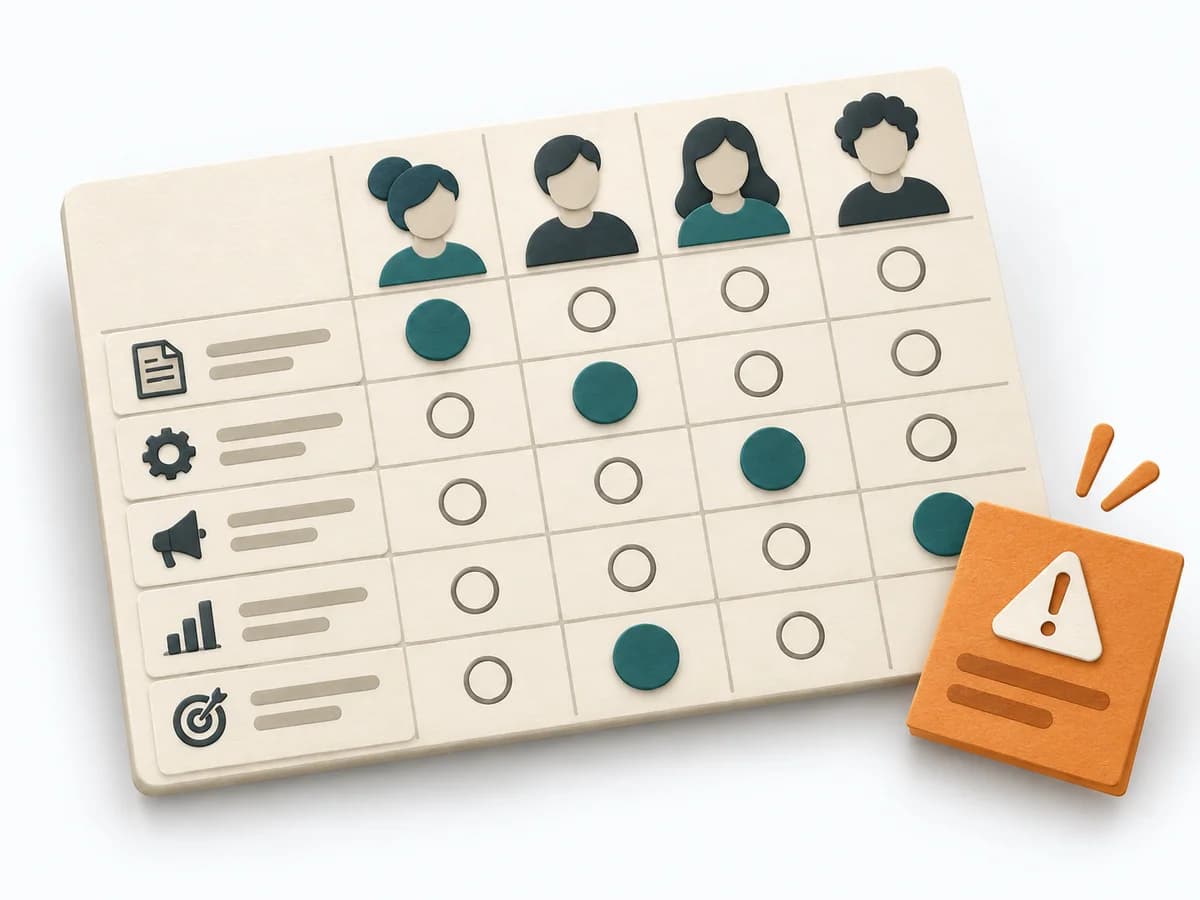
Stakeholder Mapping identifies actor groups for a concrete decision or change. Influence and interest are treated as situational working assumptions that shape participation, review, and information paths.
Fictional teaching example
Actor groups with situational assumptions about influence, interest, and engagement.
| Work row | Actor group | Interest in this situation | Influence on decision or implementation | Engagement and review |
|---|---|---|---|---|
| Actor groupWhich group is affected, influential, or knowledge-relevant? | Households with reservations | high, assumption | medium, assumption | Interview and review |
| Check assumptionWhich classification needs a conversation or review? | Volunteer tool desk | High: assumption due to added inspection work | High: assumption due to responsibility for handover | Review the workflow together; confirm assessment in conversation |
Keep classifications traceable and revisable.
Frame change

Goal
The map refers to one concrete situation.
Inputs for this step
Actions
Output
Change · decision · timeframe
Evidence, context, and source
Quality check
Is the map bounded to one decision?
Pitfall
The map becomes a permanent ranking of people. Limit the assessment to this decision and period.
Timing: 10–15 minutes
Identify groups
Goal
Direct and indirect perspectives are visible.
Inputs for this step
Actions
Output
Actor group · impact · role · source
Evidence, context, and source
Quality check
Are direct and indirect actors represented?
Pitfall
Directly affected groups are missing. Add affected, influential, and knowledge-bearing groups.
Timing: 15–25 minutes
Map assumptions
Goal
Classifications support a reviewable engagement plan.
Inputs for this step
Actions
Output
Group · interest · influence · assumption or source
Evidence, context, and source
Quality check
Can each placement be challenged or updated?
Pitfall
Influence or interest is stated as a fixed trait. Record context, source, and uncertainty for each placement.
Timing: 20–30 minutes
Plan engagement
Goal
The map leads to proportionate engagement.
Inputs for this step
Actions
Output
Group · engagement · owner · review
Evidence, context, and source
Quality check
Does the map produce a concrete engagement action?
Pitfall
The map ends without participation or review. Assign engagement, ownership, and a review point.
Timing: 15–20 minutes
What comes out at the end
Sketch: what the artifact looks like
Stakeholder map with actor groups, situational influence and interest assumptions, and an engagement and review plan.
Record context, period, source, and date for each placement. Changes in relationships or influence create a new review state.
Prepare one concrete change, relevant actor groups, and reviewable engagement assumptions.
To be confirmed
To be confirmed
Create the map and engagement plan Time: 60–90 minutes
Complete this worksheet on paper or in your own document during the work.
| Work row | Actor group | Interest in this situation | Influence on decision or implementation | Engagement and review |
|---|---|---|---|---|
| Actor group | ||||
| Check assumption |
Blank worksheet: enter your own material.
Expected artifact: Change · decision · timeframe
Evidence, context, and source
Entry:
...
Expected artifact: Actor group · impact · role · source
Evidence, context, and source
Entry:
...
Expected artifact: Group · interest · influence · assumption or source
Evidence, context, and source
Entry:
...
Expected artifact: Group · engagement · owner · review
Evidence, context, and source
Entry:
...
...
Method guide: https://methodatlas.meierhoff-systems.de/en/methods/stakeholder-mapping/run-sheet
Concrete filled scenario, fictional example
Fictional example for orientation. Counts and timings describe this case and are not universal requirements.
Concrete filled scenario, fictional example
All details are invented. The classification applies only to the decision “adjust Saturday pickup” and is not a fixed rating of people.
| Actor group | Interest | Influence | Engagement |
|---|---|---|---|
| Households with reservations | high, assumption | medium, assumption | short interviews and review |
| Pickup team | high, assumption | high, assumption | process workshop and pilot review |
| Repair advisers | medium, assumption | medium, assumption | review requirements |
| Site leadership | medium, assumption | high, assumption | decision and review |
Test the assumptions through conversations before deciding. The map leads to a pilot review with the pickup team and feedback from affected households.
Recognize symptoms and steer against them
Quick overview, the full text is in the matching phase in the flow
The map becomes a permanent ranking of people.
Limit the assessment to this decision and period.
Directly affected groups are missing.
Add affected, influential, and knowledge-bearing groups.
Influence or interest is stated as a fixed trait.
Record context, source, and uncertainty for each placement.
The map ends without participation or review.
Assign engagement, ownership, and a review point.
When to pause, resolve prerequisites, or choose another approach
Go to the profile for purpose, similar methods, and sources or continue to the next method in the catalog.