Complete firstBounded subject
The scope and purpose of Spotify Model Mapping are stated as a concrete question.
Without scope, organisation mapping becomes arbitrary.
A practical method guide: clarify prerequisites and materials, understand the complete process, and look up outputs, pitfalls, and stop criteria.
What needs to be finished first
The scope and purpose of Spotify Model Mapping are stated as a concrete question.
Product and value flows, current teams and communities, decision and dependency data and domain decision makers are available.
What needs to be ready before start
Product and value flows, current teams and communities, decision and dependency data, shared workspace, source links, and decision log.
Leadership · team representatives · Product · People/Organisation
Collect Product and value flows, current teams and communities, decision and dependency data in advance and mark open assumptions.
2 × 90 minutes
Prepare map Spotify terms as hypotheses onto local product flows, communities, and leadership needs visibly and calibrate assessment terms before starting.
The one question this method answers
Which local structures do we need for autonomy, alignment, and craft exchange?
Phases with goal, actions, output and pitfall
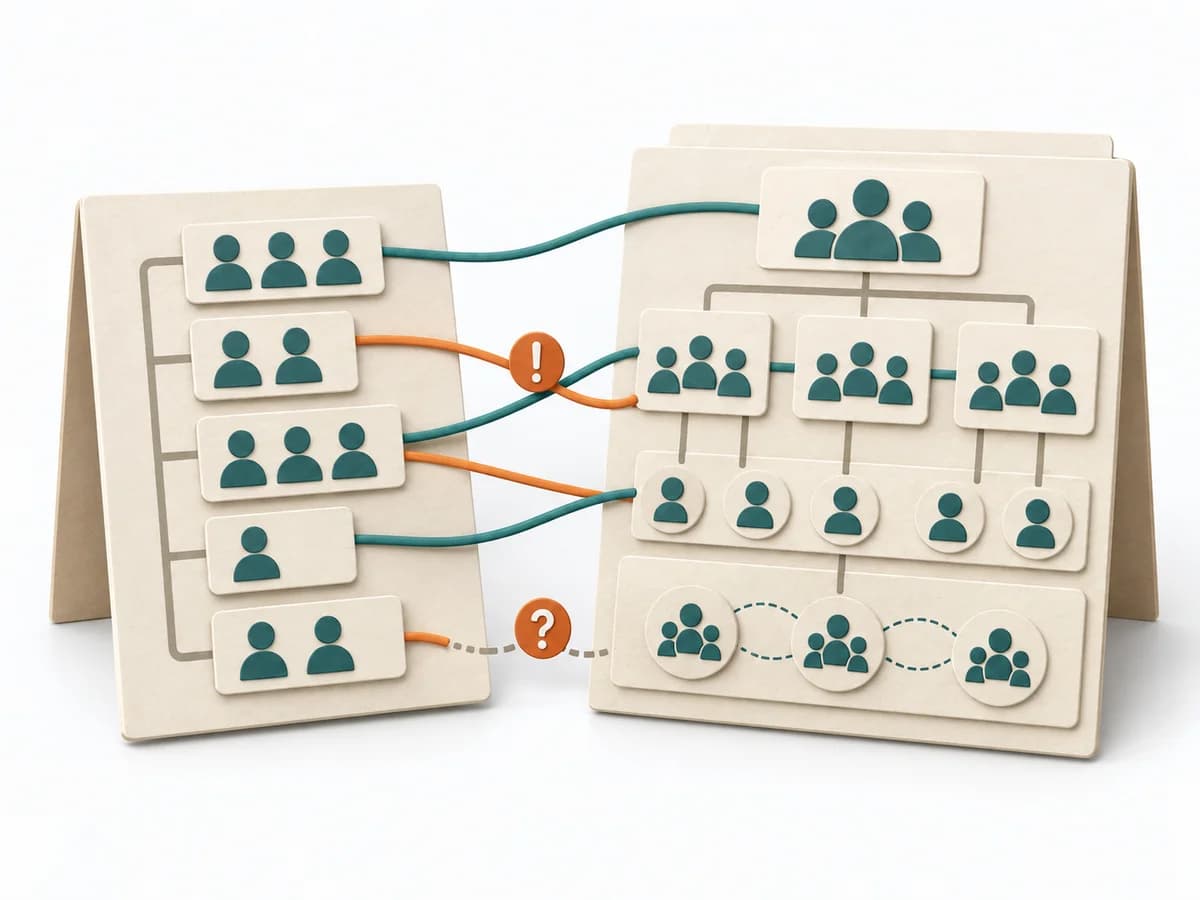
The published Spotify model describes a historical context, not a copyable framework. Mapping translates terms into local purposes, decision rights, and risks and marks deviations.
Fictional worked example
map Spotify terms as hypotheses onto local product flows, communities, and leadership needs as a precise working structure with a fictional example.
Team/community · purpose · product flow
Billing product team; long-lived product flow.
Squad · tribe · chapter · guild · none
Partly squad; no tribe.
Decision right · leadership · participation
Security chapter with people responsibility.
Misapplication · measure · review
Review hand-offs per feature after eight weeks.
Establish context
Goal
Produce context boundaries so the core question “Which local structures do we need for autonomy, alignment, and craft exchange?” can be answered with stronger support.
Inputs for this step
Actions
Output
context boundaries
context boundaries · source · uncertainty · next decision
Quality check
Are terms marked as analogies?
Pitfall
New Spotify labels hide old dependencies and unclear decision rights. Start from product flow, decision rights, and actual responsibility and remove unnecessary labels.
Timing: 10–20 minutes
Map product flow
Goal
Produce flow map so the core question “Which local structures do we need for autonomy, alignment, and craft exchange?” can be answered with stronger support.
Inputs for this step
Actions
Output
flow map
flow map · source · uncertainty · next decision
Quality check
Does the boundary minimise hand-offs?
Pitfall
New Spotify labels hide old dependencies and unclear decision rights. Start from product flow, decision rights, and actual responsibility and remove unnecessary labels.
Timing: 10–20 minutes
Map communities
Goal
Produce community map so the core question “Which local structures do we need for autonomy, alignment, and craft exchange?” can be answered with stronger support.
Inputs for this step
Actions
Output
community map
community map · source · uncertainty · next decision
Quality check
Are people responsibility and voluntary exchange distinct?
Pitfall
New Spotify labels hide old dependencies and unclear decision rights. Start from product flow, decision rights, and actual responsibility and remove unnecessary labels.
Timing: 10–20 minutes
Test hypothesis
Goal
Produce change hypothesis so the core question “Which local structures do we need for autonomy, alignment, and craft exchange?” can be answered with stronger support.
Inputs for this step
Actions
Output
change hypothesis
change hypothesis · source · uncertainty · next decision
Quality check
Is a measurable flow improvement named?
Pitfall
New Spotify labels hide old dependencies and unclear decision rights. Start from product flow, decision rights, and actual responsibility and remove unnecessary labels.
Timing: 10–20 minutes
What comes out at the end
Sketch: what the artifact looks like
Versioned organisation mapping with date, sources, owners, and next review.
Retain date, source, assumption state, and decision for every version of organisation mapping.
Plan Spotify Model Mapping around its domain steps and the concrete decision question.
To be confirmed
To be confirmed
Full initiative Time: 2 × 90 minutes
Complete this worksheet on paper or in your own document during the work.
Team/community · purpose · product flow
...
Squad · tribe · chapter · guild · none
...
Decision right · leadership · participation
...
Misapplication · measure · review
...
Spotify Engineering Culture, part 1
Expected artifact: context boundaries
context boundaries · source · uncertainty · next decision
Entry:
...
Expected artifact: flow map
flow map · source · uncertainty · next decision
Entry:
...
Expected artifact: community map
community map · source · uncertainty · next decision
Entry:
...
Expected artifact: change hypothesis
change hypothesis · source · uncertainty · next decision
Entry:
...
...
Method guide: https://methodatlas.meierhoff-systems.de/en/methods/spotify-model-mapping/run-sheet
Concrete filled scenario, fictional example
Fictional example for orientation. Counts and timings describe this case and are not universal requirements.
Concrete filled scenario, fictional example
Local unit: long-lived billing product team, partly analogous to a squad. The tribe label is omitted because two products do not share a value stream. Chapter: professional line for security engineering with explicit people responsibility. Guild: voluntary accessibility community without decision authority.
Recognize symptoms and steer against them
Quick overview, the full text is in the matching phase in the flow
New Spotify labels hide old dependencies and unclear decision rights.
Start from product flow, decision rights, and actual responsibility and remove unnecessary labels.
New Spotify labels hide old dependencies and unclear decision rights.
Start from product flow, decision rights, and actual responsibility and remove unnecessary labels.
New Spotify labels hide old dependencies and unclear decision rights.
Start from product flow, decision rights, and actual responsibility and remove unnecessary labels.
New Spotify labels hide old dependencies and unclear decision rights.
Start from product flow, decision rights, and actual responsibility and remove unnecessary labels.
When to pause, resolve prerequisites, or choose another approach
Go to the profile for purpose, similar methods, and sources or continue to the next method in the catalog.