Complete firstProblem evidence
Understand the relevant problem and existing alternatives.
Otherwise an appealing demo is evaluated without a need.
A practical method guide: clarify prerequisites and materials, understand the complete process, and look up outputs, pitfalls, and stop criteria.
What needs to be finished first
Understand the relevant problem and existing alternatives.
Prepare a consistent short representation and neutral tasks.
What needs to be ready before start
Concept, neutral tasks, observation sheet.
Target participant, neutral moderator, note-taker.
Prepare an evidenced problem and a concrete concept that can be presented neutrally.
30–45 minutes conversation plus 15 minutes synthesis.
Fix concept version and tasks in advance; discuss the problem incident first, then show the same representation. Record observation separately from interpretation.
The one question this method answers
Does the person understand the approach, and what evidenced progress could it enable in their actual context?
Phases with goal, actions, output and pitfall
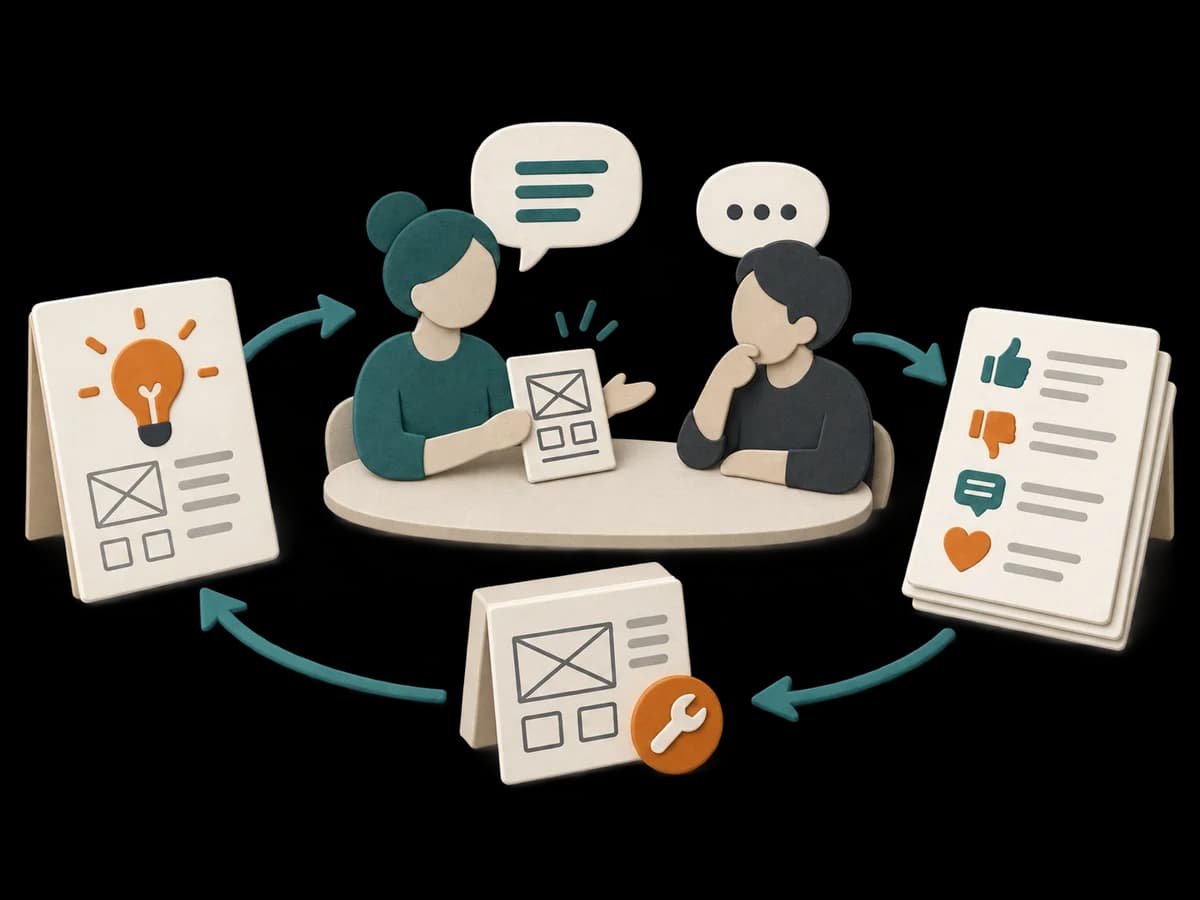
A Solution Interview uses a concrete concept to investigate whether people understand its value and how it fits their evidenced problem and current behaviour. Approval alone does not establish demand.
Fictional example
A Solution Interview uses a concrete concept to investigate whether people understand its value and how it fits their evidenced problem and current behaviour. Approval alone does not establish demand.
Which real case provides the comparison baseline?
Fictional: P04 missed a last-minute room change and currently uses email. Only after this account does the team show a clickable change alert.
Which version was shown and how? What was understood or done unaided?
Version 2 shows room, start time and acknowledgement. P04 locates the room but interprets acknowledgement as a binding course commitment. Moderator help is logged separately.
Which concrete improvement, prerequisite and switching barrier was identified?
Objection: push notifications are silenced during travel. Value therefore depends on timing and an acceptable alternative. Another app alone does not resolve the case.
Distinguish statement, observed action, fulfilled commitment and remaining uncertainty.
P04 voluntarily books an available trial session. This is an appointment, not a purchase. The team simplifies the label and tests timely notice during the pilot.
All example details are fictional and illustrate the application.
Baseline
Goal
Problem anchor
Inputs for this step
Actions
Output
Problem anchor
Was the baseline recorded before the demo?
Quality check
Was the baseline recorded before the demo?
Pitfall
The demonstration presumes the supposed problem. Ask about the actual incident first.
Timing: 5–10 minutes
Understanding
Goal
Understanding findings
Inputs for this step
Actions
Output
Understanding findings
What does the person understand without extra help?
Quality check
What does the person understand without extra help?
Pitfall
The moderator immediately explains away every confusion. Record confusion and required help as findings.
Timing: 10 minutes
Fit
Goal
Fit and objections
Inputs for this step
Actions
Output
Fit and objections
Are benefits and barriers tied to a case?
Quality check
Are benefits and barriers tied to a case?
Pitfall
A requested feature is immediately promised. Understand the reason behind the request and record it openly.
Timing: 10–15 minutes
Follow-up
Goal
Test decision
Inputs for this step
Actions
Output
Test decision
Is commitment separate from fulfilment?
Quality check
Is commitment separate from fulfilment?
Pitfall
Pilot interest is counted as a purchase. Label the signal accurately and plan the next behavioural evidence.
Timing: 10–15 minutes
What comes out at the end
Sketch: what the artifact looks like
Concept findings on understanding, fit, objections and verifiable follow-up.
Record date and scope; retain the previous version and reason when changing it.
Prepare an evidenced problem and a concrete concept that can be presented neutrally.
To be confirmed
To be confirmed
Complete cycle Time: 30–45 minutes conversation plus 15 minutes synthesis.
Complete this worksheet on paper or in your own document during the work.
Which real case provides the comparison baseline?
...
Which version was shown and how? What was understood or done unaided?
...
Which concrete improvement, prerequisite and switching barrier was identified?
...
Distinguish statement, observed action, fulfilled commitment and remaining uncertainty.
...
Answer the prompts with your own information. Explicitly mark unknowns and assumptions.
Ash Maurya: Running Lean im Gespräch
Expected artifact: Problem anchor
Was the baseline recorded before the demo?
Entry:
...
Expected artifact: Understanding findings
What does the person understand without extra help?
Entry:
...
Expected artifact: Fit and objections
Are benefits and barriers tied to a case?
Entry:
...
Expected artifact: Test decision
Is commitment separate from fulfilment?
Entry:
...
...
Method guide: https://methodatlas.meierhoff-systems.de/en/methods/solution-interview/run-sheet
Concrete filled scenario, fictional example
Fictional example for orientation. Counts and timings describe this case and are not universal requirements.
Concrete filled scenario, fictional example
Problem and current alternative: Fictional: P04 missed a last-minute room change and currently uses email. Only after this account does the team show a clickable change alert.
Concept and understanding: Version 2 shows room, start time and acknowledgement. P04 locates the room but interprets acknowledgement as a binding course commitment. Moderator help is logged separately.
Fit and objections: Objection: push notifications are silenced during travel. Value therefore depends on timing and an acceptable alternative. Another app alone does not resolve the case.
Follow-up signal and decision: P04 voluntarily books an available trial session. This is an appointment, not a purchase. The team simplifies the label and tests timely notice during the pilot.
Recognize symptoms and steer against them
Quick overview, the full text is in the matching phase in the flow
The demonstration presumes the supposed problem.
Ask about the actual incident first.
The moderator immediately explains away every confusion.
Record confusion and required help as findings.
A requested feature is immediately promised.
Understand the reason behind the request and record it openly.
Pilot interest is counted as a purchase.
Label the signal accurately and plan the next behavioural evidence.
When to pause, resolve prerequisites, or choose another approach
Go to the profile for purpose, similar methods, and sources or continue to the next method in the catalog.