Plan my session
Plan a concrete work block with agenda, roles, preparation, and a copyable result artifact.
Session: Reverse Brainstorming
The plan translates the method into a concrete facilitated work block. Your inputs flow directly into the session brief and work artifact.
Method session with 3-12. The plan uses the existing method logic and the runsheet.
RunsheetUse the session for shared understanding. Contributions are collected visibly, assumptions are aligned, and open differences remain traceable in the artifact.
The session works directly toward Reverse Ideas. After the session, the artifact should be shareable, reviewable, or reusable.
- 1
Phase 1: Formulate reverse challenge
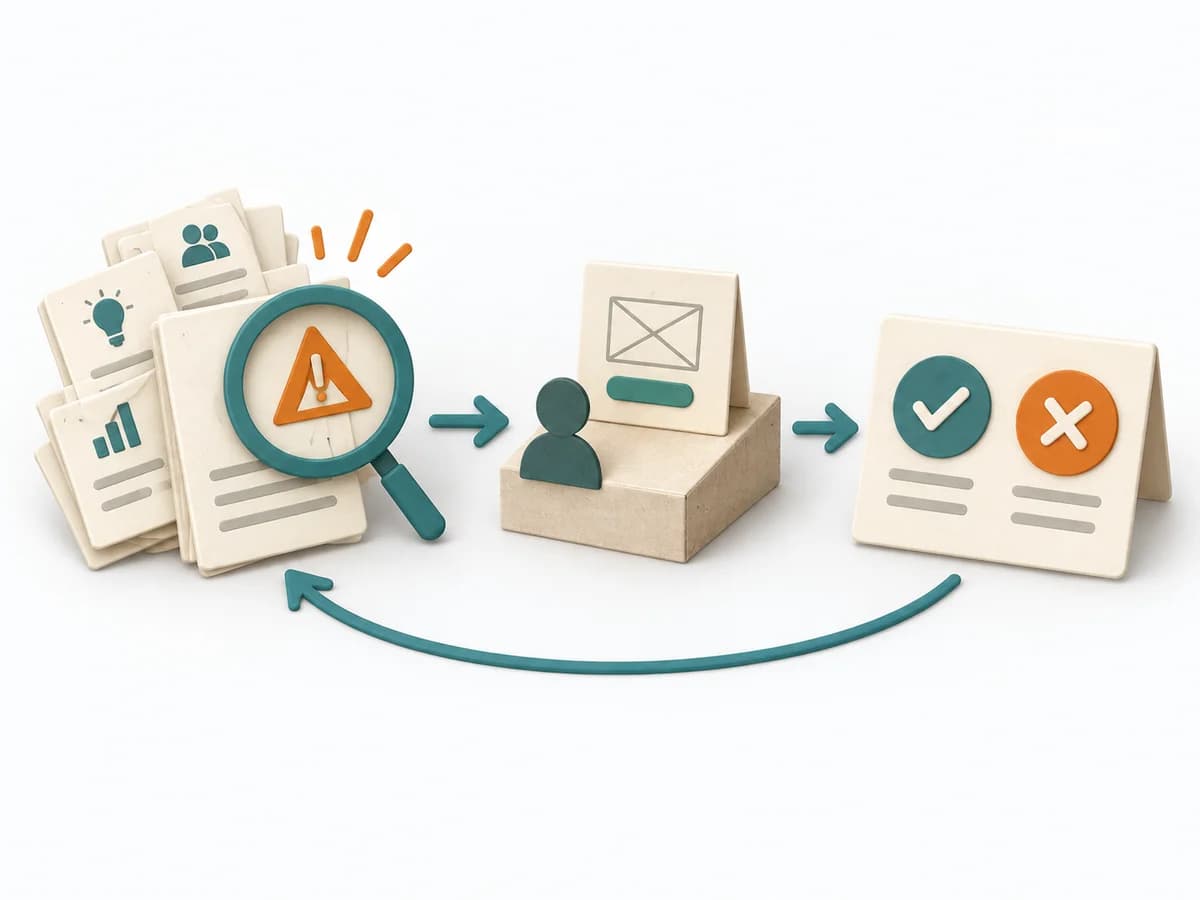
5-10 minRead original challenge aloud, invert it. Examples: "How do we lose as many new users as possible in week 1?" instead of "How do we activate new users?" Write reverse sentence on wall. Hint: Reverse sentence must be concrete and one-sided. "How do we make everything worse?" is too vague and produces play rather than usable risks.
FacilitatorReverse Ideas - 2
Phase 2: Collect bad ideas
15-20 minSolo phase 5 min: each person writes at least five ideas for how to worsen the problem. Then read and place round-robin. Laughter allowed, solution suggestions not. Hint: If solution suggestions appear, facilitator parks them visibly. We bring them back in Phase 4. Phase 2 lives from absurd deterioration.
FacilitatorRisk Themes - 3
Phase 3: Identify patterns
10-15 minCluster reverse ideas. Name a pattern per cluster (for example onboarding hidden, support unreachable, pricing opaque). Write pattern in middle column. Hint: Clusters across multiple ideas are more valuable than individual ideas. Anyone who can assign three or more reverse ideas to one pattern has found a real lever.
FacilitatorSolution Ideas - 4
Phase 4: Derive solutions
10-15 minFor each pattern, formulate positive reversal and write it as concrete action in right column. Capture owner and next step per action. Hint: Reversal is not "do the opposite", but "use the lever positively". For onboarding hidden, not only more visible, but concretely for example three-step walkthrough in app section Home.
OwnerReverse Ideas - 5
Publish artifact
10 minCheck the artifact for completeness, define location, set version or status, and name review recipients.
OwnerReverse Ideas
Session Brief
For invitations, boards, tickets, PR descriptions, or workshop notes.
session-brief.md
Session Brief: Reverse Brainstorming
Goal
Artifact: Reverse Ideas
Working Question
How would we make the problem maximally worse, and which improvements emerge when we reverse that deterioration?
Context
Original challenge as one sentence; examples of previous solution attempts that did not work; known constraints; reason for workshop (risk analysis, service improvement, creative block).
Setup
- Format: Method session
- Duration: 30-60 min
- Mode: Workshop
- Participants: One facilitator who keeps reverse question present and prevents solution thinking; three to twelve participants with problem context; one scribe for the solution column.
- Owner: One facilitator who keeps reverse question present and prevents solution thinking
- Participation mode: Team round, shared work and alignment
- Outcome logic: Finish artifact
Participation Logic
Use the session for shared understanding. Contributions are collected visibly, assumptions are aligned, and open differences remain traceable in the artifact.
Outcome Logic
The session works directly toward Reverse Ideas. After the session, the artifact should be shareable, reviewable, or reusable.
Input
Whiteboard or Miro board with three columns (Reverse ideas, Patterns, Reversed solutions); sticky notes; timer; visible reverse challenge.
Preparation
Write original challenge, next to it reverse variant: "How do we ensure the opposite happens?" Both visible. Prepare three columns. Rule: in Phase 2 no solutions, only making it worse.
Agenda
-
Phase 1: Formulate reverse challenge (5-10 min) Owner: Facilitator Action: Read original challenge aloud, invert it. Examples: "How do we lose as many new users as possible in week 1?" instead of "How do we activate new users?" Write reverse sentence on wall. Hint: Reverse sentence must be concrete and one-sided. "How do we make everything worse?" is too vague and produces play rather than usable risks. Output: Reverse Ideas
-
Phase 2: Collect bad ideas (15-20 min) Owner: Facilitator Action: Solo phase 5 min: each person writes at least five ideas for how to worsen the problem. Then read and place round-robin. Laughter allowed, solution suggestions not. Hint: If solution suggestions appear, facilitator parks them visibly. We bring them back in Phase 4. Phase 2 lives from absurd deterioration. Output: Risk Themes
-
Phase 3: Identify patterns (10-15 min) Owner: Facilitator Action: Cluster reverse ideas. Name a pattern per cluster (for example onboarding hidden, support unreachable, pricing opaque). Write pattern in middle column. Hint: Clusters across multiple ideas are more valuable than individual ideas. Anyone who can assign three or more reverse ideas to one pattern has found a real lever. Output: Solution Ideas
-
Phase 4: Derive solutions (10-15 min) Owner: Owner Action: For each pattern, formulate positive reversal and write it as concrete action in right column. Capture owner and next step per action. Hint: Reversal is not "do the opposite", but "use the lever positively". For onboarding hidden, not only more visible, but concretely for example three-step walkthrough in app section Home. Output: Reverse Ideas
-
Publish artifact (10 min) Owner: Owner Action: Check the artifact for completeness, define location, set version or status, and name review recipients. Output: Reverse Ideas
Closeout
- Update result artifact: Reverse Ideas
- Define location, version, and review recipients.
- Define owner, next step, and review date.
Work artifact
Pre-filled starting point based on the matching template.
work-artifact.md
Reverse Ideas: Reverse Brainstorming
Working Question
How would we make the problem maximally worse, and which improvements emerge when we reverse that deterioration?
Context
Original challenge as one sentence; examples of previous solution attempts that did not work; known constraints; reason for workshop (risk analysis, service improvement, creative block).
Participants
- Owner: One facilitator who keeps reverse question present and prevents solution thinking
- Participants: One facilitator who keeps reverse question present and prevents solution thinking; three to twelve participants with problem context; one scribe for the solution column.
Input
Whiteboard or Miro board with three columns (Reverse ideas, Patterns, Reversed solutions); sticky notes; timer; visible reverse challenge.
Template
Reverse Brainstorming Working Template
Goal
Use negative thinking to surface risks and turn them into improvements.
Context
What challenge should the group explore, and what kind of outcome is needed?
Input
- Challenge statement:
- Constraints:
- Reference material:
- Participants:
Working area
- Reverse question:
- Worst ideas:
- Risk patterns:
- Useful reversals:
- Solution ideas:
Output artifacts
- Reverse ideas:
- Risk themes:
- Solution ideas:
Open questions
- ...
Decision / next step
Owner, date, and success signal.
Completion Check
- Reverse Ideas is complete enough for review:
- Location:
- Version / status:
- Review by:
- Next step:
Next Step
- Review result
- Mark open questions
- Schedule review or decision
Reverse Brainstorming Working Template
View templateCompact working template for Reverse Brainstorming with reverse ideas, risk themes, and solution ideas.markdown
reverse-brainstorming-working-template.md
Compact working template for Reverse Brainstorming with reverse ideas, risk themes, and solution ideas.
Reverse Brainstorming Working Template
Goal
Use negative thinking to surface risks and turn them into improvements.
Context
What challenge should the group explore, and what kind of outcome is needed?
Input
- Challenge statement:
- Constraints:
- Reference material:
- Participants:
Working area
- Reverse question:
- Worst ideas:
- Risk patterns:
- Useful reversals:
- Solution ideas:
Output artifacts
- Reverse ideas:
- Risk themes:
- Solution ideas:
Open questions
- ...
Decision / next step
Owner, date, and success signal.
- Working question, owner, and target artifact are visible.
- The result fits Reverse Ideas.
- One entry per session with date, challenge and participants. When repeated on same challenge, quote earlier reverse ideas at the beginning and mark new patterns.
- Open questions are noted as follow-ups.
- The next review or decision point is scheduled.