Complete firstClear goal
A desired outcome and influenceable conditions are known.
Without a concrete goal the reversal becomes arbitrary.
A practical method guide: clarify prerequisites and materials, understand the complete process, and look up outputs, pitfalls, and stop criteria.
What needs to be finished first
A desired outcome and influenceable conditions are known.
What needs to be ready before start
Positive and reversed question, cards, table for harmful mechanism and counter-idea.
Domain experts, affected-user perspective and facilitator.
Define positive goal and context; label negative ideas as a thought experiment only.
30–60 minutes
Display goal and reverse question side by side; collect negative ideas and later countermeasures separately.
The one question this method answers
How could we worsen the problem and what does that teach us about solving it?
Phases with goal, actions, output and pitfall
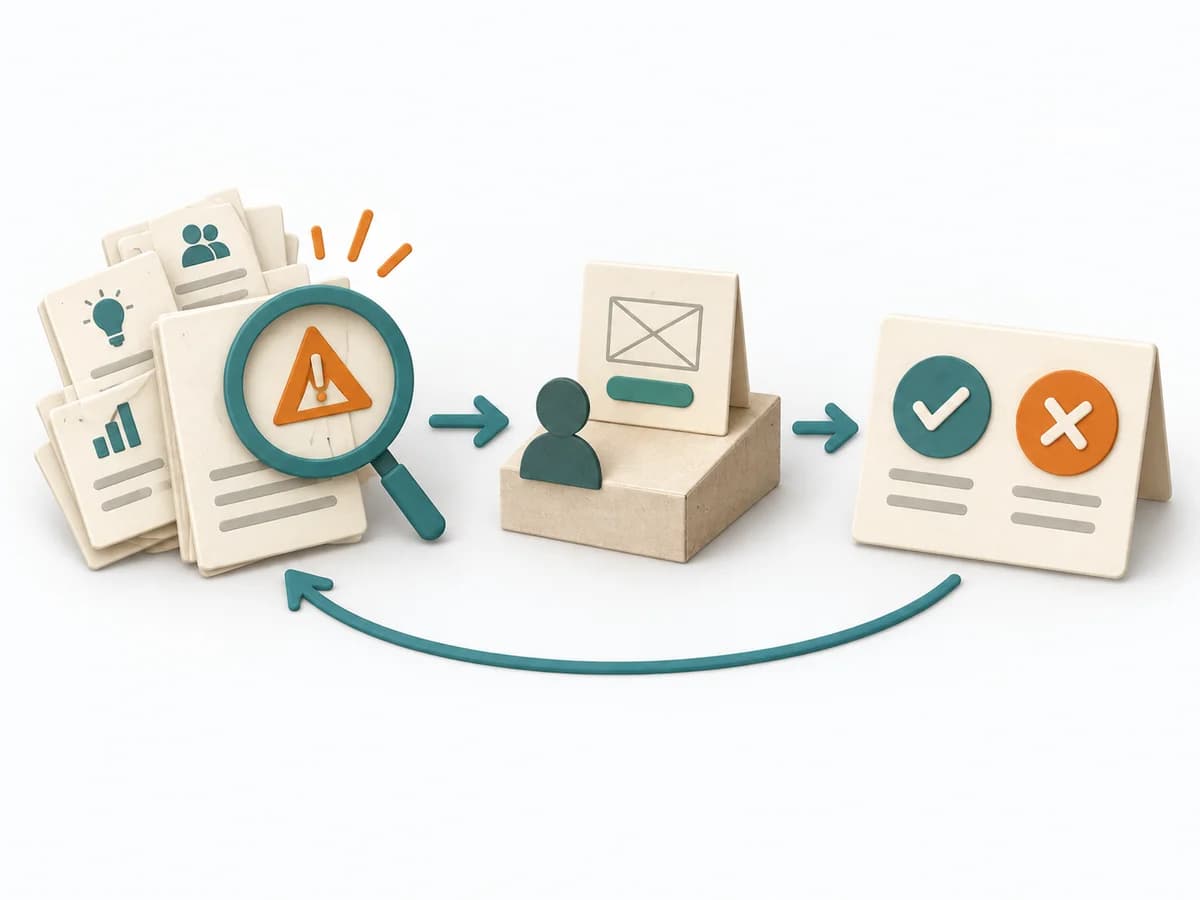
The goal question is reversed. The team deliberately generates ways to worsen the problem, examines their mechanisms and translates them into useful countermeasures.
Fictional example
The goal question is reversed. The team deliberately generates ways to worsen the problem, examines their mechanisms and translates them into useful countermeasures.
Which outcome do we want to improve?
Fictional: how can we make instructors’ first session easier?
What is the direct opposite of this effect?
How can we make the first session as confusing as possible?
Which action worsens the problem, and why?
Announce room changes after the start: orientation arrives too late.
Which concrete action prevents this mechanism?
Confirm room and contact the previous day; send changes through direct messages.
Who tests what with whom and how is impact recognised?
Lea trials confirmation with three new instructors and asks before the start whether room and contact are clear.
All example details are fictional and illustrate the application.
Reverse question

Goal
Reverse question
Inputs for this step
Actions
Output
Reverse question
Does the reversal address the same problem?
Quality check
Does the reversal address the same problem?
Pitfall
The reverse question changes the subject. Compare the goal and reverse question side by side.
Timing: 10–15 minutes
Worsening ideas
Goal
Negative mechanisms
Inputs for this step
Actions
Output
Negative mechanisms
Is the harmful mechanism clear?
Quality check
Is the harmful mechanism clear?
Pitfall
Buzzwords replace understandable worsening ideas. Ask for the action and its consequence.
Timing: 10–15 minutes
Counter-ideas
Goal
Concrete counter-ideas
Inputs for this step
Actions
Output
Concrete counter-ideas
Is the counter-idea more than simply not doing it?
Quality check
Is the counter-idea more than simply not doing it?
Pitfall
Communicate unclearly becomes only communicate clearly. Add observable action, timing and recipient.
Timing: 10–15 minutes
Test selection
Goal
Test brief
Inputs for this step
Actions
Output
Test brief
Does the test examine the expected effect?
Quality check
Does the test examine the expected effect?
Pitfall
The funniest idea wins without checking value. Return to the original goal and an observable improvement.
Timing: 10–15 minutes
What comes out at the end
Sketch: what the artifact looks like
Traceable chain from negative idea through mechanism to constructive reversal and next test.
Record date and scope; retain the previous version and reason when changing it.
Define positive goal and context; label negative ideas as a thought experiment only.
To be confirmed
To be confirmed
Complete cycle Time: 30–60 minutes
Complete this worksheet on paper or in your own document during the work.
Which outcome do we want to improve?
...
What is the direct opposite of this effect?
...
Which action worsens the problem, and why?
...
Which concrete action prevents this mechanism?
...
Who tests what with whom and how is impact recognised?
...
Answer the prompts with your own information. Explicitly mark unknowns and assumptions.
IAF Library / SessionLab: Reverse Brainstorming
Expected artifact: Reverse question
Does the reversal address the same problem?
Entry:
...
Expected artifact: Negative mechanisms
Is the harmful mechanism clear?
Entry:
...
Expected artifact: Concrete counter-ideas
Is the counter-idea more than simply not doing it?
Entry:
...
Expected artifact: Test brief
Does the test examine the expected effect?
Entry:
...
...
Method guide: https://methodatlas.meierhoff-systems.de/en/methods/reverse-brainstorming/run-sheet
Concrete filled scenario, fictional example
Fictional example for orientation. Counts and timings describe this case and are not universal requirements.
Concrete filled scenario, fictional example
Goal question: Fictional: how can we make instructors’ first session easier?
Reverse question: How can we make the first session as confusing as possible?
Negative idea and mechanism: Announce room changes after the start: orientation arrives too late.
Constructive reversal: Confirm room and contact the previous day; send changes through direct messages.
Test: Lea trials confirmation with three new instructors and asks before the start whether room and contact are clear.
Recognize symptoms and steer against them
Quick overview, the full text is in the matching phase in the flow
The reverse question changes the subject.
Compare the goal and reverse question side by side.
Buzzwords replace understandable worsening ideas.
Ask for the action and its consequence.
Communicate unclearly becomes only communicate clearly.
Add observable action, timing and recipient.
The funniest idea wins without checking value.
Return to the original goal and an observable improvement.
When to pause, resolve prerequisites, or choose another approach
Go to the profile for purpose, similar methods, and sources or continue to the next method in the catalog.