Complete firstHypothesis
Name segment, suspected problem and a disconfirming finding.
Without disconfirmation criteria, every answer confirms the idea.
A practical method guide: clarify prerequisites and materials, understand the complete process, and look up outputs, pitfalls, and stop criteria.
What needs to be finished first
Name segment, suspected problem and a disconfirming finding.
Select people by real context rather than agreement.
What needs to be ready before start
Neutral guide, evidence record, recruitment criteria.
Target participant, interviewer, note-taker.
Write the problem hypothesis internally; recruit people with relevant experience.
30–45 minutes conversation plus 15 minutes analysis.
Keep the hypothesis visible internally; organise notes by incident, consequence and alternative. Keep solution materials outside the conversation.
The one question this method answers
Which real problem matters enough to this target group that they already act on it?
Phases with goal, actions, output and pitfall
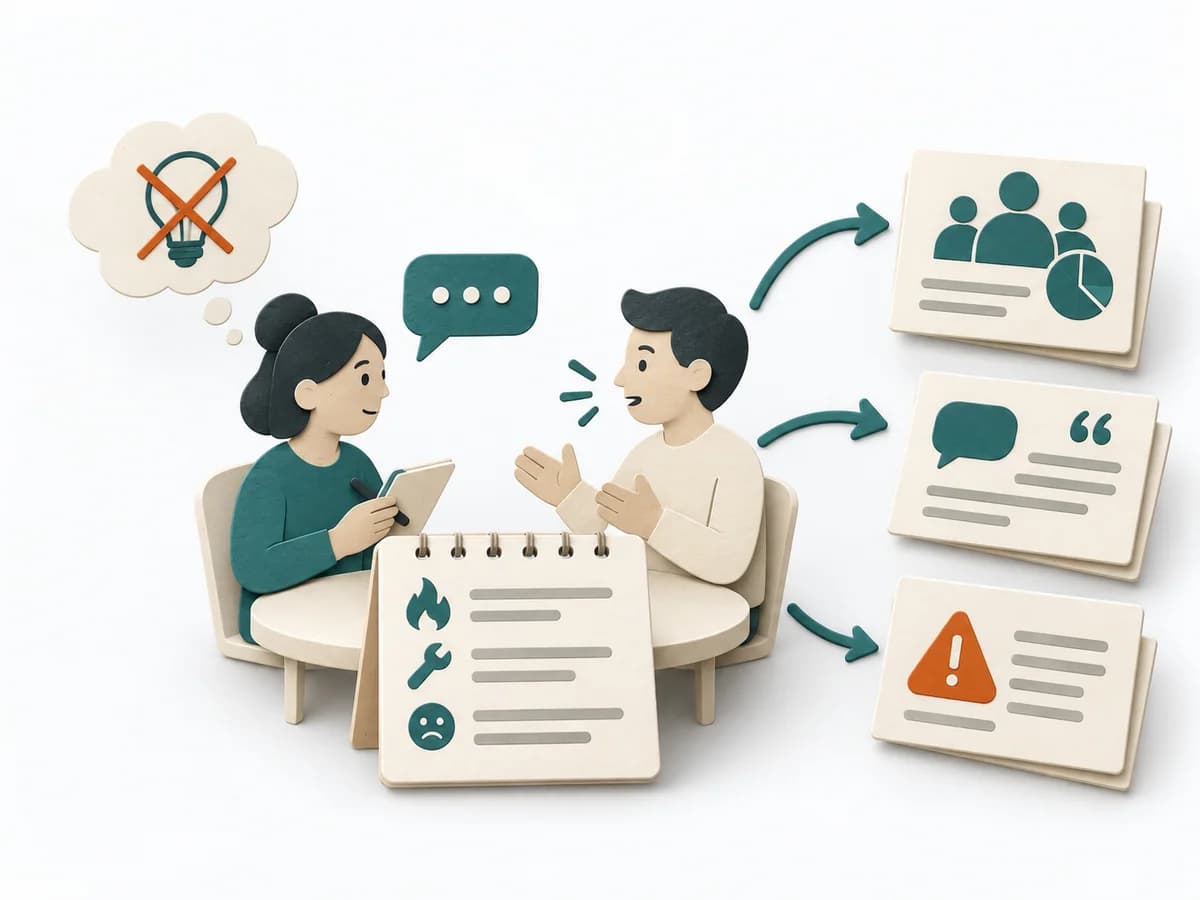
A Problem Interview investigates whether a suspected difficulty actually occurs in a target group’s life and examines consequences, alternatives and effort already spent.
Fictional example
A Problem Interview investigates whether a suspected difficulty actually occurs in a target group’s life and examines consequences, alternatives and effort already spent.
What problem is suspected for whom? Which finding would contradict it?
Fictional: part-time instructors lose time reconciling changing course rooms. Counterevidence would be an already reliable, effortless process.
Document the latest incident, sequence, consequences and basis for estimates.
P07 received a room change by email on Monday, noticed it only on arrival and recalls starting ten minutes late. The preceding week went smoothly.
What is currently done, paid for, worked around or deliberately tolerated?
P07 checks email before leaving; no tool purchased. This change arrived after departure. Timely change information matters more than another calendar view.
What supports or weakens the hypothesis? Which alternative explanation and gap remain?
The incident supports a notification problem, not yet a recurring reconciliation problem. Next case: an instructor with frequent changes; also examine change timing and channel.
All example details are fictional and illustrate the application.
Context
Goal
Context profile
Inputs for this step
Actions
Output
Context profile
Is the person speaking from experience?
Quality check
Is the person speaking from experience?
Pitfall
Agreement questions reveal the desired answer. Ask neutrally about workflow and event.
Timing: 5–10 minutes
Incident
Goal
Problem incident
Inputs for this step
Actions
Output
Problem incident
Is there a contrasting case without the problem?
Quality check
Is there a contrasting case without the problem?
Pitfall
A general annoyance is treated as urgent demand. Ask about consequences and actual response.
Timing: 10–15 minutes
Alternatives
Goal
Alternatives profile
Inputs for this step
Actions
Output
Alternatives profile
Are effort and switching barriers concrete?
Quality check
Are effort and switching barriers concrete?
Pitfall
Hypothetical purchase intent is requested. Ask about past purchases, attempts and abandoned efforts.
Timing: 10–15 minutes
Synthesis
Goal
Problem profile
Inputs for this step
Actions
Output
Problem profile
Could counterevidence change our direction?
Quality check
Could counterevidence change our direction?
Pitfall
Only confirming quotes are retained. Give contradictions equal visibility.
Timing: 15 minutes
What comes out at the end
Sketch: what the artifact looks like
Problem profile with concrete incidents, consequences, alternatives and counterevidence.
Record date and scope; retain the previous version and reason when changing it.
Write the problem hypothesis internally; recruit people with relevant experience.
To be confirmed
To be confirmed
Complete cycle Time: 30–45 minutes conversation plus 15 minutes analysis.
Complete this worksheet on paper or in your own document during the work.
What problem is suspected for whom? Which finding would contradict it?
...
Document the latest incident, sequence, consequences and basis for estimates.
...
What is currently done, paid for, worked around or deliberately tolerated?
...
What supports or weakens the hypothesis? Which alternative explanation and gap remain?
...
Answer the prompts with your own information. Explicitly mark unknowns and assumptions.
Ash Maurya: Interview zu Running Lean
Expected artifact: Context profile
Is the person speaking from experience?
Entry:
...
Expected artifact: Problem incident
Is there a contrasting case without the problem?
Entry:
...
Expected artifact: Alternatives profile
Are effort and switching barriers concrete?
Entry:
...
Expected artifact: Problem profile
Could counterevidence change our direction?
Entry:
...
...
Method guide: https://methodatlas.meierhoff-systems.de/en/methods/problem-interview/run-sheet
Concrete filled scenario, fictional example
Fictional example for orientation. Counts and timings describe this case and are not universal requirements.
Concrete filled scenario, fictional example
Segment and hypothesis: Fictional: part-time instructors lose time reconciling changing course rooms. Counterevidence would be an already reliable, effortless process.
Incident and consequences: P07 received a room change by email on Monday, noticed it only on arrival and recalls starting ten minutes late. The preceding week went smoothly.
Alternatives and effort: P07 checks email before leaving; no tool purchased. This change arrived after departure. Timely change information matters more than another calendar view.
Evidence and next case: The incident supports a notification problem, not yet a recurring reconciliation problem. Next case: an instructor with frequent changes; also examine change timing and channel.
Recognize symptoms and steer against them
Quick overview, the full text is in the matching phase in the flow
Agreement questions reveal the desired answer.
Ask neutrally about workflow and event.
A general annoyance is treated as urgent demand.
Ask about consequences and actual response.
Hypothetical purchase intent is requested.
Ask about past purchases, attempts and abandoned efforts.
Only confirming quotes are retained.
Give contradictions equal visibility.
When to pause, resolve prerequisites, or choose another approach
Go to the profile for purpose, similar methods, and sources or continue to the next method in the catalog.