Complete firstExperience access
A relevant past situation and voluntary participation.
Without an experience, the conversation collects general opinions.
A practical method guide: clarify prerequisites and materials, understand the complete process, and look up outputs, pitfalls, and stop criteria.
What needs to be finished first
A relevant past situation and voluntary participation.
Clarify product outcome and exploration area internally.
What needs to be ready before start
Open guide, notes, optional agreed recording.
Participant, interviewer, quiet note-taker.
Recruit someone with a recent relevant experience.
20–30 minutes conversation, 15 minutes synthesis; repeat according to learning needs.
Choose a quiet setting; prepare an open story invitation and an event timeline for notes. Keep note-taking separate from interviewing.
The one question this method answers
Which needs emerge from a specific lived situation?
Phases with goal, actions, output and pitfall
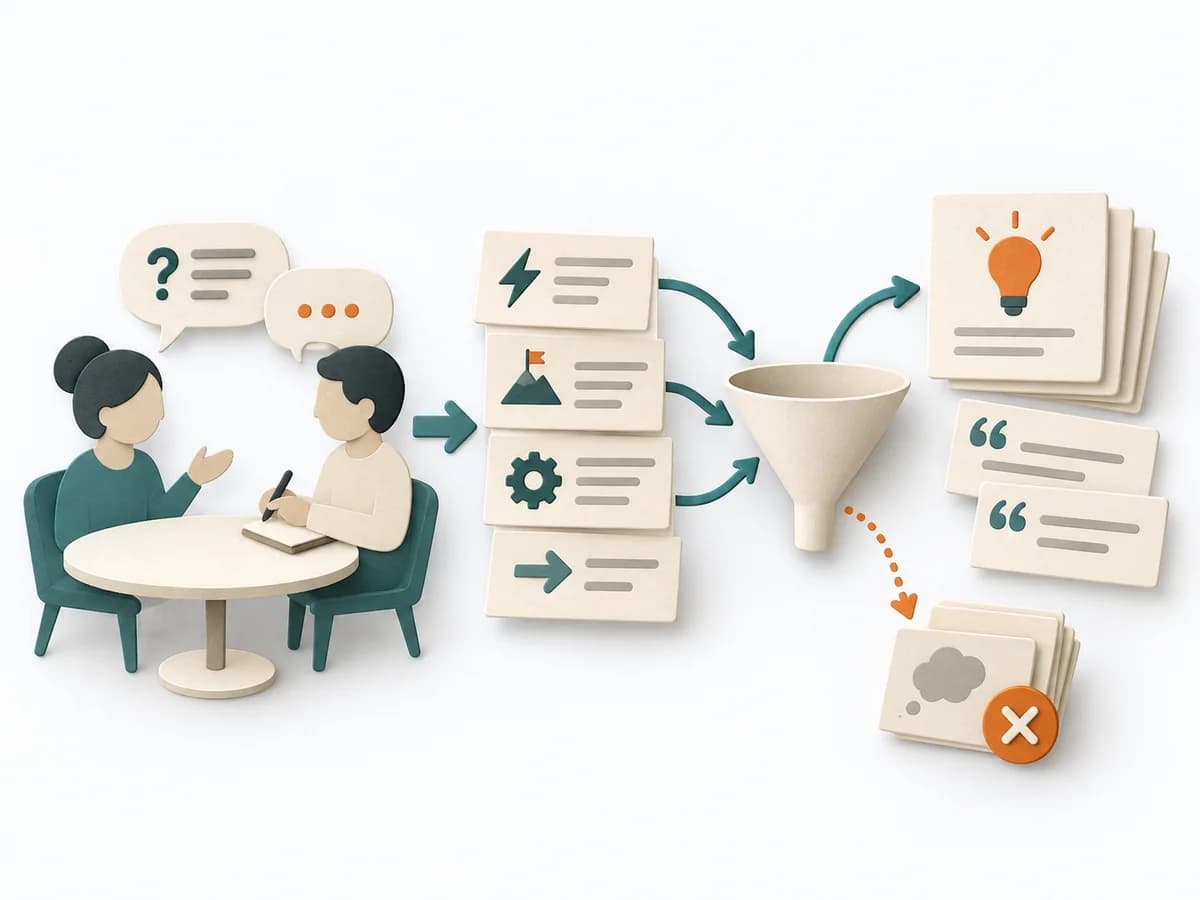
An Opportunity Interview collects specific past experiences to discover unmet needs, obstacles and desires in context. The story provides leads for further discovery.
Fictional example
An Opportunity Interview collects specific past experiences to discover unmet needs, obstacles and desires in context. The story provides leads for further discovery.
Which participant, relevant event and consent? Avoid unnecessary identifying data.
Fictional participant P03 searched for an evening course on Tuesday. Voluntary conversation; notes only agreed. Opening: invite the story of that last search.
Record trigger, actual steps, decisions and outcome.
After a shift-pattern change, P03 opened three course pages, copied times onto paper and called about an unclear end date. No enrolment followed yet.
Record need, scene and participant statement separately from interpretation.
Opportunity: compare every session with changing shifts. Evidence: times were copied and supplemented by phone. Team interpretation: individual pages hinder comparison; still untested.
Which open questions, contrasting cases and further interviews would help?
Next contrast: someone with regular working hours. It remains unclear whether missing dates or shift changes were decisive. No frequency claim from P03.
All example details are fictional and illustrate the application.
Opening
Goal
Story anchor
Inputs for this step
Actions
Output
Story anchor
Has a specific event been selected?
Quality check
Has a specific event been selected?
Pitfall
The team presents its new idea. Set aside the idea and ask about the last situation.
Timing: 5 minutes
Story
Goal
Event sequence
Inputs for this step
Actions
Output
Event sequence
Can actions and context be reconstructed?
Quality check
Can actions and context be reconstructed?
Pitfall
The guide interrupts every revealing detour. Follow the story and fill gaps afterwards.
Timing: 10–15 minutes
Probing
Goal
Need evidence
Inputs for this step
Actions
Output
Need evidence
Is each need tied to a scene?
Quality check
Is each need tied to a scene?
Pitfall
A feature request is accepted as a need. Ask about the occasion and desired progress.
Timing: 5–10 minutes
Snapshot
Goal
Interview snapshot
Inputs for this step
Actions
Output
Interview snapshot
Is each opportunity traceable?
Quality check
Is each opportunity traceable?
Pitfall
One interview is treated as market-size evidence. Mark it as qualitative evidence and investigate other contexts.
Timing: 15 minutes
What comes out at the end
Sketch: what the artifact looks like
Interview snapshot with event sequence, evidenced needs and open questions.
Record date and scope; retain the previous version and reason when changing it.
Recruit someone with a recent relevant experience.
To be confirmed
To be confirmed
Complete cycle Time: 20–30 minutes conversation, 15 minutes synthesis; repeat according to learning needs.
Complete this worksheet on paper or in your own document during the work.
Which participant, relevant event and consent? Avoid unnecessary identifying data.
...
Record trigger, actual steps, decisions and outcome.
...
Record need, scene and participant statement separately from interpretation.
...
Which open questions, contrasting cases and further interviews would help?
...
Answer the prompts with your own information. Explicitly mark unknowns and assumptions.
Teresa Torres: Story-Based Customer Interviews
Expected artifact: Story anchor
Has a specific event been selected?
Entry:
...
Expected artifact: Event sequence
Can actions and context be reconstructed?
Entry:
...
Expected artifact: Need evidence
Is each need tied to a scene?
Entry:
...
Expected artifact: Interview snapshot
Is each opportunity traceable?
Entry:
...
...
Method guide: https://methodatlas.meierhoff-systems.de/en/methods/opportunity-interview/run-sheet
Concrete filled scenario, fictional example
Fictional example for orientation. Counts and timings describe this case and are not universal requirements.
Concrete filled scenario, fictional example
Context and story anchor: Fictional participant P03 searched for an evening course on Tuesday. Voluntary conversation; notes only agreed. Opening: invite the story of that last search.
Event sequence: After a shift-pattern change, P03 opened three course pages, copied times onto paper and called about an unclear end date. No enrolment followed yet.
Opportunities with evidence: Opportunity: compare every session with changing shifts. Evidence: times were copied and supplemented by phone. Team interpretation: individual pages hinder comparison; still untested.
Contrasts and follow-up: Next contrast: someone with regular working hours. It remains unclear whether missing dates or shift changes were decisive. No frequency claim from P03.
Recognize symptoms and steer against them
Quick overview, the full text is in the matching phase in the flow
The team presents its new idea.
Set aside the idea and ask about the last situation.
The guide interrupts every revealing detour.
Follow the story and fill gaps afterwards.
A feature request is accepted as a need.
Ask about the occasion and desired progress.
One interview is treated as market-size evidence.
Mark it as qualitative evidence and investigate other contexts.
When to pause, resolve prerequisites, or choose another approach
Go to the profile for purpose, similar methods, and sources or continue to the next method in the catalog.