Complete firstConcrete subject
Set an urgent theme, open invitation, rooms, and time slots; prepare the proceedings repository.
Without a boundary the run becomes generic and untestable.
A practical method guide: clarify prerequisites and materials, understand the complete process, and look up outputs, pitfalls, and stop criteria.
What needs to be finished first
Set an urgent theme, open invitation, rooms, and time slots; prepare the proceedings repository.
Facilitator · participants · hosts or session owners · scribe
What needs to be ready before start
Guiding question, visible agenda, work surfaces, timer, and result repository
Facilitator · participants · hosts or session owners · scribe
Set an urgent theme, open invitation, rooms, and time slots; prepare the proceedings repository. Prepare real cases, sources, and boundaries.
Half a day to two days.
Create a workspace with Marketplace frame · Session proposals · Agenda · Session reports · Proceedings; keep example values separate from live data.
The one question this method answers
Which topics must participants put on the agenda themselves to act on the theme?
Phases with goal, actions, output and pitfall
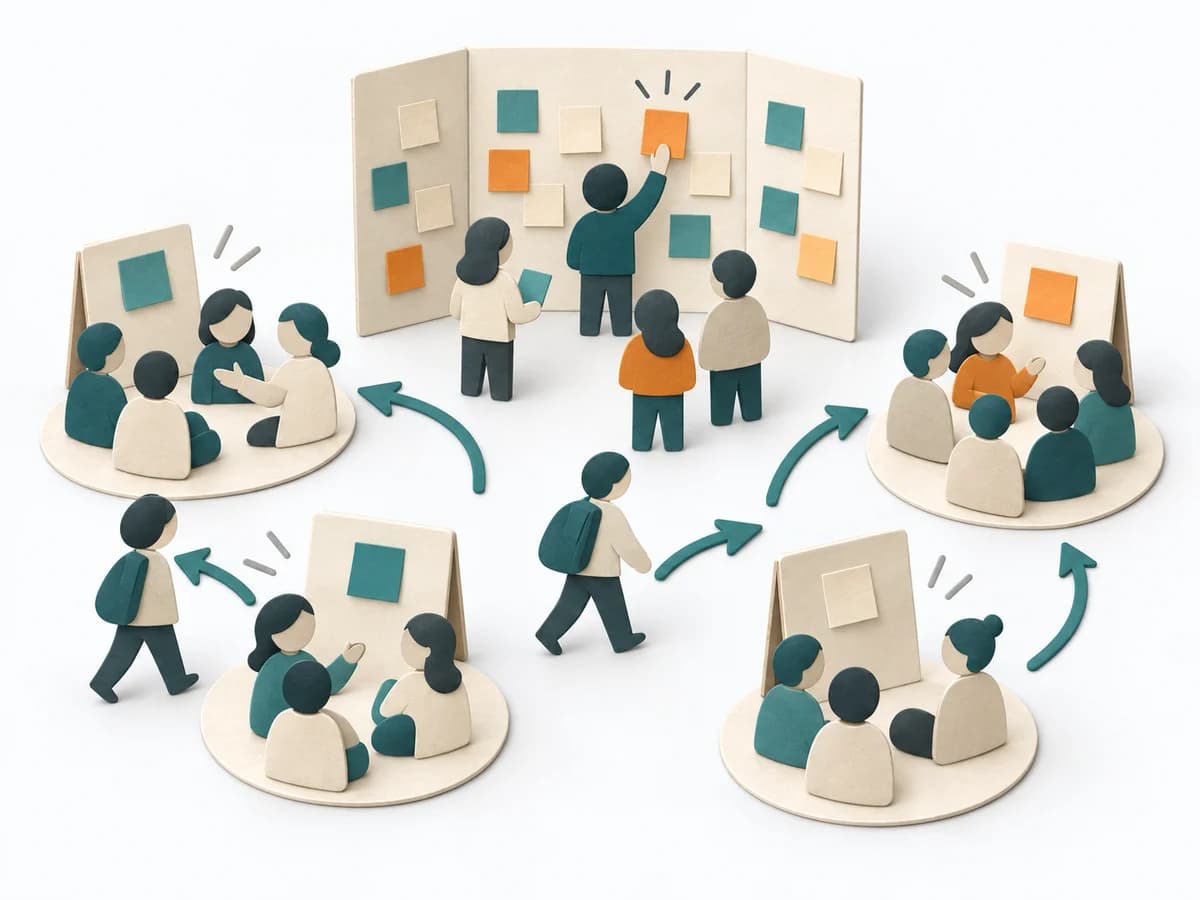
Die Teilnehmenden setzen selbst Schwerpunkte, bilden dazu Sessions und wechseln dort dorthin, wo ihre Aufmerksamkeit am meisten Nutzen verspricht. So entsteht ein offenes Arbeitsfeld, in dem relevante Fragen statt vorgefertigter Programmpunkte die Energie lenken.
Fictional example
Fictional values are assigned to explicit method fields.
| Session | Time | Room | Host | Working question | Proceedings | Next step |
|---|---|---|---|---|---|---|
| Slots and capacityTrack session proposal with time, room, host, question, result, and follow-up. | 10:00 | Elbe | Lea | How do we link slots to real warehouse capacity? | Three bottlenecks, board photo | Pilot eight slots on 4 Nov, Lea |
| Express pickupTrack session proposal with time, room, host, question, result, and follow-up. | 11:15 | Alster | Murat | Which express cases justify interruption? | Four case types and one open data question | Review 30 cases by 27 Oct, Cem |
All details are fictional.
Frame
Goal
Marketplace frame: Explain the theme, invitation, available spaces, and hard time boundaries.
Inputs for this step
Actions
Output
Marketplace frame
Explain the theme, invitation, available spaces, and hard time boundaries
Quality check
Are theme, invitation, time boundaries, and law of two feet explained?
Pitfall
When the law of two feet is not explained, participants stay in the wrong sessions out of politeness. Explain the theme, invitation, time boundaries, and the law of two feet explicitly before the marketplace.
Timing: Use the time needed within the overall frame; close the step only after its check passes.
Proposals
Goal
Session proposals: Participants propose sessions with title, question, and host.
Inputs for this step
Actions
Output
Session proposals
Participants propose sessions with title, question, and host
Quality check
Does each proposal have a title, working question, and accountable host?
Pitfall
When a proposal names only a title without a working question, interested people do not know what to expect. Require a title, a concrete working question, and an accountable host for every proposal.
Timing: Use the time needed within the overall frame; close the step only after its check passes.
Marketplace
Goal
Agenda: Place session proposals into time slots and rooms together.
Inputs for this step
Actions
Output
Agenda
Place session proposals into time slots and rooms together
Quality check
Is each proposal assigned to exactly one room and time slot?
Pitfall
When several proposals claim the same room or time slot, the start turns chaotic. Assign proposals to rooms and time slots together and visibly before sessions begin.
Timing: Use the time needed within the overall frame; close the step only after its check passes.
Sessions
Goal
Session reports: Participants choose and move between sessions based on learning or contribution, and document results.
Inputs for this step
Actions
Output
Session reports
Participants choose and move between sessions based on learning or contribution, and document results
Quality check
Does every session create an accessible report with insights and open points?
Pitfall
When participants stay in a session out of politeness although they neither learn nor contribute, they waste everyone's time. Actively encourage moving on per the law of two feet and have every session documented.
Timing: Use the time needed within the overall frame; close the step only after its check passes.
Proceedings
Goal
Proceedings: Publish session reports and consolidate next steps with owners.
Inputs for this step
Actions
Output
Proceedings
Publish session reports and consolidate next steps with owners
Quality check
Are proceedings published and actions assigned an owner and date?
Pitfall
When session reports disappear after the day, insights and commitments are lost. Publish the proceedings promptly and assign every action an owner and date.
Timing: Use the time needed within the overall frame; close the step only after its check passes.
What comes out at the end
Sketch: what the artifact looks like
Proceedings with evidence, open points, owner, and review.
Record date, owner, source state, and review date; preserve earlier versions.
Plan subject, participation, complete flow, and review.
To be confirmed
To be confirmed
Complete run Time: Half a day to two days.
Complete this worksheet on paper or in your own document during the work.
| Session | Time | Room | Host | Working question | Proceedings | Next step |
|---|---|---|---|---|---|---|
| Slots and capacity | ||||||
| Express pickup |
The blank worksheet contains prompts only.
Reference source · original teaching example
Expected artifact: Marketplace frame
Explain the theme, invitation, available spaces, and hard time boundaries
Entry:
...
Expected artifact: Session proposals
Participants propose sessions with title, question, and host
Entry:
...
Expected artifact: Agenda
Place session proposals into time slots and rooms together
Entry:
...
Expected artifact: Session reports
Participants choose and move between sessions based on learning or contribution, and document results
Entry:
...
Expected artifact: Proceedings
Publish session reports and consolidate next steps with owners
Entry:
...
...
Method guide: https://methodatlas.meierhoff-systems.de/en/methods/open-space-technology/run-sheet
Concrete filled scenario, fictional example
Fictional example for orientation. Counts and timings describe this case and are not universal requirements.
Concrete filled scenario, fictional example
| Session | Time | Room | Host | Working question | Proceedings | Next step |
|---|---|---|---|---|---|---|
| Slots and capacity | 10:00 | Elbe | Lea | How do we link slots to real warehouse capacity? | Three bottlenecks, board photo | Pilot eight slots on 4 Nov, Lea |
| Express pickup | 11:15 | Alster | Murat | Which express cases justify interruption? | Four case types and one open data question | Review 30 cases by 27 Oct, Cem |
Recognize symptoms and steer against them
Quick overview, the full text is in the matching phase in the flow
When the law of two feet is not explained, participants stay in the wrong sessions out of politeness.
Explain the theme, invitation, time boundaries, and the law of two feet explicitly before the marketplace.
When a proposal names only a title without a working question, interested people do not know what to expect.
Require a title, a concrete working question, and an accountable host for every proposal.
When several proposals claim the same room or time slot, the start turns chaotic.
Assign proposals to rooms and time slots together and visibly before sessions begin.
When participants stay in a session out of politeness although they neither learn nor contribute, they waste everyone's time.
Actively encourage moving on per the law of two feet and have every session documented.
When session reports disappear after the day, insights and commitments are lost.
Publish the proceedings promptly and assign every action an owner and date.
When to pause, resolve prerequisites, or choose another approach
Go to the profile for purpose, similar methods, and sources or continue to the next method in the catalog.