Complete firstBounded subject
The scope and purpose of MORT Analysis are stated as a concrete question.
Without scope, MORT investigation record becomes arbitrary.
A practical method guide: clarify prerequisites and materials, understand the complete process, and look up outputs, pitfalls, and stop criteria.
What needs to be finished first
The scope and purpose of MORT Analysis are stated as a concrete question.
secured event chronology, interviews and artefacts, MORT diagram and definitions manual and domain decision makers are available.
What needs to be ready before start
secured event chronology, interviews and artefacts, MORT diagram and definitions manual, shared workspace, source links, and decision log.
Lead investigator · safety/domain experts · worker representatives · management liaison
Collect secured event chronology, interviews and artefacts, MORT diagram and definitions manual in advance and mark open assumptions.
Several days to weeks
Prepare MORT tree with evidence-based branch assessment and causal linkage visibly and calibrate assessment terms before starting.
The one question this method answers
Which barrier, task, and management factors enabled or failed to prevent the event?
Phases with goal, actions, output and pitfall
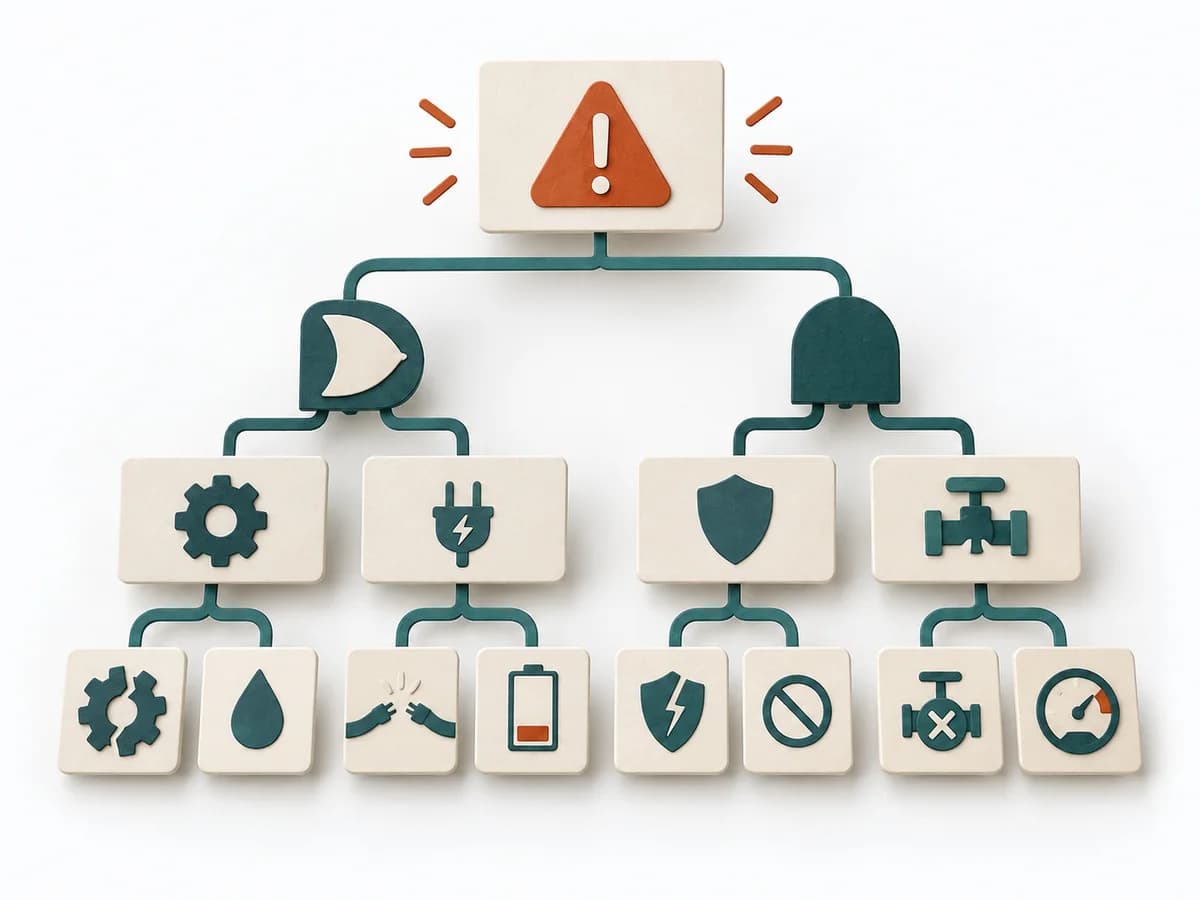
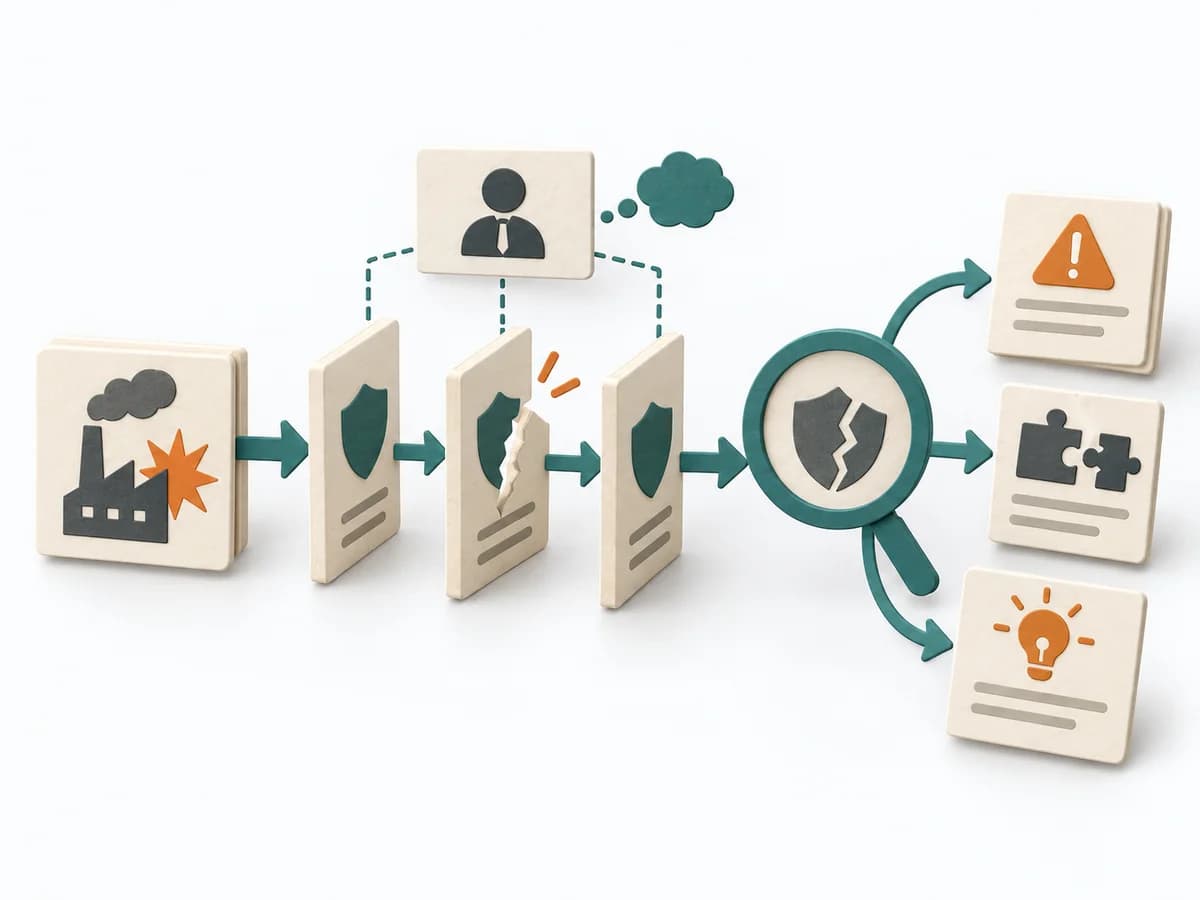
MORT is a comprehensive fault tree for events and management systems. Analysts test branches against evidence and mark adequate, less-than-adequate, or not applicable.
Fictional worked example
MORT tree with evidence-based branch assessment and causal linkage as a precise working structure with a fictional example.
Event · loss · boundary
Pump damage, six-hour shutdown.
Path · definition · status
Bypass control: LTA.
Source · finding · uncertainty
Register without owner; interview + document.
System change · owner · effectiveness test
Bypass tag + review; audit after 30 days.
The example demonstrates the domain logic of MORT Analysis; worksheets remain blank.
Establish event
Goal
Produce event basis so the core question “Which barrier, task, and management factors enabled or failed to prevent the event?” can be answered with stronger support.
Inputs for this step
Actions
Output
event basis
event basis · source · uncertainty · next decision
Quality check
Are facts, statements, and interpretation separated?
Pitfall
MORT branches are rated from conjecture or completed without a risk-relevant scope. Stabilise chronology and evidence register first, prioritise branches, and use unknown rather than invented ratings.
Timing: 10–20 minutes
Select branches
Goal
Produce analysis tree so the core question “Which barrier, task, and management factors enabled or failed to prevent the event?” can be answered with stronger support.
Inputs for this step
Actions
Output
analysis tree
analysis tree · source · uncertainty · next decision
Quality check
Is every branch defined through the manual?
Pitfall
MORT branches are rated from conjecture or completed without a risk-relevant scope. Stabilise chronology and evidence register first, prioritise branches, and use unknown rather than invented ratings.
Timing: 10–20 minutes
Evaluate
Goal
Produce rated MORT so the core question “Which barrier, task, and management factors enabled or failed to prevent the event?” can be answered with stronger support.
Inputs for this step
Actions
Output
rated MORT
rated MORT · source · uncertainty · next decision
Quality check
Does every rating have a source and rationale?
Pitfall
MORT branches are rated from conjecture or completed without a risk-relevant scope. Stabilise chronology and evidence register first, prioritise branches, and use unknown rather than invented ratings.
Timing: 10–20 minutes
Correct system
Goal
Produce corrective plan so the core question “Which barrier, task, and management factors enabled or failed to prevent the event?” can be answered with stronger support.
Inputs for this step
Actions
Output
corrective plan
corrective plan · source · uncertainty · next decision
Quality check
Do actions address barrier and management system?
Pitfall
MORT branches are rated from conjecture or completed without a risk-relevant scope. Stabilise chronology and evidence register first, prioritise branches, and use unknown rather than invented ratings.
Timing: 10–20 minutes
What comes out at the end
Sketch: what the artifact looks like
Versioned MORT investigation record with date, sources, owners, and next review.
Retain date, source, assumption state, and decision for every version of MORT investigation record.
Plan MORT Analysis around its domain steps and the concrete decision question.
To be confirmed
To be confirmed
Full initiative Time: Several days to weeks
Complete this worksheet on paper or in your own document during the work.
Event · loss · boundary
...
Path · definition · status
...
Source · finding · uncertainty
...
System change · owner · effectiveness test
...
Enter only real input, sources, and decisions.
U.S. Department of Energy: MORT User's Manual
Expected artifact: event basis
event basis · source · uncertainty · next decision
Entry:
...
Expected artifact: analysis tree
analysis tree · source · uncertainty · next decision
Entry:
...
Expected artifact: rated MORT
rated MORT · source · uncertainty · next decision
Entry:
...
Expected artifact: corrective plan
corrective plan · source · uncertainty · next decision
Entry:
...
...
Method guide: https://methodatlas.meierhoff-systems.de/en/methods/mort-analysis/run-sheet
Concrete filled scenario, fictional example
Fictional example for orientation. Counts and timings describe this case and are not universal requirements.
Concrete filled scenario, fictional example
Top event: pump damage and six-hour shutdown. Barrier: interlock bypassed during maintenance without a visible tag. Task: restart check lacked a removal step. Management: bypass register had no owner or review. Corrections address tagging, check, and governance; individual blame is not treated as the system cause.
Recognize symptoms and steer against them
Quick overview, the full text is in the matching phase in the flow
MORT branches are rated from conjecture or completed without a risk-relevant scope.
Stabilise chronology and evidence register first, prioritise branches, and use unknown rather than invented ratings.
MORT branches are rated from conjecture or completed without a risk-relevant scope.
Stabilise chronology and evidence register first, prioritise branches, and use unknown rather than invented ratings.
MORT branches are rated from conjecture or completed without a risk-relevant scope.
Stabilise chronology and evidence register first, prioritise branches, and use unknown rather than invented ratings.
MORT branches are rated from conjecture or completed without a risk-relevant scope.
Stabilise chronology and evidence register first, prioritise branches, and use unknown rather than invented ratings.
When to pause, resolve prerequisites, or choose another approach
Go to the profile for purpose, similar methods, and sources or continue to the next method in the catalog.