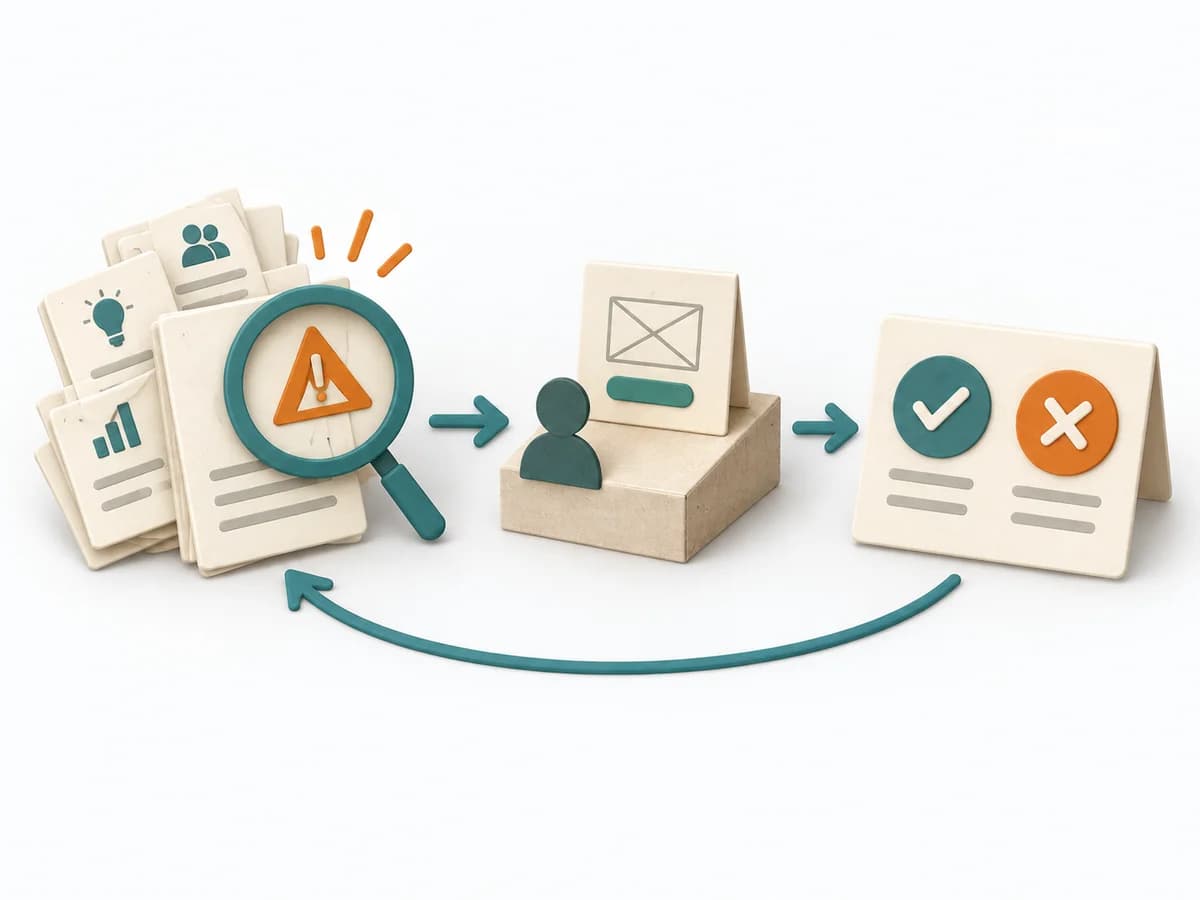
Complete firstOne product bet
A clear scope, initial audience, and decision question are known.
Without scope, several bets mix and the fields become generic.
A practical method guide: clarify prerequisites and materials, understand the complete process, and look up outputs, pitfalls, and stop criteria.
What needs to be finished first
A clear scope, initial audience, and decision question are known.
Observations, interviews, or planned access to affected people exist or are marked as gaps.
What needs to be ready before start
Lean Canvas template with nine fields, notes, pens, existing observations, and a place for hypothesis tests.
A facilitator protects scope and hypothesis status. Participants bring customer, product, and economic perspectives. An owner follows up on tests.
Gather customer signals, known alternatives, initial costs, and possible channels.
45 to 90 minutes for a first draft. Validation and experiments are planned separately.
Use one surface per bet. Mark statements as fact, assumption, or open question. Leave missing fields empty or name the knowledge gap.
The one question this method answers
Which assumptions about problem, segment, solution, and economics must we test next?
Phases with goal, actions, output and pitfall
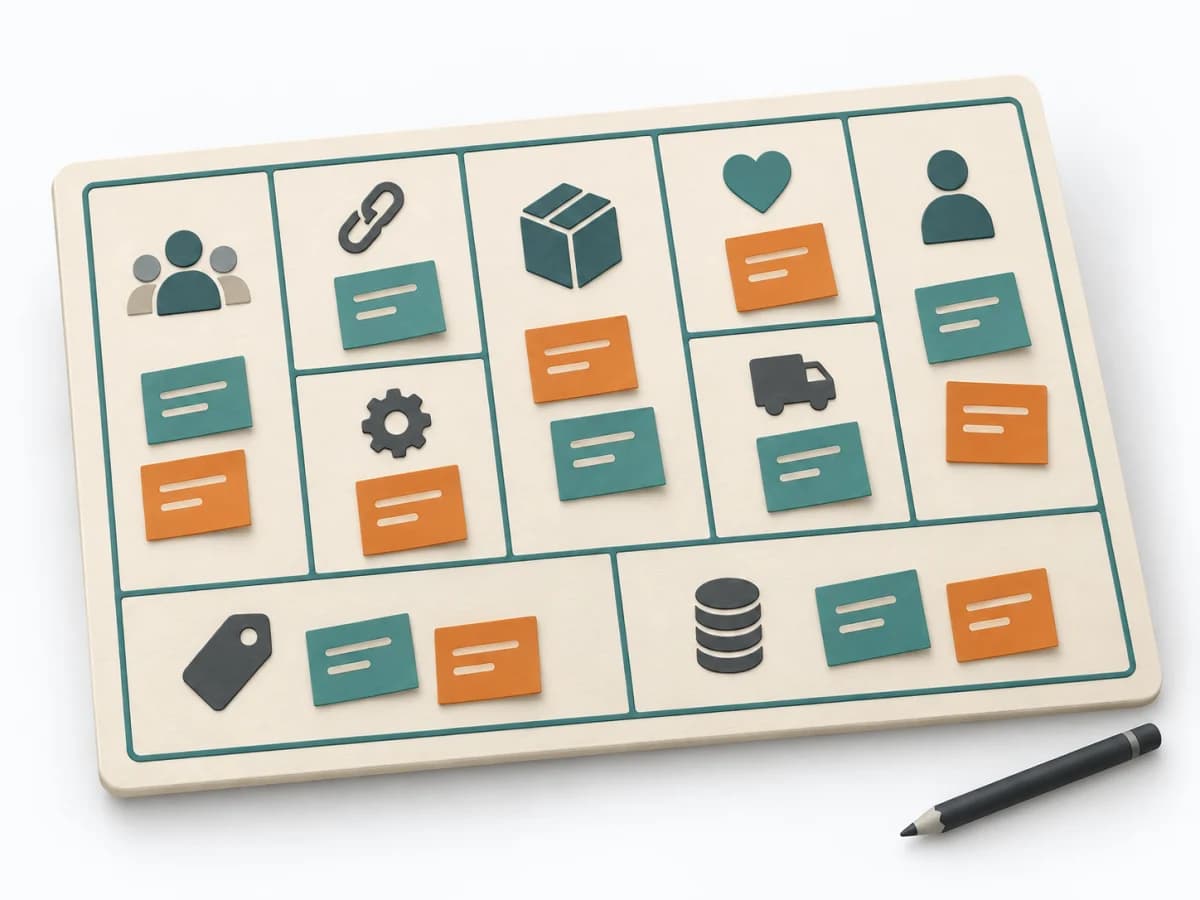
Lean Canvas places problem, customer segments, solution, and business assumptions in nine fields. Each statement remains a hypothesis until suitable evidence supports it.
Fictional neighborhood tool-lending example
Nine canonical core fields for an early product bet.
Which unresolved problems matter for the segment?
Fictional: Rare use often does not justify buying a tool.
Which minimum solution addresses the prioritized problem?
Fictional: Checked tools with simple pickup.
What concrete progress do you promise the segment?
Fictional: The right tool is available nearby.
What is hard to copy and already plausible?
Leave blank if no real advantage is evidenced.
Who experiences the problem most strongly? Who are the early adopters?
Fictional: Households with a renovation date soon as early searchers.
Which few signals show behavior or learning?
Fictional: Searches, pickups, and repeat use.
How will you reach the segment for learning and delivery?
Fictional: Neighborhood groups and local meeting places.
Which major costs apply to this bet?
Fictional: Maintenance, support, and storage.
Which revenue assumption applies to this bet?
Fictional: A possible fee per lending transaction.
Scope
Goal
A testable frame is defined.
Inputs for this step
Actions
Output
Bounded product bet and segment
One version covers one bet.
Quality check
The segment is narrower than a whole market. Early adopters are described as people with an early need or search.
Pitfall
The canvas speaks about several audiences at once. Choose one audience and park other variants as separate versions.
Timing: 10–15 minutes
Problem

Goal
Problem hypotheses are separated from solution ideas.
Inputs for this step
Actions
Output
Prioritized problem hypotheses and alternatives
Missing evidence remains visible as a hypothesis.
Quality check
Problems describe an affected state. Alternatives include doing nothing and manual paths.
Pitfall
Problem fields already contain features. Extract the feature and describe the state it should change.
Timing: 15–20 minutes
Solution
Goal
Solution, value, and differentiation are linked as hypotheses.
Inputs for this step
Actions
Output
Solution sketch with value proposition
Unbacked statements remain assumptions.
Quality check
The solution addresses a prioritized problem. Unfair advantage is more than an easily copied feature.
Pitfall
The UVP promises technical properties instead of customer value. Rewrite it around the progress the segment should make.
Timing: 15–20 minutes
Economics

Goal
The bet shows how it could be reached, measured, and sustained.
Inputs for this step
Actions
Output
Connected operating and learning assumptions
Do not present unsupported numbers as forecasts.
Quality check
Metrics show behavior or learning rather than only reach. Costs and revenues refer to the same bet.
Pitfall
Many metrics hide the one learning question. Reduce to signals that enable a next decision.
Timing: 15–20 minutes
Risks

Goal
A small experiment backlog with decision criteria is ready.
Inputs for this step
Actions
Output
Prioritized hypotheses and experiment backlog
The canvas starts learning; it is not proof.
Quality check
The first test addresses a critical uncertainty. Signal and decision criterion are observable.
Pitfall
The team treats completed fields as a validated business model. Write hypothesis status and planned evidence next to critical statements.
Timing: 15–20 minutes
What comes out at the end
Sketch: what the artifact looks like
Dated Lean Canvas with nine fields, evidence status, critical hypotheses, and a prioritized experiment backlog.
Each version gets a date, scope, and owner. New evidence creates a new version or linked change.
Prepare a first canvas draft or the check of a critical hypothesis.
To be confirmed
To be confirmed
Work on one product bet Time: 45 to 90 minutes for the draft; tests separate
Complete this worksheet on paper or in your own document during the work.
Which unresolved problems matter for the segment?
...
Which minimum solution addresses the prioritized problem?
...
What concrete progress do you promise the segment?
...
What is hard to copy and already plausible?
...
Who experiences the problem most strongly? Who are the early adopters?
...
Which few signals show behavior or learning?
...
How will you reach the segment for learning and delivery?
...
Which major costs apply to this bet?
...
Which revenue assumption applies to this bet?
...
Expected artifact: Bounded product bet and segment
One version covers one bet.
Entry:
...
Expected artifact: Prioritized problem hypotheses and alternatives
Missing evidence remains visible as a hypothesis.
Entry:
...
Expected artifact: Solution sketch with value proposition
Unbacked statements remain assumptions.
Entry:
...
Expected artifact: Connected operating and learning assumptions
Do not present unsupported numbers as forecasts.
Entry:
...
Expected artifact: Prioritized hypotheses and experiment backlog
The canvas starts learning; it is not proof.
Entry:
...
...
Method guide: https://methodatlas.meierhoff-systems.de/en/methods/lean-canvas/run-sheet
Concrete filled scenario, fictional example
Fictional example for orientation. Counts and timings describe this case and are not universal requirements.
Concrete filled scenario, fictional example
Bet: Households with occasional needs borrow checked tools close to home.
Problem: Buying and storing tools is poor value for rare use. Alternative: Hardware store, neighbor, or doing nothing.
Hypothesis: Reliable pickup matters more than maximum variety. This is unproven.
Next test: Run a small manually supported lending round and observe searches, pickups, and repeat use.
Recognize symptoms and steer against them
Quick overview, the full text is in the matching phase in the flow
The canvas speaks about several audiences at once.
Choose one audience and park other variants as separate versions.
Problem fields already contain features.
Extract the feature and describe the state it should change.
The UVP promises technical properties instead of customer value.
Rewrite it around the progress the segment should make.
Many metrics hide the one learning question.
Reduce to signals that enable a next decision.
The team treats completed fields as a validated business model.
Write hypothesis status and planned evidence next to critical statements.
When to pause, resolve prerequisites, or choose another approach
Go to the profile for purpose, similar methods, and sources or continue to the next method in the catalog.