Complete firstClear boundary
Secure stability, sponsor, scope, baseline, target, and team before the event; clarify safety and operating boundaries.
Without a boundary, cases, periods, or variables become mixed.
A practical method guide: clarify prerequisites and materials, understand the complete process, and look up outputs, pitfalls, and stop criteria.
What needs to be finished first
Secure stability, sponsor, scope, baseline, target, and team before the event; clarify safety and operating boundaries.
Stable baseline process, gemba data, target measures, materials for immediate tests, standard-work forms, and follow-up board
What needs to be ready before start
Stable baseline process, gemba data, target measures, materials for immediate tests, standard-work forms, and follow-up board
Sponsor · event lead · frontline team · process owner · safety/quality · data owner
Secure stability, sponsor, scope, baseline, target, and team before the event; clarify safety and operating boundaries.
Typically five days plus 30/60-day follow-up; one to two weeks of preparation.
Prepare a workspace with Prepare · Gemba · Target · Implement · Standardise; separate example from live data.
The one question this method answers
Which measurable process improvement can the frontline team implement, test, and standardise at the gemba within days?
Phases with goal, actions, output and pitfall
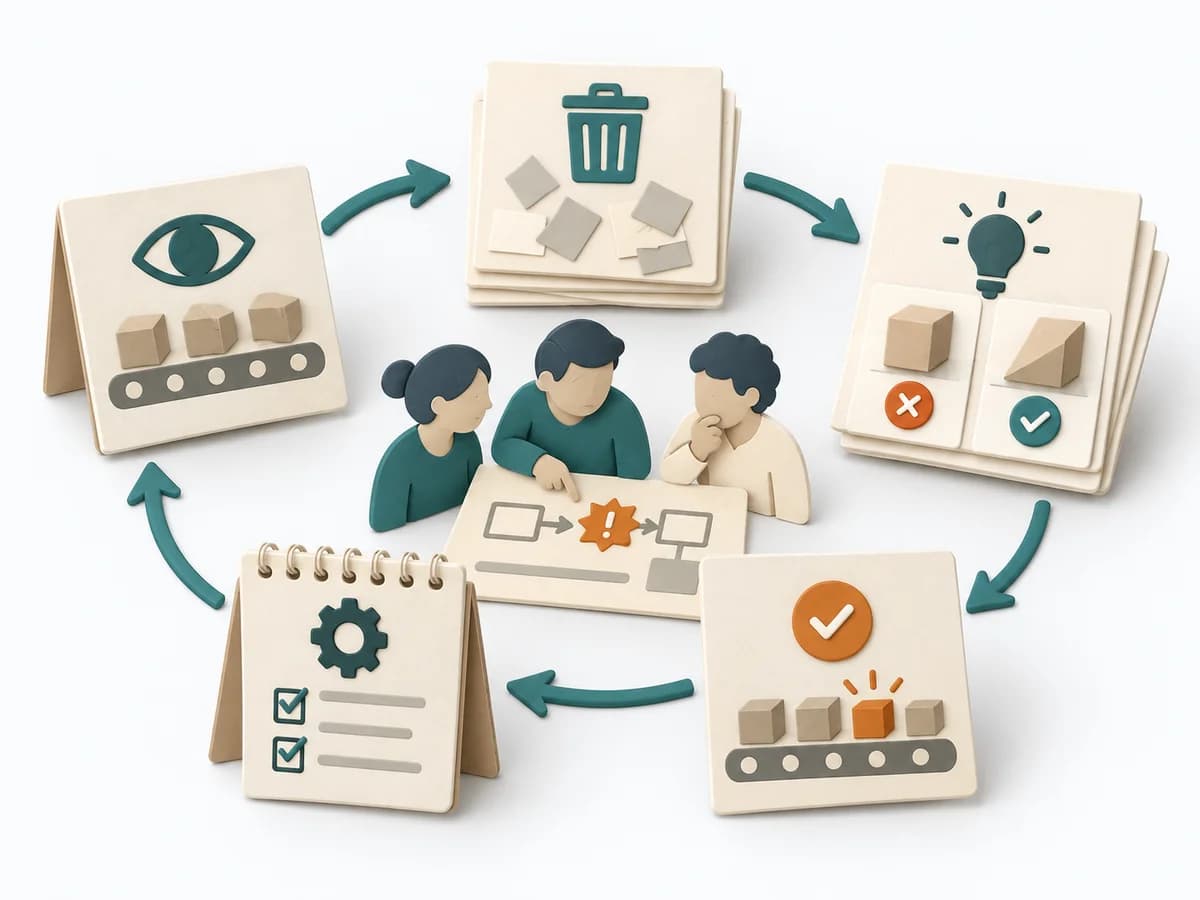
Ein klarer Ausschnitt des Arbeitsflusses wird intensiv betrachtet, sodass Probleme nicht abstrakt bleiben. Kleine Experimente zeigen direkt, welche Änderung Reibung reduziert und welche nur kosmetisch wirkt. Der Gewinn liegt in der kurzen Distanz zwischen Beobachtung, Anpassung und neuem Standard.
Fictional example
Fictional values show the actual method fields.
Clarify scope, baseline, target, team, materials, and decision authority before the event.
Scope Saturday handoff; p80 18→12 minutes; Ops sponsor; Warehouse, Support, Booking; no safety trade-offs.
Observe current work at the place; make steps, waiting, motion, inventory, and problems visible.
32 handoffs: seven-minute search, two return walks, 11 units waiting before handoff.
Examine waste and causes; design target condition, hypotheses, and daily experiments.
Sort units by slot; one-way flow; target search <2 minutes and WIP max 8.
Build changes immediately, test safely in real work, measure, and adjust daily.
Rack labels and slot cart built; 24 real handoffs: search 1.6 minutes, no wrong unit.
Capture best confirmed flow as standard work; train, assign owner, and set follow-up.
Slot cart, scan sequence, WIP8 documented; shift training; Lea owns; 30/60-day review.
All values are fictional.
Prepare
Goal
Event charter: Clarify scope, baseline, target, team, materials, and decision authority before the event.
Inputs for this step
Actions
Output
Event charter
Clarify scope, baseline, target, team, materials, and decision authority before the event.
Quality check
Are the process stable, target measurable, and required authorities present?
Pitfall
Event starts on an unstable process without baseline. Stabilise or reduce scope; close charter and data before day 1.
Timing: One to two weeks
Gemba
Goal
Current state: Observe current work at the place; make steps, waiting, motion, inventory, and problems visible.
Inputs for this step
Actions
Output
Current state
Observe current work at the place; make steps, waiting, motion, inventory, and problems visible.
Quality check
Is current state based on direct observation and measurement?
Pitfall
Conference-room assumptions replace real work. Walk process with operators, time work, and mark deviations.
Timing: Day 1
Target
Goal
Target condition: Examine waste and causes; design target condition, hypotheses, and daily experiments.
Inputs for this step
Actions
Output
Target condition
Examine waste and causes; design target condition, hypotheses, and daily experiments.
Quality check
Does the target link measurable effect to a concrete work change?
Pitfall
Brainstorming produces many ideas without target or cause. Aim a few tests at observed obstacles and target measure.
Timing: Day 2
Implement
Goal
Tested flow: Build changes immediately, test safely in real work, measure, and adjust daily.
Inputs for this step
Actions
Output
Tested flow
Build changes immediately, test safely in real work, measure, and adjust daily.
Quality check
Was real work tested for safety, quality, and delivery?
Pitfall
Team only writes an action plan for later. Implement during the event and escalate blockers daily.
Timing: Days 3–4
Standardise
Goal
New standard: Capture best confirmed flow as standard work; train, assign owner, and set follow-up.
Inputs for this step
Actions
Output
New standard
Capture best confirmed flow as standard work; train, assign owner, and set follow-up.
Quality check
Are takt/sequence/WIP, training, measure, and 30/60-day review clear?
Pitfall
Work returns to the old flow after the event. Display standard at gemba and schedule deviation response and follow-up.
Timing: Day 5 plus follow-up
What comes out at the end
Sketch: what the artifact looks like
Kaizen event report with current state, target condition, implemented tests, measured result, new standard, and follow-up.
Record date, owner, source state, and review date; preserve prior versions.
Set subject, evidence, roles, flow, and review.
To be confirmed
To be confirmed
Whole initiative Time: Typically five days plus 30/60-day follow-up; one to two weeks of preparation.
Complete this worksheet on paper or in your own document during the work.
Clarify scope, baseline, target, team, materials, and decision authority before the event.
...
Observe current work at the place; make steps, waiting, motion, inventory, and problems visible.
...
Examine waste and causes; design target condition, hypotheses, and daily experiments.
...
Build changes immediately, test safely in real work, measure, and adjust daily.
...
Capture best confirmed flow as standard work; train, assign owner, and set follow-up.
...
The blank worksheet contains prompts only.
Reference · original teaching example
Expected artifact: Event charter
Clarify scope, baseline, target, team, materials, and decision authority before the event.
Entry:
...
Expected artifact: Current state
Observe current work at the place; make steps, waiting, motion, inventory, and problems visible.
Entry:
...
Expected artifact: Target condition
Examine waste and causes; design target condition, hypotheses, and daily experiments.
Entry:
...
Expected artifact: Tested flow
Build changes immediately, test safely in real work, measure, and adjust daily.
Entry:
...
Expected artifact: New standard
Capture best confirmed flow as standard work; train, assign owner, and set follow-up.
Entry:
...
...
Method guide: https://methodatlas.meierhoff-systems.de/en/methods/kaizen-event/run-sheet
Concrete filled scenario, fictional example
Fictional example for orientation. Counts and timings describe this case and are not universal requirements.
Concrete filled scenario, fictional example
Scope Saturday handoff; p80 18→12 minutes; Ops sponsor; Warehouse, Support, Booking; no safety trade-offs.
32 handoffs: seven-minute search, two return walks, 11 units waiting before handoff.
Sort units by slot; one-way flow; target search <2 minutes and WIP max 8.
Rack labels and slot cart built; 24 real handoffs: search 1.6 minutes, no wrong unit.
Slot cart, scan sequence, WIP8 documented; shift training; Lea owns; 30/60-day review.
Recognize symptoms and steer against them
Quick overview, the full text is in the matching phase in the flow
Event starts on an unstable process without baseline.
Stabilise or reduce scope; close charter and data before day 1.
Conference-room assumptions replace real work.
Walk process with operators, time work, and mark deviations.
Brainstorming produces many ideas without target or cause.
Aim a few tests at observed obstacles and target measure.
Team only writes an action plan for later.
Implement during the event and escalate blockers daily.
Work returns to the old flow after the event.
Display standard at gemba and schedule deviation response and follow-up.
When to pause, resolve prerequisites, or choose another approach
Go to the profile for purpose, similar methods, and sources or continue to the next method in the catalog.