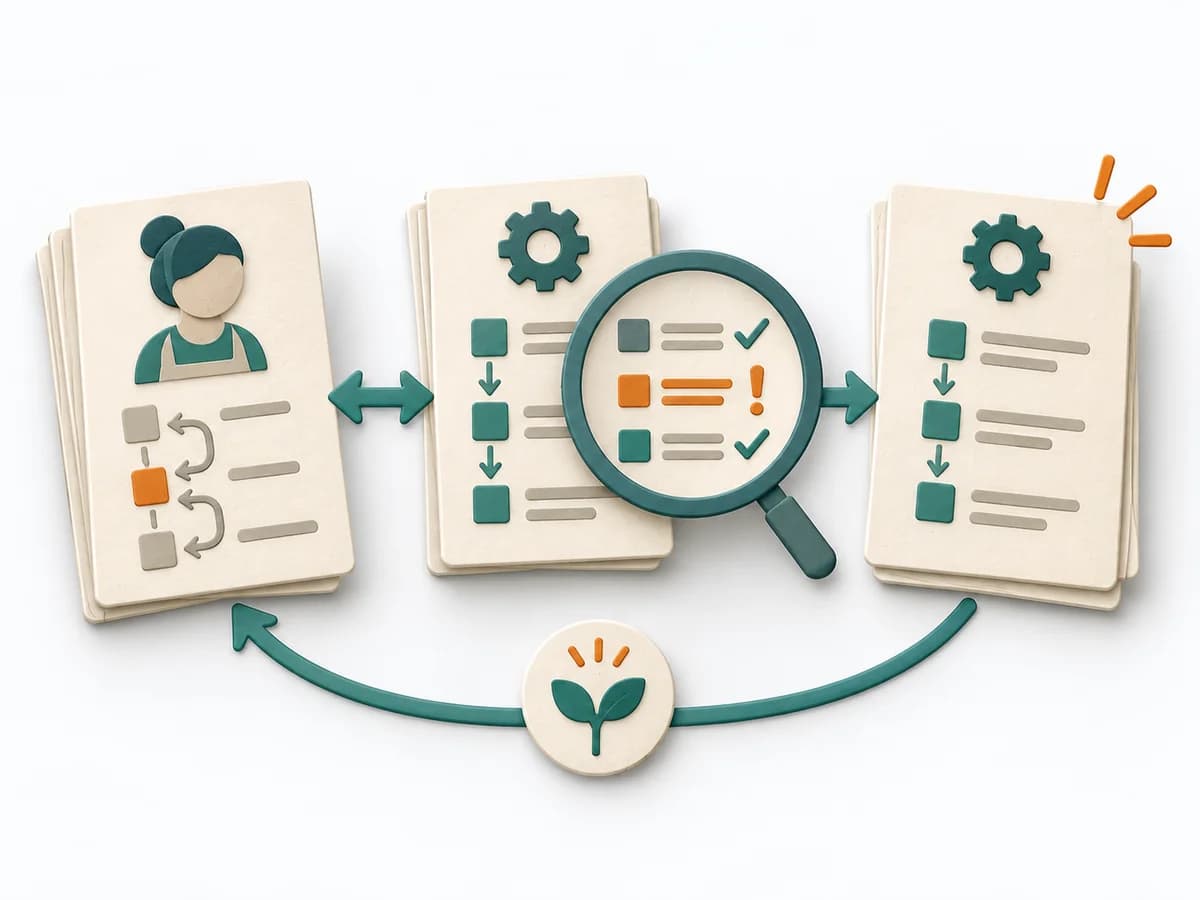
Establish practice
Define cadence, owner, participation, and success signals for a recurring team practice.
Establish the practice
Define cadence, owner, participation, and success signals so the method works as a recurring team practice.
Variant for Operating practice. The plan is derived from method form, method steps, and runsheet.
RunsheetAn operating practice works through repetition. The cadence should be small enough to hold reliably.
The steps describe one repetition and are adjusted after review.
- 1
Day 1: Gemba and current-state assessment
8 hObserve the process on site using stopwatches and spaghetti diagram. Measure cycle times per step, note waste categories (TIMWOOD), and set baseline KPIs for the event week.
OwnerObserve at least three complete process runs, not only one. Variation is an insight, not a disruption. Do not have operators change behavior for observation. - 2
Day 2: Cause analysis and target design
8 hAnalyze top-3 wastes with 5 Whys or fishbone. Sketch the target process on a flipchart with expected cycle-time reduction and concrete standard-work format.
TeamIf the target design needs investment beyond pre-approved budget, this is not a Kaizen candidate; it is a capex project. - 3
Day 3: Pilot and iterate
8 hPilot the target process in the real environment. Capture data per run and adjust together with operators immediately. Run at least three iterations per day.
TeamIf operators revert to the old flow during the pilot, the new standard is either unclear or inconvenient. Tighten it immediately. - 4
Day 4: Embed the new standard
8 hDocument the new standard as a standard work sheet with steps, cycle time, and quality checkpoints. Post visualizations at the workplace. Train all affected shifts.
TeamA standard without visible visualization will decay. At least one poster or screen at workplace, not just a PDF in the wiki. - 5
Day 5: Report-out and sustain plan
6 hPresent before-after KPI comparison. Define sustain plan with audit cadence (for example weekly for first four weeks), owner, and escalation path. Create follow-ups as A3s.
TeamWithout sustain plan, process regresses within 4-6 weeks. Schedule audit findings and escalation paths immediately.
Practice Charter
Copyable charter with purpose, cadence, owner, participation, flow, success signals, and review.
practice-charter.md
Practice Charter: Kaizen Event
Purpose
The method helps clarify workflows, data, causes, and improvements in a concrete way. It looks for patterns, causes, weak points, or bottlenecks and derives measures from them. The result is captured as a Kaizen charter, waste list, and improvement experiments.
Cadence
weekly
Owner and Participation
- Owner: open
- Participants: 4-10
- Mode: synchronous
Flow per Iteration
- Day 1: Gemba and current-state assessment (8 h) Observe the process on site using stopwatches and spaghetti diagram. Measure cycle times per step, note waste categories (TIMWOOD), and set baseline KPIs for the event week.
- Day 2: Cause analysis and target design (8 h) Analyze top-3 wastes with 5 Whys or fishbone. Sketch the target process on a flipchart with expected cycle-time reduction and concrete standard-work format.
- Day 3: Pilot and iterate (8 h) Pilot the target process in the real environment. Capture data per run and adjust together with operators immediately. Run at least three iterations per day.
- Day 4: Embed the new standard (8 h) Document the new standard as a standard work sheet with steps, cycle time, and quality checkpoints. Post visualizations at the workplace. Train all affected shifts.
- Day 5: Report-out and sustain plan (6 h) Present before-after KPI comparison. Define sustain plan with audit cadence (for example weekly for first four weeks), owner, and escalation path. Create follow-ups as A3s.
Success Signals
Kaizen Charter, Waste List, Improvement Experiments, Standard Work Update
Review
4 weeks