Plan my session
Plan a concrete work block with agenda, roles, preparation, and a copyable result artifact.
Session: ICE Scoring
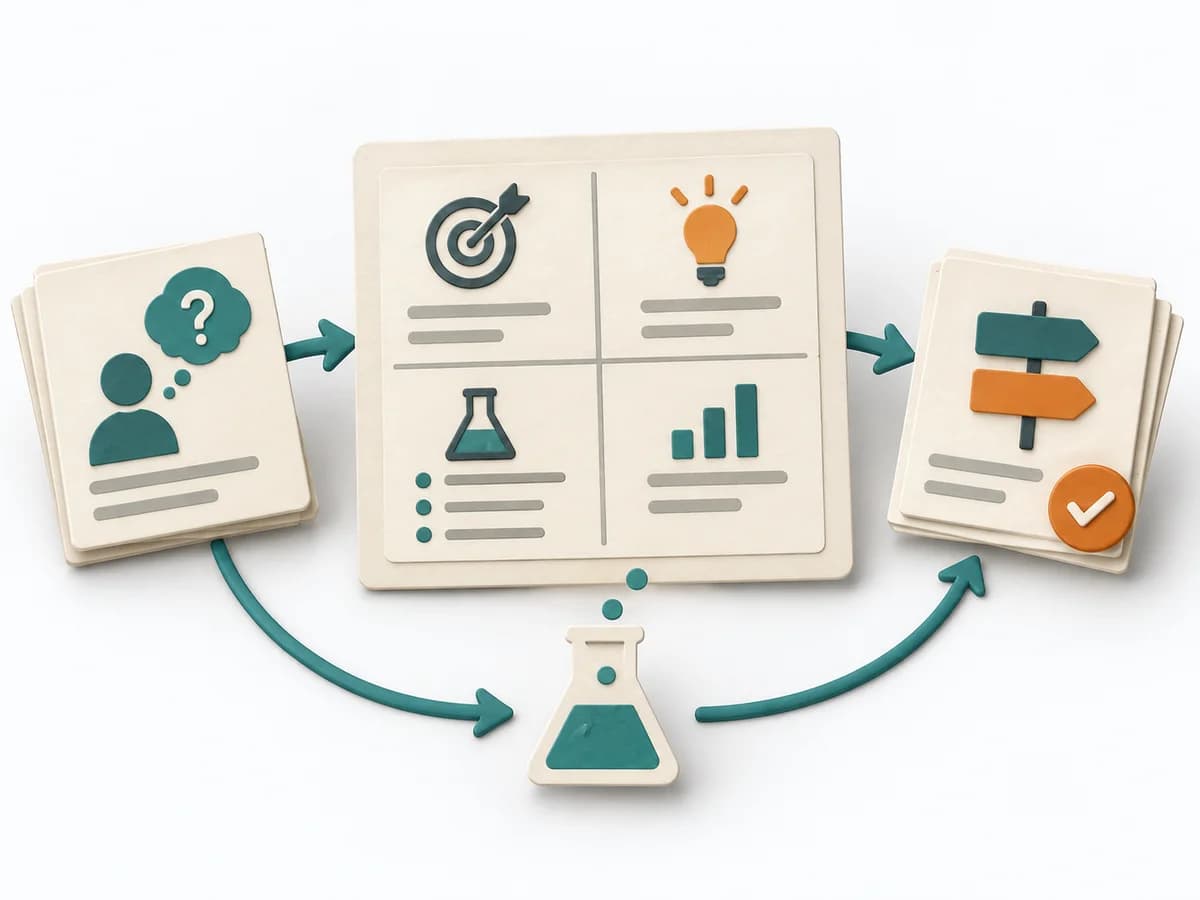
The plan translates the method into a concrete facilitated work block. Your inputs flow directly into the session brief and work artifact.
Method session with 2-8. The plan uses the existing method logic and the runsheet.
RunsheetUse the session for shared understanding. Contributions are collected visibly, assumptions are aligned, and open differences remain traceable in the artifact.
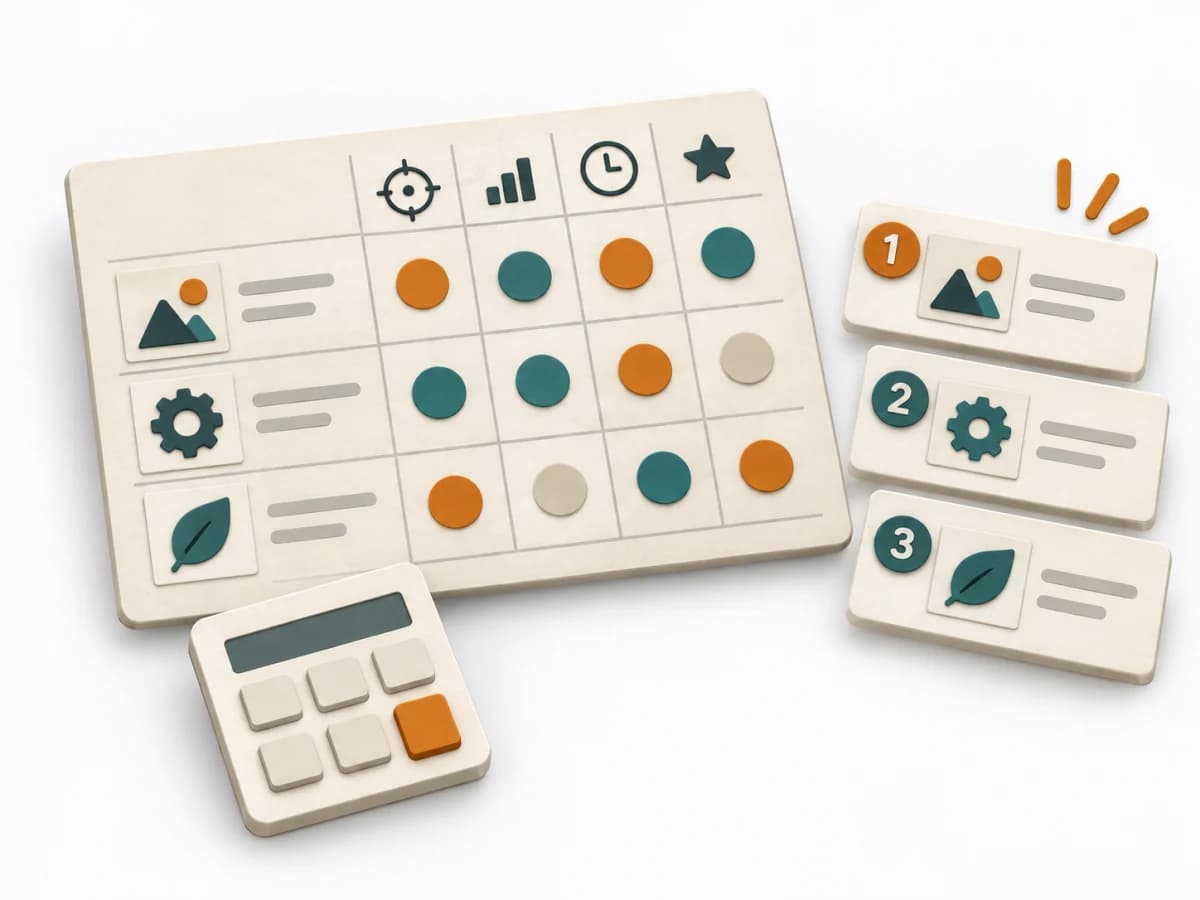
The session works directly toward ICE-Tabelle. After the session, the artifact should be shareable, reviewable, or reusable.
- 1
Phase 1: Calibrate scales
10 minUse three recent experiments as references: one high impact, one low impact, one medium. Make values explicit so each participant applies the same scale. Hint: If no reference experiments exist, anchor to concrete values from the backlog. Otherwise everyone scales against personal gut feel.
FacilitatorICE-Tabelle - 2
Phase 2: Solo rating
15-20 minEach rater assigns I, C, and E per idea alone, without discussion. Do not compute averages; keep individual points visible. Hint: Discussion in this phase distorts distribution. Reveal ratings only after all solo inputs are in.
FacilitatorTop-Ideenliste - 3
Phase 3: Check spread
15 minInspect spread per idea. If a dimension differs by more than 3 points, briefly discuss what each rater sees differently. Keep assumptions explicit; do not force averages. Hint: High spread is information, not a defect. It can indicate different assumptions or knowledge levels.
FacilitatorICE-Tabelle - 4
Phase 4: Score and cut-off
10-15 minCalculate score per idea (I * C * E or average of raters). Set a cut-off, for example top N by score or above a threshold. Allow justified exceptions. Hint: Multiplication amplifies extreme values. If an idea scores below 3 in any dimension, it should usually be excluded rather than rescued by other high dimensions.
OwnerTop-Ideenliste - 5
Publish artifact
10 minCheck the artifact for completeness, define location, set version or status, and name review recipients.
OwnerICE-Tabelle
Session Brief
For invitations, boards, tickets, PR descriptions, or workshop notes.
session-brief.md
Session Brief: ICE Scoring
Goal
Artifact: ICE-Tabelle
Working Question
Which ideas give us the highest learning rate per effort and which should we intentionally exclude?
Context
Current growth goals or outcome context; previous experiments with results for confidence calibration; known capacity per sprint.
Setup
- Format: Method session
- Duration: 30-60 min
- Mode: Workshop or async
- Participants: A facilitator (Growth Lead or PM); 3-6 raters from Product, Engineering, Marketing, or Data; a judge when variance is high.
- Owner: A facilitator (Growth Lead or PM)
- Participation mode: Team round, shared work and alignment
- Outcome logic: Finish artifact
Participation Logic
Use the session for shared understanding. Contributions are collected visibly, assumptions are aligned, and open differences remain traceable in the artifact.
Outcome Logic
The session works directly toward ICE-Tabelle. After the session, the artifact should be shareable, reviewable, or reusable.
Input
Table (idea, hypothesis, I, C, E, score, owner, status); visible scale definitions; example values for 1, 5, and 10 per dimension.
Preparation
Share table, prepare columns I, C, E with 1-10 scale. Set score anchors before start: what is Impact 10 in your context (for example move North Star by 5%), what is Ease 10 (for example <2 days of development).
Agenda
-
Phase 1: Calibrate scales (10 min) Owner: Facilitator Action: Use three recent experiments as references: one high impact, one low impact, one medium. Make values explicit so each participant applies the same scale. Hint: If no reference experiments exist, anchor to concrete values from the backlog. Otherwise everyone scales against personal gut feel. Output: ICE-Tabelle
-
Phase 2: Solo rating (15-20 min) Owner: Facilitator Action: Each rater assigns I, C, and E per idea alone, without discussion. Do not compute averages; keep individual points visible. Hint: Discussion in this phase distorts distribution. Reveal ratings only after all solo inputs are in. Output: Top-Ideenliste
-
Phase 3: Check spread (15 min) Owner: Facilitator Action: Inspect spread per idea. If a dimension differs by more than 3 points, briefly discuss what each rater sees differently. Keep assumptions explicit; do not force averages. Hint: High spread is information, not a defect. It can indicate different assumptions or knowledge levels. Output: ICE-Tabelle
-
Phase 4: Score and cut-off (10-15 min) Owner: Owner Action: Calculate score per idea (I * C * E or average of raters). Set a cut-off, for example top N by score or above a threshold. Allow justified exceptions. Hint: Multiplication amplifies extreme values. If an idea scores below 3 in any dimension, it should usually be excluded rather than rescued by other high dimensions. Output: Top-Ideenliste
-
Publish artifact (10 min) Owner: Owner Action: Check the artifact for completeness, define location, set version or status, and name review recipients. Output: ICE-Tabelle
Closeout
- Update result artifact: ICE-Tabelle
- Define location, version, and review recipients.
- Define owner, next step, and review date.
Work artifact
Pre-filled starting point based on the matching template.
work-artifact.md
ICE-Tabelle: ICE Scoring
Working Question
Which ideas give us the highest learning rate per effort and which should we intentionally exclude?
Context
Current growth goals or outcome context; previous experiments with results for confidence calibration; known capacity per sprint.
Participants
- Owner: A facilitator (Growth Lead or PM)
- Participants: A facilitator (Growth Lead or PM); 3-6 raters from Product, Engineering, Marketing, or Data; a judge when variance is high.
Input
Table (idea, hypothesis, I, C, E, score, owner, status); visible scale definitions; example values for 1, 5, and 10 per dimension.
Template
ICE Scoring Working Template
Goal
Prioritizes ideas by Impact, Confidence, and Ease.
Context
When and for what do we use this method?
Input
Which data, observations, decisions, or materials are available?
Execution
Short notes along the runsheet.
Output artifacts
- ICE table:
- Top ideas list:
Assumptions and open questions
- ...
Decision / next step
Owner, date, and success signal.
Completion Check
- ICE-Tabelle is complete enough for review:
- Location:
- Version / status:
- Review by:
- Next step:
Next Step
- Review result
- Mark open questions
- Schedule review or decision
ICE Scoring Working Template
View templateCompact working template for ICE Scoring with context, input, output artifacts, and next step.markdown
ice-scoring-working-template.md
Compact working template for ICE Scoring with context, input, output artifacts, and next step.
ICE Scoring Working Template
Goal
Prioritizes ideas by Impact, Confidence, and Ease.
Context
When and for what do we use this method?
Input
Which data, observations, decisions, or materials are available?
Execution
Short notes along the runsheet.
Output artifacts
- ICE table:
- Top ideas list:
Assumptions and open questions
- ...
Decision / next step
Owner, date, and success signal.
- Working question, owner, and target artifact are visible.
- The result fits ICE-Tabelle.
- Include date and raters in the header each scoring round. Do not overwrite old scores; add a new column or snapshot so confidence calibration can be learned over time.
- Open questions are noted as follow-ups.
- The next review or decision point is scheduled.