Complete firstDecidable Issue
The question permits several concrete Positions and falls within the group mandate.
Resolve factual lookups before mapping Positions.
A practical method guide: clarify prerequisites and materials, understand the complete process, and look up outputs, pitfalls, and stop criteria.
What needs to be finished first
The question permits several concrete Positions and falls within the group mandate.
Relevant evidence and opposing perspectives can be introduced.
What needs to be ready before start
Shared map, decision question, known options, evidence, criteria and source links.
Issue owner, participants with distinct perspectives and a mapper who maintains consistent links.
Decision boundary, existing options, known facts and prior partial decisions.
60–120 minutes for an initial map; continue when new arguments emerge
Define the Issue, Position, Pro and Con notation; give every element a stable label and source.
The one question this method answers
Which position answers the Issue most convincingly given the current arguments?
Phases with goal, actions, output and pitfall
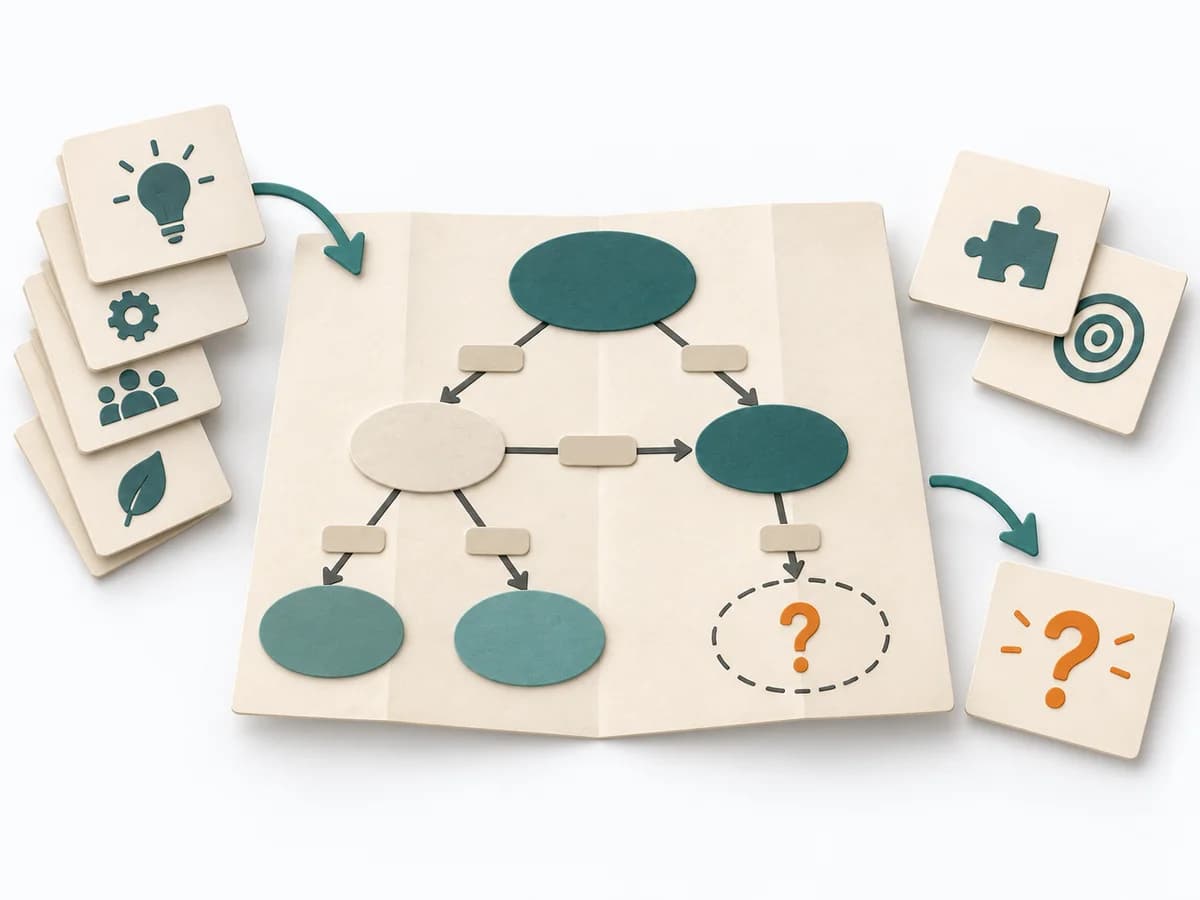
IBIS represents deliberation as a network of Issues, Positions and Arguments. Each position answers a specific issue; pro and con arguments attach to one position. The map preserves what was selected, rejected or left open.
Fictional example
Typed entries keep the question, alternatives, reasons and decision state connected.
What open question must be decided? Add scope, owner and status.
Should the training provider confirm course bookings immediately?
What concrete answers are available? Write one assertion per Position.
A: confirm immediately; B: review manually first.
What reasons support or object to which Position? Add source or assumption status.
Pro A: 78% compliant. Con A: seat limits may be exceeded.
Which decision-relevant sub-questions arise from Positions or Arguments?
Can seat limits be checked automatically before confirmation?
Which Position was selected by whom, under what conditions and with what review trigger?
Pilot A after an automated seat check; review after 100 bookings.
The example is a small excerpt. In a real map, Arguments may generate additional Issues.
Issue

Goal
Bounded Issue
Inputs for this step
Actions
Output
Issue node
Question, scope, owner and status
Quality check
Can at least two distinct answers be stated? Is the question within the mandate?
Pitfall
A wish or solution is recorded as the Issue. Reframe it as an open decision question.
Timing: 10–20 minutes
Positions
Goal
Visible option space
Inputs for this step
Actions
Output
Position nodes
One assertion per Position
Quality check
Does every Position answer the Issue? Are materially different alternatives separate?
Pitfall
Reasons and answers are mixed in one node. Keep the answer as a Position and create separate Arguments.
Timing: 15–25 minutes
Arguments
Goal
Reasoned argument network
Inputs for this step
Actions
Output
Pro and Con Arguments
Claim, target, source and direction
Quality check
Is the direction of every link explicit? Can readers distinguish facts, judgements and assumptions?
Pitfall
One Argument judges several Positions at once. Split it or create a separate link for each Position.
Timing: 25–45 minutes
Sub-Issues
Goal
Visible knowledge gaps
Inputs for this step
Actions
Output
Linked sub-Issues
Question, trigger, owner and due date
Quality check
Could the answer change a Position? Is the origin of the sub-Issue visible?
Pitfall
The map grows with unrelated research questions. Keep only decision-relevant Issues and park the rest elsewhere.
Timing: 10–20 minutes
Status
Goal
Traceable decision state
Inputs for this step
Actions
Output
Statused IBIS map
Decision, rationale, conditions and review
Quality check
Do rejected Positions and Arguments remain readable? Is it clear who decided and when to revisit?
Pitfall
The loudest voice is treated as an implicit decision. Ask the mandated decision maker to confirm and record the decision.
Timing: 10–20 minutes
What comes out at the end
Sketch: what the artifact looks like
Versioned IBIS map containing Issues, Positions, Pro and Con arguments, status and open follow-up questions.
Date every change; preserve earlier positions when an Issue is decided and record rationale.
State one genuinely contested question as an Issue and define the decision boundary.
To be confirmed
To be confirmed
Complete workflow Time: 60–120 minutes for an initial map; continue when new arguments emerge
Complete this worksheet on paper or in your own document during the work.
What open question must be decided? Add scope, owner and status.
...
What concrete answers are available? Write one assertion per Position.
...
What reasons support or object to which Position? Add source or assumption status.
...
Which decision-relevant sub-questions arise from Positions or Arguments?
...
Which Position was selected by whom, under what conditions and with what review trigger?
...
Type entries, assign stable IDs and document the direction of every relationship.
Expected artifact: Issue node
Question, scope, owner and status
Entry:
...
Expected artifact: Position nodes
One assertion per Position
Entry:
...
Expected artifact: Pro and Con Arguments
Claim, target, source and direction
Entry:
...
Expected artifact: Linked sub-Issues
Question, trigger, owner and due date
Entry:
...
Expected artifact: Statused IBIS map
Decision, rationale, conditions and review
Entry:
...
...
Method guide: https://methodatlas.meierhoff-systems.de/en/methods/ibis/run-sheet
Concrete filled scenario, fictional example
Fictional example for orientation. Counts and timings describe this case and are not universal requirements.
Concrete filled scenario, fictional example
Issue: Should the training provider confirm course bookings immediately?
Position A: Confirm immediately. Pro: Participants gain certainty; 78% of last-quarter bookings met the rules. Con: Corporate seat limits may be exceeded.
Position B: Review manually first. Pro: Special terms remain controlled. Con: Current review takes a median 26 hours and causes abandonment.
Follow-up Issue: Can seat limits be checked automatically before confirmation?
Status: Position A is selected for a pilot if the seat-limit check runs first. Owner: Mira; review after 100 bookings.
Recognize symptoms and steer against them
Quick overview, the full text is in the matching phase in the flow
A wish or solution is recorded as the Issue.
Reframe it as an open decision question.
Reasons and answers are mixed in one node.
Keep the answer as a Position and create separate Arguments.
One Argument judges several Positions at once.
Split it or create a separate link for each Position.
The map grows with unrelated research questions.
Keep only decision-relevant Issues and park the rest elsewhere.
The loudest voice is treated as an implicit decision.
Ask the mandated decision maker to confirm and record the decision.
When to pause, resolve prerequisites, or choose another approach
Go to the profile for purpose, similar methods, and sources or continue to the next method in the catalog.