Complete firstClear scope
One concrete process where work happens; agree purpose, participation, and respectful boundaries in advance.
Without a boundary, data, perspectives, or flows become mixed.
A practical method guide: clarify prerequisites and materials, understand the complete process, and look up outputs, pitfalls, and stop criteria.
What needs to be finished first
One concrete process where work happens; agree purpose, participation, and respectful boundaries in advance.
Relevant people and sources can be included.
What needs to be ready before start
Shared workspace, accessible sources, and a decision log.
Host · observing leader · frontline staff
Clarify the question, timeframe, data access, roles, and known uncertainties in advance.
30–60 minutes for one bounded walk; repetition may be needed to verify observations.
Create a shared version. Label facts, assumptions, and decisions separately.
The one question this method answers
What is happening where work occurs, and which process question should we investigate together?
Phases with goal, actions, output and pitfall
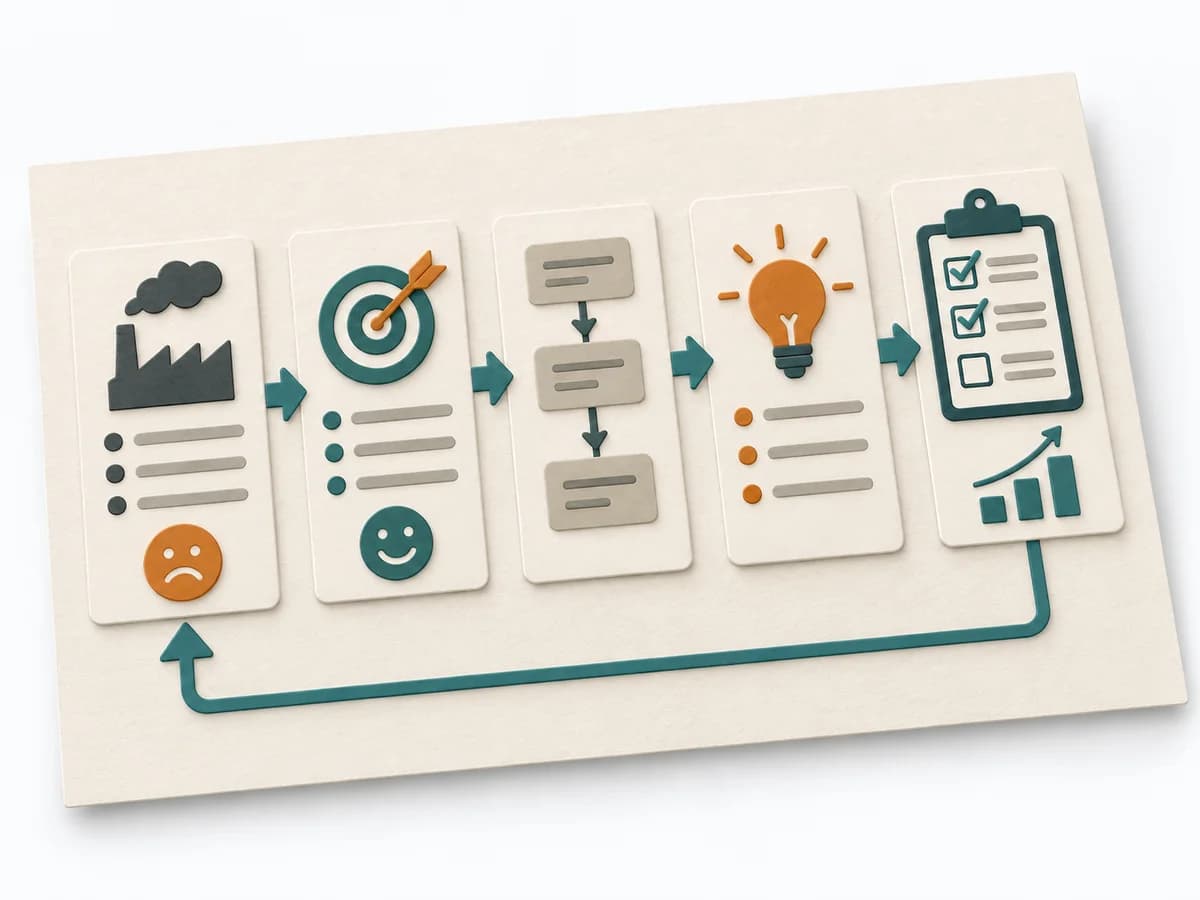
Gemba Walk uses respectful observation at the place of work to show how work actually flows and where the process needs support. Conversations with the people involved help interpret observations and investigate suitable improvements.
Fictional worked example
Learn through respectful direct observation how value-creating work actually flows and where the process needs support.
Record why the walk is happening and which process is in scope.
Understand order handoff to reduce customer wait.
Record observed steps, waits, and tools.
3 of 8 cases lack delivery address; two systems reconciled manually.
Capture perspectives with consent and context.
Fictional staff voice: “The address is often in the note but not the form.”
Agree what the team will investigate or what obstacle to remove.
Inspect data origin with the team; infer no cause or blame from one observation.
Fictional walk in digital order processing: three of eight sampled cases wait for a missing delivery address; staff reconcile it across two systems. Observation: duplicate entry. No cause is claimed yet; team will inspect where address data originates.
Purpose

Goal
Do people know why the work is being observed?
Inputs for this step
Actions
Output
Agreed observation purpose and process boundary
Agreed observation purpose and process boundary
Quality check
Do people know why the work is being observed?
Pitfall
Walk becomes personnel inspection Observe process conditions and ask with genuine curiosity.
Timing: Part of the agreed work block; research may be separate.
Observe
Goal
Is the note observation rather than judgment?
Inputs for this step
Actions
Output
Evidence-led process observations
Evidence-led process observations
Quality check
Is the note observation rather than judgment?
Pitfall
Proposed fix biases observation Describe purpose, process, and actual work first; separate hypotheses.
Timing: Part of the agreed work block; research may be separate.
Ask

Goal
Are the people doing the work speaking for themselves?
Inputs for this step
Actions
Output
Attributed frontline perspectives
Attributed frontline perspectives
Quality check
Are the people doing the work speaking for themselves?
Pitfall
Staff cannot speak candidly Be transparent about purpose and respond respectfully to observations.
Timing: Part of the agreed work block; research may be separate.
Follow-up

Goal
Is the observation kept separate from individual performance evaluation?
Inputs for this step
Actions
Output
Validated learning and support question
Validated learning and support question
Quality check
Is the observation kept separate from individual performance evaluation?
Pitfall
One walk is generalized Label the observation as a sample and plan repetition or data review.
Timing: Part of the agreed work block; research may be separate.
What comes out at the end
Sketch: what the artifact looks like
Versioned result with question, evidence, open issues, next action, ownership, and review date.
Record date, scope, sources, and changes. Preserve earlier observations.
Prepare Gemba Walk with a clear question, roles, and sources.
To be confirmed
To be confirmed
Plan the full method Time: Set according to scope and available evidence
Complete this worksheet on paper or in your own document during the work.
Record why the walk is happening and which process is in scope.
...
Record observed steps, waits, and tools.
...
Capture perspectives with consent and context.
...
Agree what the team will investigate or what obstacle to remove.
...
Blank worksheet: start with a bounded question. Enter observed facts only, mark assumptions, and record open questions and sources.
How to Go to the Gemba · Lean Enterprise Institute
Expected artifact: Agreed observation purpose and process boundary
Agreed observation purpose and process boundary
Entry:
...
Expected artifact: Evidence-led process observations
Evidence-led process observations
Entry:
...
Expected artifact: Attributed frontline perspectives
Attributed frontline perspectives
Entry:
...
Expected artifact: Validated learning and support question
Validated learning and support question
Entry:
...
...
Method guide: https://methodatlas.meierhoff-systems.de/en/methods/gemba-walk/run-sheet
Concrete filled scenario, fictional example
Fictional example for orientation. Counts and timings describe this case and are not universal requirements.
Concrete filled scenario, fictional example
Fictional walk in digital order processing: three of eight sampled cases wait for a missing delivery address; staff reconcile it across two systems. Observation: duplicate entry. No cause is claimed yet; team will inspect where address data originates.
All names and values are invented for illustration. Unresolved explanations remain questions.
Recognize symptoms and steer against them
Quick overview, the full text is in the matching phase in the flow
Walk becomes personnel inspection
Observe process conditions and ask with genuine curiosity.
Proposed fix biases observation
Describe purpose, process, and actual work first; separate hypotheses.
Staff cannot speak candidly
Be transparent about purpose and respond respectfully to observations.
One walk is generalized
Label the observation as a sample and plan repetition or data review.
When to pause, resolve prerequisites, or choose another approach
Go to the profile for purpose, similar methods, and sources or continue to the next method in the catalog.