Complete firstDecision-relevant hypothesis
One falsifiable assumption and the investment depending on it are named.
Without decision relevance, the team measures activity rather than risk reduction.
A practical method guide: clarify prerequisites and materials, understand the complete process, and look up outputs, pitfalls, and stop criteria.
What needs to be finished first
One falsifiable assumption and the investment depending on it are named.
Population, data capture, privacy, and stop authority are clear.
What needs to be ready before start
Canvas, hypothesis source, baseline, audience access, event definitions, privacy review, and decision log.
Experiment owner · Product · Research/Analytics · risk or compliance expert
Prepare the hypothesis, investment decision, available population, baseline, and relevant guardrails.
30–45 minutes to design; execution is separate
Record hypothesis, test, primary metric, and threshold in the Experiment Canvas; verify data capture and stop boundary before launch. The Test Card offers the same four core fields for simple tests. Maintain one authoritative plan.
The one question this method answers
Which critical assumption will we test through what observable behaviour, and which pre-set threshold decides?
Phases with goal, actions, output and pitfall
An Experiment Canvas makes the team state what must be true, how it will test the claim, what it will measure, and which threshold triggers a decision. Activity is not evidence; the measure must fit the hypothesis.
Fictional worked example
Eight fields connect assumption, test, measurement, safeguards, and decision.
What must be true?
At least 30% of exposed active project leads start a CSV export.
Which investment depends on this?
Build an interactive prototype above threshold; otherwise revise the value proposition.
Who sees what, for how long?
Fake door for 200 eligible active accounts over 7 days.
Numerator, denominator, segment, window
Unique export starts / exposed active accounts in 7 days.
Which boundary applies before launch?
Success ≥30% with at least 150 exposed active accounts.
When to pause or stop?
Stop above 3% support complaints about the unavailable feature.
Which raw data and quality checks?
Exposure and click events, account segment, bot filter, deviation log.
What did the rule yield and what follows?
32% at n=181; guardrail 1.1%. Build prototype and test usability.
Hypothesis

Goal
Define one decision-relevant, falsifiable assumption.
Inputs for this step
Actions
Output
Testable hypothesis
Audience · behaviour · context · expected outcome
Quality check
Can an outcome clearly weaken the claim?
Pitfall
Several assumptions are bundled into one sentence, making any result ambiguous. Split the claim and select the most consequential assumption.
Timing: 5–10 minutes
Design
Goal
Choose the smallest ethical test that yields enough evidence for the decision.
Inputs for this step
Actions
Output
Test design
Population · intervention · duration · data capture · ethics
Quality check
Does the test directly address the hypothesis?
Pitfall
The team selects a fast opinion test for a hypothesis about actual behaviour. Match evidence strength to the decision and collect behavioural data where needed.
Timing: 10–15 minutes
Measure
Goal
Define a computable primary metric, data basis, and decision threshold.
Inputs for this step
Actions
Output
Measurement rule
Metric · formula · threshold · minimum data · guardrail
Quality check
Can raw data determine success or failure unambiguously?
Pitfall
The threshold is chosen after seeing results, or activity is confused with effect. Freeze and version threshold, denominator, and analysis rule before launch.
Timing: 10–15 minutes
Learn
Goal
Evaluate observed data against the pre-set rule and take the next decision.
Inputs for this step
Actions
Output
Learning card
Data · deviations · result · decision · new assumption
Quality check
Does the decision follow the pre-set rule and evidence strength?
Pitfall
A surprising result is made to fit by changing segments or thresholds after the fact. Label exploratory analysis separately and create a new test for new hypotheses.
Timing: Execution separate; 15–30 minutes analysis
What comes out at the end
Sketch: what the artifact looks like
Versioned Experiment Canvas as the authoritative test plan; record evaluation and next action with a raw-data link in the canvas or in a linked Learning Card.
Retain date, author, source state, and decision status for each revision; do not overwrite earlier results.
Plan Experiment Canvas with real scope, suitable roles, and a clear decision objective.
To be confirmed
To be confirmed
Full learning cycle Time: 30–45 minutes to design; execution is separate
Complete this worksheet on paper or in your own document during the work.
What must be true?
...
Which investment depends on this?
...
Who sees what, for how long?
...
Numerator, denominator, segment, window
...
Which boundary applies before launch?
...
When to pause or stop?
...
Which raw data and quality checks?
...
What did the rule yield and what follows?
...
Strategyzer: Validate Your Ideas with the Test Card
Expected artifact: Testable hypothesis
Audience · behaviour · context · expected outcome
Entry:
...
Expected artifact: Test design
Population · intervention · duration · data capture · ethics
Entry:
...
Expected artifact: Measurement rule
Metric · formula · threshold · minimum data · guardrail
Entry:
...
Expected artifact: Learning card
Data · deviations · result · decision · new assumption
Entry:
...
...
Method guide: https://methodatlas.meierhoff-systems.de/en/methods/experiment-canvas/run-sheet
Concrete filled scenario, fictional example
Fictional example for orientation. Counts and timings describe this case and are not universal requirements.
Concrete filled scenario, fictional example
Fictional example: we believe at least 30% of weekly active project leads will start a CSV export when offered in the results view. Test: clickable fake door for 200 eligible accounts over seven days. Primary metric: unique export starts / exposed active accounts. Success ≥30%; stop if support complaints exceed 3%. Then build a prototype; otherwise revise the value proposition.
Recognize symptoms and steer against them
Quick overview, the full text is in the matching phase in the flow
Several assumptions are bundled into one sentence, making any result ambiguous.
Split the claim and select the most consequential assumption.
The team selects a fast opinion test for a hypothesis about actual behaviour.
Match evidence strength to the decision and collect behavioural data where needed.
The threshold is chosen after seeing results, or activity is confused with effect.
Freeze and version threshold, denominator, and analysis rule before launch.
A surprising result is made to fit by changing segments or thresholds after the fact.
Label exploratory analysis separately and create a new test for new hypotheses.
When to pause, resolve prerequisites, or choose another approach
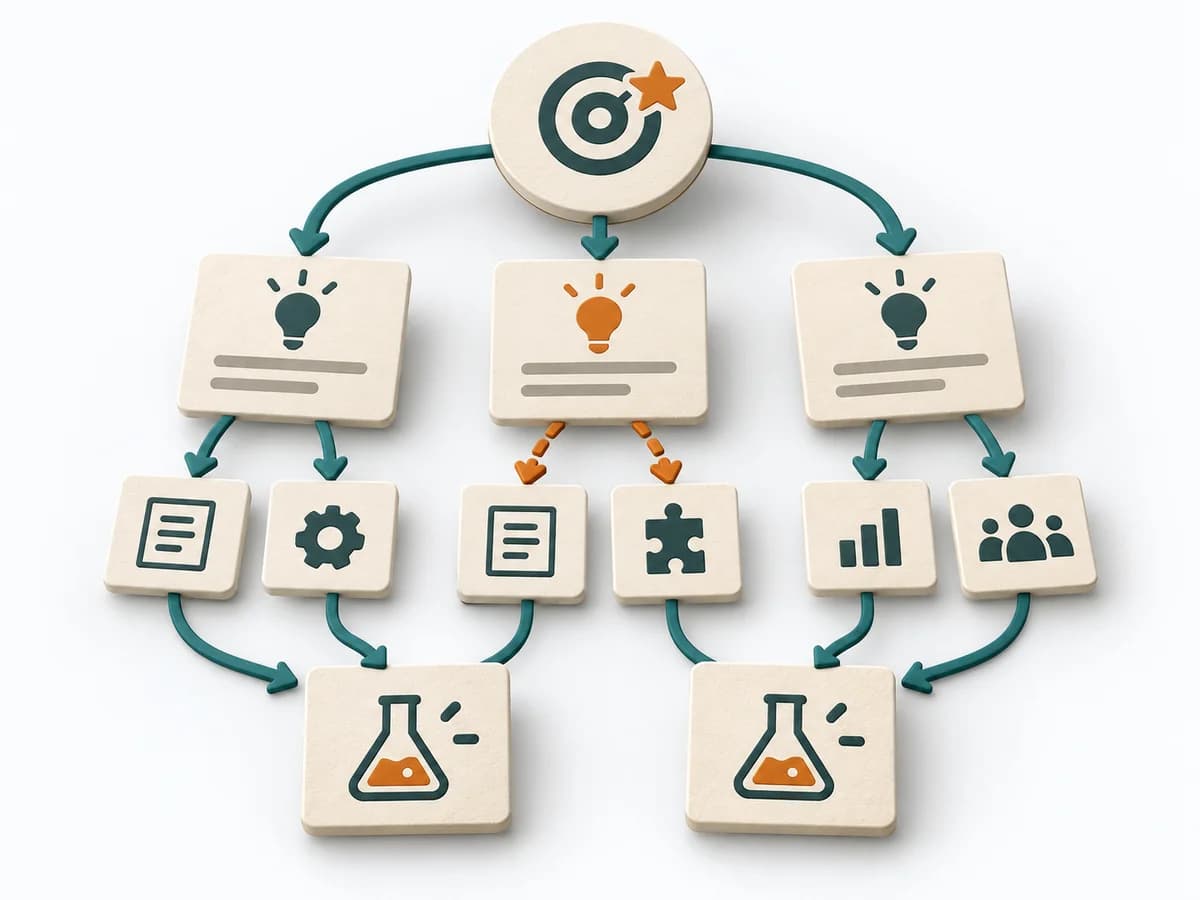
Updates the solution tree with the test's learning and decision outcome.

Reorders the next risky assumption based on the test result.

Condenses the completed test evaluation into observation, insight, and next action while referencing the existing plan.
Go to the profile for purpose, similar methods, and sources or continue to the next method in the catalog.