Complete firstDomain knowledge
Domain experts can explain terms and business rules through real workflows.
Without domain language the result can become a system-box diagram.
A practical method guide: clarify prerequisites and materials, understand the complete process, and look up outputs, pitfalls, and stop criteria.
What needs to be finished first
Domain experts can explain terms and business rules through real workflows.
Representatives of involved teams can confirm dependencies and influence.
What needs to be ready before start
Context cards, integration contracts, team list, arrows with a U/D legend and domain-term notes.
Domain experts, model owners, involved development teams and facilitator.
Collect a domain slice, concrete business workflows, team ownership and known interfaces. Keep current and target views separate.
90–180 minutes for an initial slice; further modelling sessions as needed
Lay out context cards with terms and owners; add a U/D legend and derive connections from concrete integrations.
The one question this method answers
Where do particular models apply and how must their owning teams collaborate?
Phases with goal, actions, output and pitfall
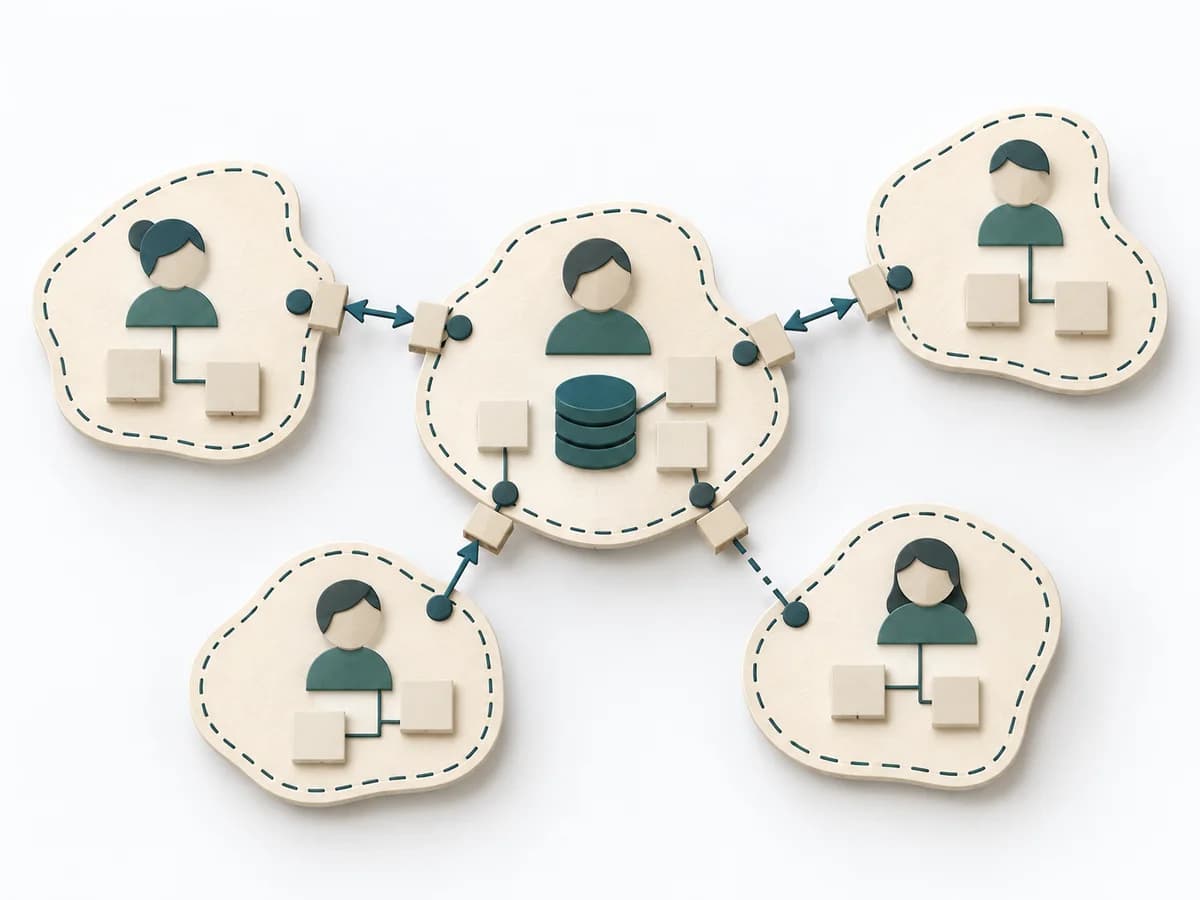
A context map shows bounded contexts with their own domain language and model ownership, plus integration and team relationships. Upstream and downstream describe model dependency, not automatically the direction of a data packet.
Fictional example
A context map shows bounded contexts with their own domain language and model ownership, plus integration and team relationships. Upstream and downstream describe model dependency, not automatically the direction of a data packet.
Record purpose, domain terms, boundaries and owner per context.
Fictional: Catalog (Offering team) manages courses; Enrollment (Participation team) manages seat reservations; Billing (Finance team) manages receivables.
Record contexts, U/D roles, contract, patterns and change coordination.
Catalog U → Enrollment D: course ID and offering via a versioned API. Catalog offers OHS/Published Language; Enrollment translates external statuses through an ACL into its reservation model.
Describe another relationship including influence over the interface.
Enrollment U → Billing D: confirmed enrolment event. Customer/Supplier: Billing can negotiate required billing fields with the Participation team.
Which meaning or responsibility is unclear, who will clarify it and with what evidence?
On cancellation, reservation status differs from receivable status. Both teams review three cancellation cases by Friday and document event rules.
All example details are fictional and illustrate the application.
Contexts
Goal
Context inventory
Inputs for this step
Actions
Output
Context inventory
Does a consistent domain language apply within each boundary?
Quality check
Does a consistent domain language apply within each boundary?
Pitfall
Every microservice becomes a bounded context without examination. Compare model meanings and justify boundaries in domain terms.
Timing: 20–40 minutes
Ownership
Goal
Confirmed ownership
Inputs for this step
Actions
Output
Confirmed ownership
Are ownership and current-state status confirmed?
Quality check
Are ownership and current-state status confirmed?
Pitfall
Desired architecture hides current dependencies. First map contracts and responsibilities actually in use.
Timing: 15–25 minutes
Dependency
Goal
Labelled context relationships
Inputs for this step
Actions
Output
Labelled context relationships
Is the arrow meaning explained in a legend?
Quality check
Is the arrow meaning explained in a legend?
Pitfall
Data flow is confused with influence direction. Label both perspectives separately and check with the teams.
Timing: 20–35 minutes
Patterns
Goal
Justified relationship patterns
Inputs for this step
Actions
Output
Justified relationship patterns
Does the pattern describe actual collaboration and translation?
Quality check
Does the pattern describe actual collaboration and translation?
Pitfall
Patterns become decorative labels without agreement. Clarify consequences for changes, translation and coordination per pattern.
Timing: 20–40 minutes
Risks
Goal
Reviewed map and clarification tasks
Inputs for this step
Actions
Output
Reviewed map and clarification tasks
Does each unresolved relationship have a clarification task?
Quality check
Does each unresolved relationship have a clarification task?
Pitfall
The map immediately triggers a large redesign. First test the highest-risk assumption against a business case.
Timing: 15–30 minutes
What comes out at the end
Sketch: what the artifact looks like
Versioned context map with boundaries, domain terms, owners, directed dependencies, relationship patterns and open modelling questions.
Record date and scope; retain the previous version and reason when changing it.
Collect a domain slice, concrete business workflows, team ownership and known interfaces. Keep current and target views separate.
To be confirmed
To be confirmed
Complete cycle Time: 90–180 minutes for an initial slice; further modelling sessions as needed
Complete this worksheet on paper or in your own document during the work.
Record purpose, domain terms, boundaries and owner per context.
...
Record contexts, U/D roles, contract, patterns and change coordination.
...
Describe another relationship including influence over the interface.
...
Which meaning or responsibility is unclear, who will clarify it and with what evidence?
...
Answer the prompts with your own information. Explicitly mark unknowns and assumptions.
Expected artifact: Context inventory
Does a consistent domain language apply within each boundary?
Entry:
...
Expected artifact: Confirmed ownership
Are ownership and current-state status confirmed?
Entry:
...
Expected artifact: Labelled context relationships
Is the arrow meaning explained in a legend?
Entry:
...
Expected artifact: Justified relationship patterns
Does the pattern describe actual collaboration and translation?
Entry:
...
Expected artifact: Reviewed map and clarification tasks
Does each unresolved relationship have a clarification task?
Entry:
...
...
Method guide: https://methodatlas.meierhoff-systems.de/en/methods/domain-context-map/run-sheet
Concrete filled scenario, fictional example
Fictional example for orientation. Counts and timings describe this case and are not universal requirements.
Concrete filled scenario, fictional example
Context inventory: Fictional: Catalog (Offering team) manages courses; Enrollment (Participation team) manages seat reservations; Billing (Finance team) manages receivables.
Relationship 1: Catalog U → Enrollment D: course ID and offering via a versioned API. Catalog offers OHS/Published Language; Enrollment translates external statuses through an ACL into its reservation model.
Relationship 2: Enrollment U → Billing D: confirmed enrolment event. Customer/Supplier: Billing can negotiate required billing fields with the Participation team.
Open modelling question: On cancellation, reservation status differs from receivable status. Both teams review three cancellation cases by Friday and document event rules.
Recognize symptoms and steer against them
Quick overview, the full text is in the matching phase in the flow
Every microservice becomes a bounded context without examination.
Compare model meanings and justify boundaries in domain terms.
Desired architecture hides current dependencies.
First map contracts and responsibilities actually in use.
Data flow is confused with influence direction.
Label both perspectives separately and check with the teams.
Patterns become decorative labels without agreement.
Clarify consequences for changes, translation and coordination per pattern.
The map immediately triggers a large redesign.
First test the highest-risk assumption against a business case.
When to pause, resolve prerequisites, or choose another approach
Go to the profile for purpose, similar methods, and sources or continue to the next method in the catalog.