Complete firstConcrete subject
Define research question, duration, and triggering event; plan privacy, support, and a short pilot.
Without a boundary the run becomes generic and untestable.
A practical method guide: clarify prerequisites and materials, understand the complete process, and look up outputs, pitfalls, and stop criteria.
What needs to be finished first
Define research question, duration, and triggering event; plan privacy, support, and a short pilot.
Research lead · participants · recorder or analyst · domain decision owner
What needs to be ready before start
Consent, research protocol, secure raw-data store, and analysis surface
Research lead · participants · recorder or analyst · domain decision owner
Define research question, duration, and triggering event; plan privacy, support, and a short pilot. Prepare real cases, sources, and boundaries.
One to four weeks plus exit interviews.
Create a workspace with Study plan · Sample · Piloted template · Diary entries · Longitudinal patterns; keep example values separate from live data.
The one question this method answers
Which recurring experiences, triggers, and changes appear over time beyond a single session?
Phases with goal, actions, output and pitfall
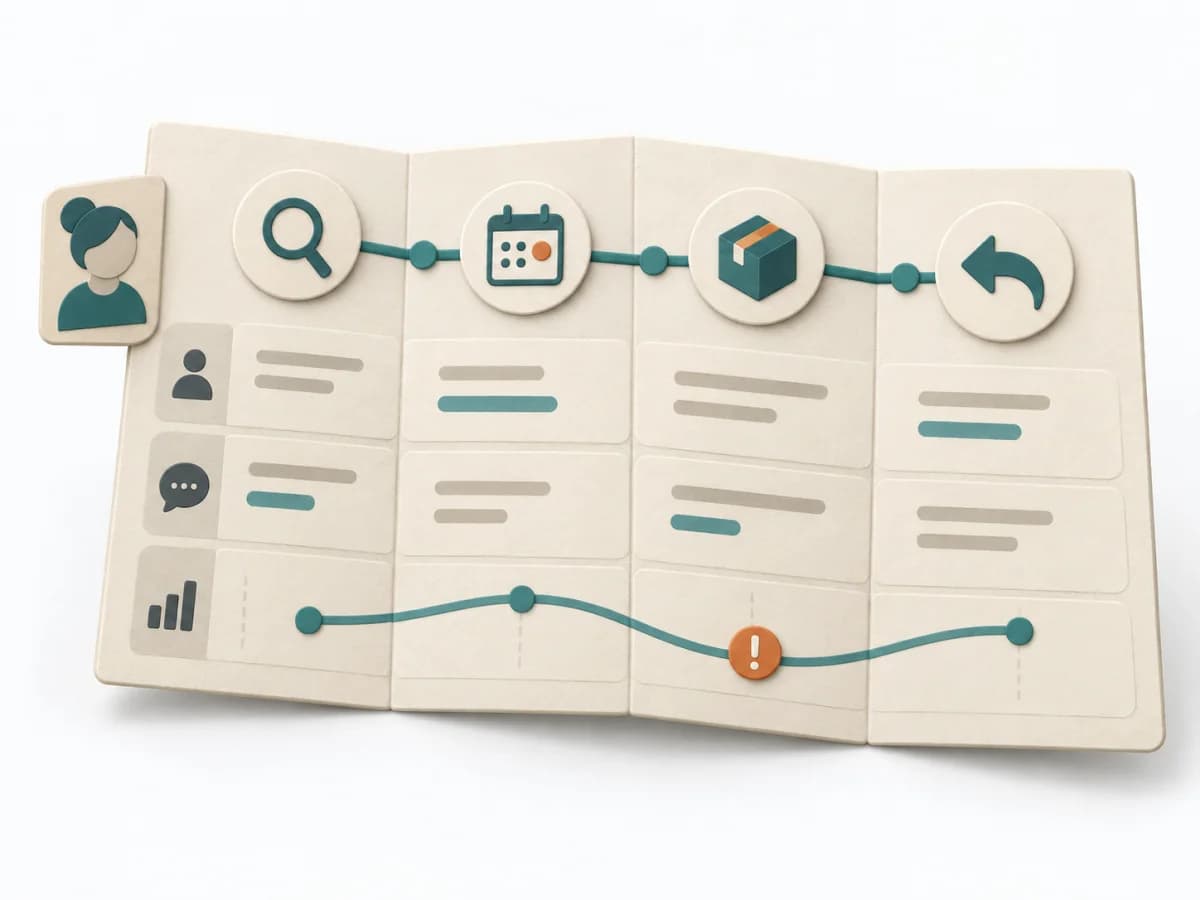
A diary study captures moments close to participants’ lived experience, preserving context and time. Later analysis reveals patterns across duration, change, and repetition in everyday use.
Fictional example
Fictional values are assigned to explicit method fields.
| Entry | Time | Trigger | Action | Experience | Evidence |
|---|---|---|---|---|---|
| MondayRecord a timely diary entry with trigger, action, experience, and evidence. | 08:42 | Part unavailable in the job | Searched chat, then called warehouse | Frustrated; customer waiting | Screenshot of empty inventory |
| ThursdayRecord a timely diary entry with trigger, action, experience, and evidence. | 15:10 | Alternative suggested | Checked compatibility through a photo | Uncertain but faster than Monday | Label photo and six-minute timer |
| TuesdayRecord a timely diary entry with trigger, action, experience, and evidence. | 11:25 | Same part recurs | Reused own photo | Confident; no call needed | Photo ID and completion time |
All details are fictional.
Design

Goal
Study plan: Define research focus, duration, event- or interval-based logging, and privacy.
Inputs for this step
Actions
Output
Study plan
Define research focus, duration, event- or interval-based logging, and privacy
Quality check
Are question, duration, event logic, and privacy explicit?
Pitfall
When duration and event logic stay unclear, participants later do not know when an entry is due. Fix the research focus, duration, entry triggers, and privacy rules clearly before the study starts.
Timing: Use the time needed within the overall frame; close the step only after its check passes.
Template
Goal
Sample: Pilot a diary format with short prompts, timestamps, and optional media evidence.
Inputs for this step
Actions
Output
Piloted template
Pilot a diary format with short prompts, timestamps, and optional media evidence
Quality check
Is the template short, understandable in daily use, and piloted with real entries?
Pitfall
When the template uses long prompts or jargon, participants abandon entries in daily life. Pilot the format with short prompts and timestamps against real test entries and simplify it afterward.
Timing: Use the time needed within the overall frame; close the step only after its check passes.
Recruit
Goal
Piloted template: Onboard participants, practise one entry, and explain the support path.
Inputs for this step
Actions
Output
Onboarded sample
Onboard participants, practise one entry, and explain the support path
Quality check
Can participants create a complete entry and reach support?
Pitfall
When participants start without practice, it stays unclear whether they can create a complete entry or reach support when needed. Select participants deliberately by experience, practice one example entry together, and show the support channel.
Timing: Use the time needed within the overall frame; close the step only after its check passes.
Diary
Goal
Diary entries: Collect entries over time, monitor completion, and send neutral reminders.
Inputs for this step
Actions
Output
Diary entries
Collect entries over time, monitor completion, and send neutral reminders
Quality check
Do reminders remain neutral, with missing entries visible rather than filled in?
Pitfall
When reminders suggest the expected answer or missing entries get filled in afterward, the longitudinal data is distorted. Keep reminders neutral and leave missing entries visible as gaps instead of filling them in.
Timing: Use the time needed within the overall frame; close the step only after its check passes.
Analyse
Goal
Longitudinal patterns: Analyse entries across time, triggers, and cases, then deepen findings in exit interviews.
Inputs for this step
Actions
Output
Longitudinal patterns
Analyse entries across time, triggers, and cases, then deepen findings in exit interviews
Quality check
Are longitudinal patterns supported by entries and checked in exit interviews?
Pitfall
When time patterns are asserted only from a gut feeling, they cannot be defended in the exit interview. Ground every pattern in concrete entries and verify it with participants during the exit interview.
Timing: Use the time needed within the overall frame; close the step only after its check passes.
What comes out at the end
Sketch: what the artifact looks like
Longitudinal patterns with evidence, open points, owner, and review.
Record date, owner, source state, and review date; preserve earlier versions.
Plan subject, participation, complete flow, and review.
To be confirmed
To be confirmed
Whole initiative Time: One to four weeks plus exit interviews.
Complete this worksheet on paper or in your own document during the work.
| Entry | Time | Trigger | Action | Experience | Evidence |
|---|---|---|---|---|---|
| Monday | |||||
| Thursday | |||||
| Tuesday |
The blank worksheet contains prompts only.
Reference source · original teaching example
Expected artifact: Study plan
Define research focus, duration, event- or interval-based logging, and privacy
Entry:
...
Expected artifact: Piloted template
Pilot a diary format with short prompts, timestamps, and optional media evidence
Entry:
...
Expected artifact: Onboarded sample
Onboard participants, practise one entry, and explain the support path
Entry:
...
Expected artifact: Diary entries
Collect entries over time, monitor completion, and send neutral reminders
Entry:
...
Expected artifact: Longitudinal patterns
Analyse entries across time, triggers, and cases, then deepen findings in exit interviews
Entry:
...
...
Method guide: https://methodatlas.meierhoff-systems.de/en/methods/diary-study/run-sheet
Concrete filled scenario, fictional example
Fictional example for orientation. Counts and timings describe this case and are not universal requirements.
Concrete filled scenario, fictional example
| Entry | Time | Trigger | Action | Experience | Evidence |
|---|---|---|---|---|---|
| Monday | 08:42 | Part unavailable in the job | Searched chat, then called warehouse | Frustrated; customer waiting | Screenshot of empty inventory |
| Thursday | 15:10 | Alternative suggested | Checked compatibility through a photo | Uncertain but faster than Monday | Label photo and six-minute timer |
| Tuesday | 11:25 | Same part recurs | Reused own photo | Confident; no call needed | Photo ID and completion time |
Recognize symptoms and steer against them
Quick overview, the full text is in the matching phase in the flow
When duration and event logic stay unclear, participants later do not know when an entry is due.
Fix the research focus, duration, entry triggers, and privacy rules clearly before the study starts.
When the template uses long prompts or jargon, participants abandon entries in daily life.
Pilot the format with short prompts and timestamps against real test entries and simplify it afterward.
When participants start without practice, it stays unclear whether they can create a complete entry or reach support when needed.
Select participants deliberately by experience, practice one example entry together, and show the support channel.
When reminders suggest the expected answer or missing entries get filled in afterward, the longitudinal data is distorted.
Keep reminders neutral and leave missing entries visible as gaps instead of filling them in.
When time patterns are asserted only from a gut feeling, they cannot be defended in the exit interview.
Ground every pattern in concrete entries and verify it with participants during the exit interview.
When to pause, resolve prerequisites, or choose another approach
Go to the profile for purpose, similar methods, and sources or continue to the next method in the catalog.