Complete firstDecision subject
Bound one decision landscape and collect 12–30 concrete situations rather than abstract themes.
Without a clear boundary, cases and signals become mixed.
A practical method guide: clarify prerequisites and materials, understand the complete process, and look up outputs, pitfalls, and stop criteria.
What needs to be finished first
Bound one decision landscape and collect 12–30 concrete situations rather than abstract themes.
Concrete case cards, Cynefin domain surface, evidence notes, boundary area, and action log
What needs to be ready before start
Concrete case cards, Cynefin domain surface, evidence notes, boundary area, and action log
Facilitator experienced with Cynefin · case owners · domain perspectives · decision owner for experiments and stabilisation
Bound one decision landscape and collect 12–30 concrete situations rather than abstract themes.
90–150 minutes for 12–30 concrete cases and derived response logics.
Divide the workspace into Collect cases · Calibrate domains · Sort independently · Test boundaries · Match response; keep sources, assumptions, and decisions separate.
The one question this method answers
Which context does each concrete case inhabit, and which decision logic fits it?
Phases with goal, actions, output and pitfall
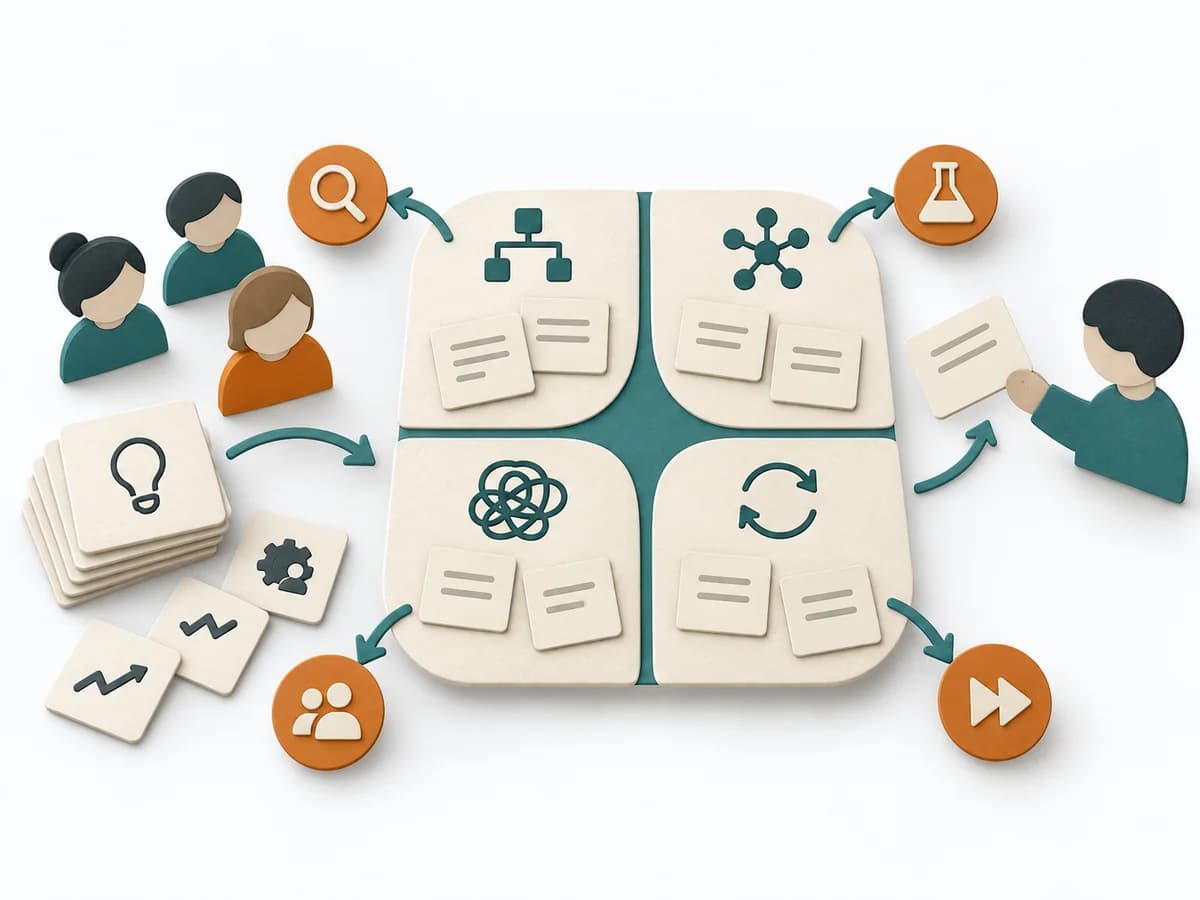
A Cynefin workshop classifies situations by their degree of order, uncertainty, and complexity. The classification indicates where analysis, experiments, or rapid stabilisation fit.
Fictional example
Fictional values demonstrate the method-specific fields.
| Case | Evidence | Causality | Domain | Response | Next step |
|---|---|---|---|---|---|
| Returns routineAdd rationale and evidence. | Same flow in 17 cases | Cause and effect known | Clear | Sense–categorise–respond | Continue standard |
| Machine selectionAdd rationale and evidence. | Three viable technical models | Several right answers; expertise required | Complicated | Sense–analyse–respond | Expert comparison |
| Express congestionAdd rationale and evidence. | Patterns differ by Saturday | Effect only clear in hindsight | Complex | Probe–sense–respond | Two safe slot probes |
| Coolant leakAdd rationale and evidence. | Immediate hazard | No time for analysis | Chaotic | Act–sense–respond | Isolate, then reassess |
All values are fictional.
Cases
Goal
Granular case set: Capture concrete situations as short stories with trigger, observed course, and current decision need.
Inputs for this step
Actions
Output
Granular case set
Capture concrete situations as short stories with trigger, observed course, and current decision need.
Quality check
Does each card describe an actual case rather than a category or solution wish?
Pitfall
Cards say process, culture, or digitalisation and cannot be placed meaningfully. Replace each category with an observed case, time, and decision.
Timing: 15–25 minutes
Domains
Goal
Shared domain criteria: Explain Clear, Complicated, Complex, Chaotic, and Confused through causality and matching response logic.
Inputs for this step
Actions
Output
Shared domain criteria
Explain Clear, Complicated, Complex, Chaotic, and Confused through causality and matching response logic.
Quality check
Can everyone explain domains through causality and response rather than importance or difficulty?
Pitfall
Complex is used as a synonym for difficult. Test one example per domain against causality and response logic.
Timing: 15–20 minutes
Sort
Goal
Provisional domain map: Place cases individually first, then compare rationale and evidence; keep genuine uncertainty in Confused.
Inputs for this step
Actions
Output
Provisional domain map
Place cases individually first, then compare rationale and evidence; keep genuine uncertainty in Confused.
Quality check
Is every placement justified by observable causality or lack of predictability?
Pitfall
The highest-ranking person sorts aloud and the group follows. Sort silently, reveal together, and discuss divergent rationales first.
Timing: 20–30 minutes
Boundaries
Goal
Resolved boundary cases: Examine disputed cases, movement between domains, and the Clear-to-Chaotic cliff; decompose bundles when needed.
Inputs for this step
Actions
Output
Resolved boundary cases
Examine disputed cases, movement between domains, and the Clear-to-Chaotic cliff; decompose bundles when needed.
Quality check
Are divergent placements, domain movement, and subproblems visible?
Pitfall
The group forces one domain onto a bundle of different subproblems. Decompose the case and classify each subproblem with its own context and horizon.
Timing: 20–30 minutes
Respond
Goal
Context-aware action plan: Choose a domain-appropriate response for each case; for complex cases define safe-to-fail probes and signals.
Inputs for this step
Actions
Output
Context-aware action plan
Choose a domain-appropriate response for each case; for complex cases define safe-to-fail probes and signals.
Quality check
Does each action match domain logic and have an owner, signal, and review?
Pitfall
A detailed long-range plan is mandated for a complex case before any probe. Define small parallel probes with amplification, dampening, and stop signals.
Timing: 20–35 minutes
What comes out at the end
Sketch: what the artifact looks like
Cynefin case map with domain rationale, boundary cases, and a matching response for each case.
Record date, owner, evidence state, decision, and review; preserve earlier cycles.
Set subject, evidence, roles, flow, and review.
To be confirmed
To be confirmed
Complete run Time: 90–150 minutes for 12–30 concrete cases and derived response logics.
Complete this worksheet on paper or in your own document during the work.
| Case | Evidence | Causality | Domain | Response | Next step |
|---|---|---|---|---|---|
| Returns routine | |||||
| Machine selection | |||||
| Express congestion | |||||
| Coolant leak |
The blank worksheet contains prompts only.
Reference · original teaching example
Expected artifact: Granular case set
Capture concrete situations as short stories with trigger, observed course, and current decision need.
Entry:
...
Expected artifact: Shared domain criteria
Explain Clear, Complicated, Complex, Chaotic, and Confused through causality and matching response logic.
Entry:
...
Expected artifact: Provisional domain map
Place cases individually first, then compare rationale and evidence; keep genuine uncertainty in Confused.
Entry:
...
Expected artifact: Resolved boundary cases
Examine disputed cases, movement between domains, and the Clear-to-Chaotic cliff; decompose bundles when needed.
Entry:
...
Expected artifact: Context-aware action plan
Choose a domain-appropriate response for each case; for complex cases define safe-to-fail probes and signals.
Entry:
...
...
Method guide: https://methodatlas.meierhoff-systems.de/en/methods/cynefin-workshop/run-sheet
Concrete filled scenario, fictional example
Fictional example for orientation. Counts and timings describe this case and are not universal requirements.
Concrete filled scenario, fictional example
| Case | Evidence | Causality | Domain | Response | Next step |
|---|---|---|---|---|---|
| Returns routine | Same flow in 17 cases | Cause and effect known | Clear | Sense–categorise–respond | Continue standard |
| Machine selection | Three viable technical models | Several right answers; expertise required | Complicated | Sense–analyse–respond | Expert comparison |
| Express congestion | Patterns differ by Saturday | Effect only clear in hindsight | Complex | Probe–sense–respond | Two safe slot probes |
| Coolant leak | Immediate hazard | No time for analysis | Chaotic | Act–sense–respond | Isolate, then reassess |
Recognize symptoms and steer against them
Quick overview, the full text is in the matching phase in the flow
Cards say process, culture, or digitalisation and cannot be placed meaningfully.
Replace each category with an observed case, time, and decision.
Complex is used as a synonym for difficult.
Test one example per domain against causality and response logic.
The highest-ranking person sorts aloud and the group follows.
Sort silently, reveal together, and discuss divergent rationales first.
The group forces one domain onto a bundle of different subproblems.
Decompose the case and classify each subproblem with its own context and horizon.
A detailed long-range plan is mandated for a complex case before any probe.
Define small parallel probes with amplification, dampening, and stop signals.
When to pause, resolve prerequisites, or choose another approach
Go to the profile for purpose, similar methods, and sources or continue to the next method in the catalog.