Plan my session
Plan a concrete work block with agenda, roles, preparation, and a copyable result artifact.
Session: Barcamp
The plan translates the method into a concrete facilitated work block. Your inputs flow directly into the session brief and work artifact.
Method session with 15-200. The plan uses the existing method logic and the runsheet.
RunsheetUse the session for shared understanding. Contributions are collected visibly, assumptions are aligned, and open differences remain traceable in the artifact.
The session works directly toward Session Board. After the session, the artifact should be shareable, reviewable, or reusable.
- 1
Phase 1: Opening and format
20-30 minThe host explains the format, the rule of two feet (everyone can change rooms at any time), the code of conduct, slot structure, and documentation expectations. Short introduction round with name and one keyword. Hint: The opening decides the energy. If it drags on, the group is lost. Keep it under 30 min, even for large camps. Clarity about the rule of two feet prevents later guilt about leaving a room.
FacilitatorSession Board - 2
Phase 2: Pitches and session plan
30-60 minRound-robin 30-60 s pitch per proposal (name, topic, what happens in the session). Cards go on the wall. If there are too many proposals, run a vote with dots. Hosts map the cards to rooms and slots. Hint: Pitches are not talks. Anyone who pitches for 2 min signals a lecture, so gently cut them short. More pitches than slots is normal; voting helps, but a final host decision prevents deadlock.
FacilitatorSession Notes - 3
Phase 3: Sessions
3-8 h (multiple slots)Parallel 45-min sessions. The session owner moderates, often with a question format ('Who has experience with X?'). The documentation team spreads out. After each slot, leave 15 min for room changes and energy. Hint: Sessions without an owner are often the best ones (shared search) but also riskier. At least one person per session should feel responsible. If a room stays empty, cancel the session instead of forcing it.
FacilitatorCommunity Learnings - 4
Phase 4: Marketplace and highlights
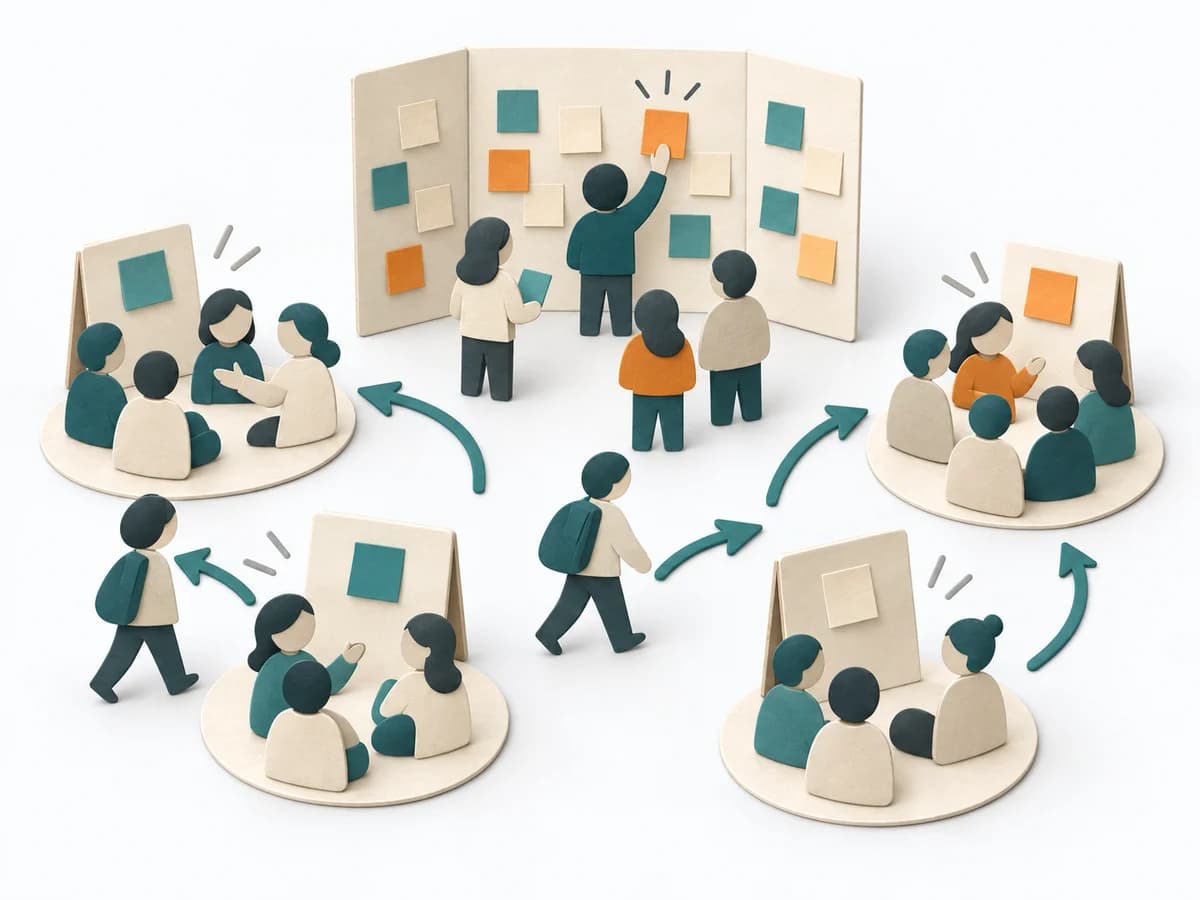
30-60 minAfter all slots, each session collects 3 highlights as short sticky notes on a central wall. Marketplace walk: participants walk around and read. Optional microphone round with 60 s per session owner. Hint: Highlights are not a session transcript. Three concrete takeaways are enough. For more than 12 sessions, use the microphone round as a visual photo gallery instead.
FacilitatorSession Board - 5
Phase 5: Closing and follow-up
15-30 minHosts briefly ask for the mood (1 word per person, quickly). The documentation team announces the note distribution date. Announce follow-up actions or community dates. Hint: Without clear follow-up communication, the energy fades within 2 weeks. Name a binding date for the notes release (for example 7 days), otherwise nothing gets sent.
OwnerSession Notes - 6
Publish artifact
10 minCheck the artifact for completeness, define location, set version or status, and name review recipients.
OwnerSession Board
Session Brief
For invitations, boards, tickets, PR descriptions, or workshop notes.
session-brief.md
Session Brief: Barcamp
Goal
Artifact: Session Board
Working Question
Which topics are alive enough in this group today to deserve a session, and what does each participant take away at the end?
Context
Date, location, overarching theme, slot plan with slot lengths (typically 45 min plus 15 min break), and participant count sent in advance to everyone. Send the code of conduct with registration. Communicate the rule of two feet.
Setup
- Format: Method session
- Duration: Half a day to 2 days
- Mode: Workshop
- Participants: One or two hosts for opening, session planning, and energy check; one session owner per session (emerges ad hoc during pitching); a documentation team (3-5 people) for session notes; a logistics team for room changes.
- Owner: One or two hosts for opening, session planning, and energy check
- Participation mode: Team round, shared work and alignment
- Outcome logic: Finish artifact
Participation Logic
Use the session for shared understanding. Contributions are collected visibly, assumptions are aligned, and open differences remain traceable in the artifact.
Outcome Logic
The session works directly toward Session Board. After the session, the artifact should be shareable, reviewable, or reusable.
Input
Large room plus 3-8 session rooms (or digital breakouts); session plan wall (grid: rooms x slots); pitch cards; pens; sticky notes; voting material such as dot stickers; catering; recording setup if desired.
Preparation
Hang the session plan wall with empty room columns and slot rows. Prepare pitch cards. Rehearse the opening and session planning. For more than 60 people, prepare a documentation tool (for example shared Notion) in advance.
Agenda
-
Phase 1: Opening and format (20-30 min) Owner: Facilitator Action: The host explains the format, the rule of two feet (everyone can change rooms at any time), the code of conduct, slot structure, and documentation expectations. Short introduction round with name and one keyword. Hint: The opening decides the energy. If it drags on, the group is lost. Keep it under 30 min, even for large camps. Clarity about the rule of two feet prevents later guilt about leaving a room. Output: Session Board
-
Phase 2: Pitches and session plan (30-60 min) Owner: Facilitator Action: Round-robin 30-60 s pitch per proposal (name, topic, what happens in the session). Cards go on the wall. If there are too many proposals, run a vote with dots. Hosts map the cards to rooms and slots. Hint: Pitches are not talks. Anyone who pitches for 2 min signals a lecture, so gently cut them short. More pitches than slots is normal; voting helps, but a final host decision prevents deadlock. Output: Session Notes
-
Phase 3: Sessions (3-8 h (multiple slots)) Owner: Facilitator Action: Parallel 45-min sessions. The session owner moderates, often with a question format ('Who has experience with X?'). The documentation team spreads out. After each slot, leave 15 min for room changes and energy. Hint: Sessions without an owner are often the best ones (shared search) but also riskier. At least one person per session should feel responsible. If a room stays empty, cancel the session instead of forcing it. Output: Community Learnings
-
Phase 4: Marketplace and highlights (30-60 min) Owner: Facilitator Action: After all slots, each session collects 3 highlights as short sticky notes on a central wall. Marketplace walk: participants walk around and read. Optional microphone round with 60 s per session owner. Hint: Highlights are not a session transcript. Three concrete takeaways are enough. For more than 12 sessions, use the microphone round as a visual photo gallery instead. Output: Session Board
-
Phase 5: Closing and follow-up (15-30 min) Owner: Owner Action: Hosts briefly ask for the mood (1 word per person, quickly). The documentation team announces the note distribution date. Announce follow-up actions or community dates. Hint: Without clear follow-up communication, the energy fades within 2 weeks. Name a binding date for the notes release (for example 7 days), otherwise nothing gets sent. Output: Session Notes
-
Publish artifact (10 min) Owner: Owner Action: Check the artifact for completeness, define location, set version or status, and name review recipients. Output: Session Board
Closeout
- Update result artifact: Session Board
- Define location, version, and review recipients.
- Define owner, next step, and review date.
Work artifact
Pre-filled starting point based on the matching template.
work-artifact.md
Session Board: Barcamp
Working Question
Which topics are alive enough in this group today to deserve a session, and what does each participant take away at the end?
Context
Date, location, overarching theme, slot plan with slot lengths (typically 45 min plus 15 min break), and participant count sent in advance to everyone. Send the code of conduct with registration. Communicate the rule of two feet.
Participants
- Owner: One or two hosts for opening, session planning, and energy check
- Participants: One or two hosts for opening, session planning, and energy check; one session owner per session (emerges ad hoc during pitching); a documentation team (3-5 people) for session notes; a logistics team for room changes.
Input
Large room plus 3-8 session rooms (or digital breakouts); session plan wall (grid: rooms x slots); pitch cards; pens; sticky notes; voting material such as dot stickers; catering; recording setup if desired.
Template
Barcamp Working Template
Goal
Organize an open session marketplace with participant-driven topics and outcomes.
Context
When and for what do we use this method?
Input
Which data, observations, decisions, or materials are available?
Working area
- Topic proposals:
- Session slots:
- Hosts and supporters:
- Session notes:
- Outcome signals:
Output artifacts
- Session marketplace:
- Schedule:
- Outcome notes:
Open questions
- ...
Next step
Owner, date, and success signal.
Completion Check
- Session Board is complete enough for review:
- Location:
- Version / status:
- Review by:
- Next step:
Next Step
- Review result
- Mark open questions
- Schedule review or decision
Barcamp Working Template
View templateCompact working template for Barcamp with session marketplace, slots, outcomes, and next step.canvas
barcamp-working-template.md
Compact working template for Barcamp with session marketplace, slots, outcomes, and next step.
Barcamp Working Template
Goal
Organize an open session marketplace with participant-driven topics and outcomes.
Context
When and for what do we use this method?
Input
Which data, observations, decisions, or materials are available?
Working area
- Topic proposals:
- Session slots:
- Hosts and supporters:
- Session notes:
- Outcome signals:
Output artifacts
- Session marketplace:
- Schedule:
- Outcome notes:
Open questions
- ...
Next step
Owner, date, and success signal.
- Working question, owner, and target artifact are visible.
- The result fits Session Board.
- One area or repo branch per camp with date and theme in the title. Do not overwrite notes. Link follow-up camps to previous editions so topic recurrence stays visible.
- Open questions are noted as follow-ups.
- The next review or decision point is scheduled.