Complete firstShared context
Period and goal are set.
Without a frame, contributions are hard to compare.
A practical method guide: clarify prerequisites and materials, understand the complete process, and look up outputs, pitfalls, and stop criteria.
What needs to be finished first
Period and goal are set.
What needs to be ready before start
Board, Stickies, Timer
The facilitator explains the four Ls and protects voluntary contributions; participants write independently first; the scribe clusters themes and records actions.
Collect the Sprint or project cycle, milestones, and relevant artifacts beforehand.
60 minutes
Prepare four blank columns: Liked, Learned, Lacked, and Longed For. Contributions are voluntary and describe work and effects.
The one question this method answers
What did we like, learn, lack, and long for, and which small improvement will we inspect afterward?
Phases with goal, actions, output and pitfall
The 4Ls Retrospective makes valued experiences, learning, missing elements, and wishes visible. The shared reflection leads to agreed actions whose impact is reviewed later.
Fictional example
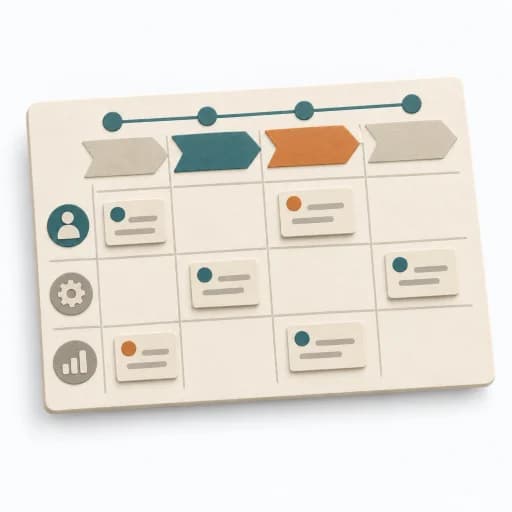
Structured board with a blank workspace and fictional example view.
Fictional: immediate reservation confirmation
The desk confirms reservations directly.
Fictional: device check prevents questions
The team learns from a repeatable flow.
Fictional: return without network hard to see
A missing offline cue makes work harder.
Fictional: clear offline guide
The team wishes for a compact guide.
Fictional: test guide with two returns
Kim checks the effect next cycle.
Frame
Goal
Set milestones, period, and conversation agreements without forced disclosure.
Inputs for this step
Actions
Output
Period and agreements
Period and agreements
Quality check
Is the step concrete, safe, and actionable?
Pitfall
The discussion stays generic or blames people. Return to observable work, effects, and the next check.
Timing: 10–20 minutes
Reflect
Goal
Collect independently: Liked, Learned, Lacked, and Longed For.
Inputs for this step
Actions
Output
4Ls contributions
4Ls contributions
Quality check
Is the step concrete, safe, and actionable?
Pitfall
The discussion stays generic or blames people. Return to observable work, effects, and the next check.
Timing: 10–20 minutes
Cluster
Goal
Read contributions, cluster themes, and ask about effects without exposing individuals.
Inputs for this step
Actions
Output
Themes and learnings
Themes and learnings
Quality check
Is the step concrete, safe, and actionable?
Pitfall
The discussion stays generic or blames people. Return to observable work, effects, and the next check.
Timing: 10–20 minutes
Choose
Goal
Choose a few actions with owner, date, and a later check of their effect.
Inputs for this step
Actions
Output
Action plan
Action plan
Quality check
Is the step concrete, safe, and actionable?
Pitfall
The discussion stays generic or blames people. Return to observable work, effects, and the next check.
Timing: 10–20 minutes
Follow-up
Goal
Prepare a clear follow-up review.
Inputs for this step
Actions
Output
Agreed follow-up plan
Action · owner · review date · signal · record location
Quality check
Are owner, review date and effect signal clearly agreed?
Pitfall
An action is marked done without checking effect. Schedule a later check in the next cycle.
Timing: 5–10 minutes to agree follow-up
What comes out at the end
Sketch: what the artifact looks like
4Ls reflection board with contributions, milestones, themes, and a few actions with owner, date, and later effect check.
Keep date, period, and owner on the artifact.
Plan purpose, period, and the next work block.
To be confirmed
To be confirmed
Whole flow Time: In one session
Complete this worksheet on paper or in your own document during the work.
...
...
...
...
...
Safe and voluntary ...
The 4 Ls Retrospective Technique | Atlassian
Expected artifact: Period and agreements
Period and agreements
Entry:
...
Expected artifact: 4Ls contributions
4Ls contributions
Entry:
...
Expected artifact: Themes and learnings
Themes and learnings
Entry:
...
Expected artifact: Action plan
Action plan
Entry:
...
Expected artifact: Agreed follow-up plan
Action · owner · review date · signal · record location
Entry:
...
...
Method guide: https://methodatlas.meierhoff-systems.de/en/methods/4ls-retrospective/run-sheet
Concrete filled scenario, fictional example
Fictional example for orientation. Counts and timings describe this case and are not universal requirements.
Concrete filled scenario, fictional example
Liked: The desk confirmed reservations immediately. Learned: A short device check prevents later questions. Lacked: Returns without network were hard to see. Longed For: A clear offline guide.
Action: Kim tests the guide with two returns; inspect the effect next cycle.
Recognize symptoms and steer against them
Quick overview, the full text is in the matching phase in the flow
The discussion stays generic or blames people.
Return to observable work, effects, and the next check.
The discussion stays generic or blames people.
Return to observable work, effects, and the next check.
The discussion stays generic or blames people.
Return to observable work, effects, and the next check.
The discussion stays generic or blames people.
Return to observable work, effects, and the next check.
An action is marked done without checking effect.
Schedule a later check in the next cycle.
When to pause, resolve prerequisites, or choose another approach
Go to the profile for purpose, similar methods, and sources or continue to the next method in the catalog.