Plan my session
Plan a concrete work block with agenda, roles, preparation, and a copyable result artifact.
Session: 1-2-4-All
The plan translates the method into a concrete facilitated work block. Your inputs flow directly into the session brief and work artifact.
Method session with 4-100+. The plan uses the existing method logic and the runsheet.
RunsheetUse the session for shared understanding. Contributions are collected visibly, assumptions are aligned, and open differences remain traceable in the artifact.
The session works directly toward Idea List. After the session, the artifact should be shareable, reviewable, or reusable.
- 1
0-1 min
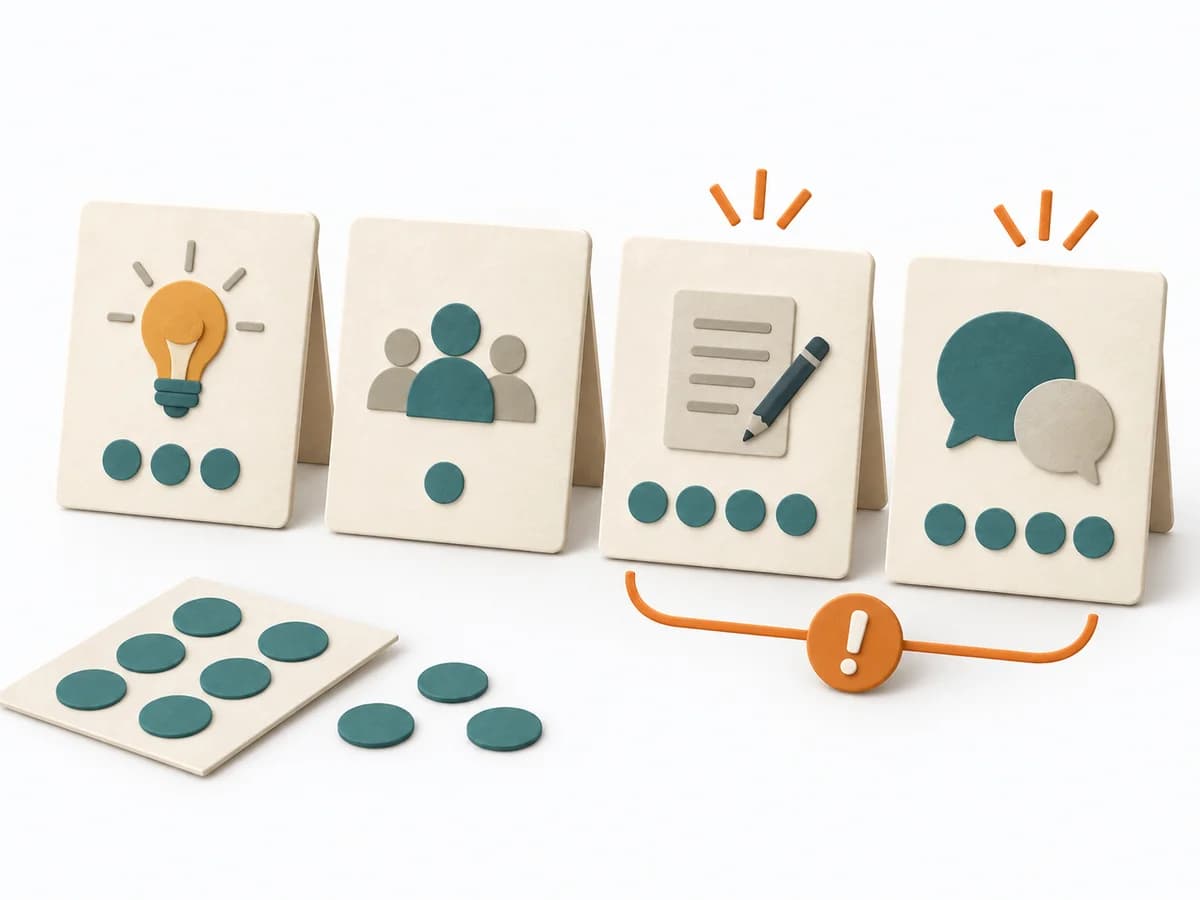
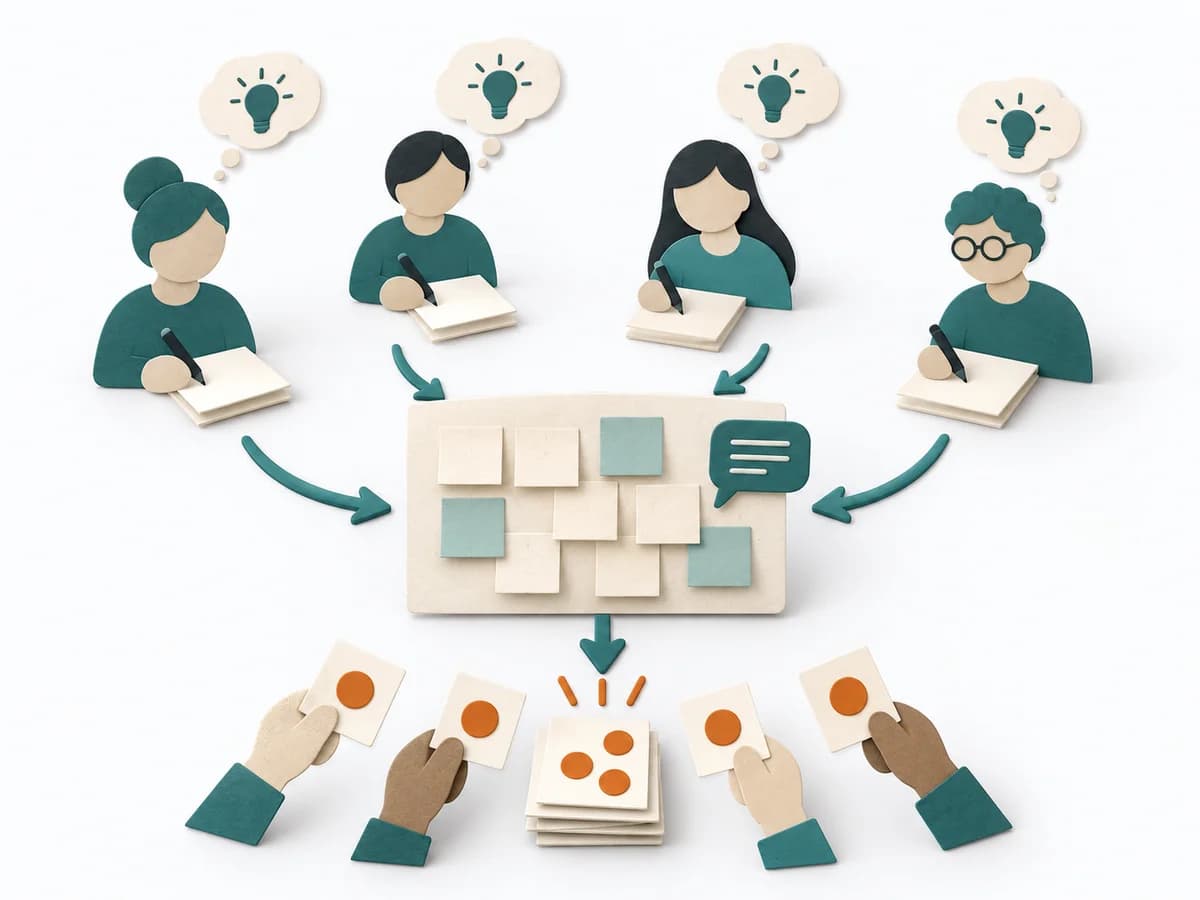
1 minSilent individual work: Each person notes answers, ideas, or concerns about the question. Bullet points are enough. Hint: If the room gets noisy, the facilitator reminds everyone of silence. Writing is mandatory, otherwise the thought is lost in the pair phase.
FacilitatorIdea List - 2
1-3 min
2 minPair exchange: Two people swap their notes, find common ground, and add to each other. One shared list per pair. Hint: If someone has already read their sheet aloud after 30 seconds, they should actively ask the other person. Not two monologues, but dialogic synthesis.
FacilitatorShared Insights - 3
3-7 min
4 minGroups of four: Two pairs merge, compare their lists, and agree on two to three core points or patterns. Hint: Four is the upper limit. A group of five suppresses one voice, a group of six splits into two camps. Stay strictly at four.
FacilitatorEmergent Themes - 4
7-12 min
5 minPlenary synthesis: Each 4-person group names its two to three core points in 30 seconds. The facilitator clusters them visibly on the board. No discussion in this phase. Hint: If groups start arguing, the facilitator interrupts: 'First collect, then distill.' Argumentation happens after 1-2-4-All in a separate discussion round.
OwnerIdea List - 5
Publish artifact
10 minCheck the artifact for completeness, define location, set version or status, and name review recipients.
OwnerIdea List
Session Brief
For invitations, boards, tickets, PR descriptions, or workshop notes.
session-brief.md
Session Brief: 1-2-4-All
Goal
Artifact: Idea List
Working Question
Which answers, ideas, or concerns about the question emerge when each person first thinks alone and then increasingly in the group?
Context
Question sent to the group as a single sentence in advance, at least 30 minutes before; context for the question in two to three sentences; desired output type (idea, assumption, decision, risk).
Setup
- Format: Method session
- Duration: 12-15 min core flow, plus 5-15 min plenary synthesis
- Mode: Workshop
- Participants: One facilitator who leads phases and timing strictly; four to 60 participants; above 20 people, a co-facilitator for forming the 4-person groups and for plenary synthesis.
- Owner: One facilitator who leads phases and timing strictly
- Participation mode: Team round, shared work and alignment
- Outcome logic: Finish artifact
Participation Logic
Use the session for shared understanding. Contributions are collected visibly, assumptions are aligned, and open differences remain traceable in the artifact.
Outcome Logic
The session works directly toward Idea List. After the session, the artifact should be shareable, reviewable, or reusable.
Input
Timer with audible signal; whiteboard or Miro board for synthesis; pens or digital sticky notes; visible question at the top of the board.
Preparation
Make the question central and clearly visible. Announce timer phases: 1 min alone, 2 min in pairs, 4 min in fours, 5 min plenary. Rule: write during the 1-person phase, otherwise ideas evaporate.
Agenda
-
0-1 min (1 min) Owner: Facilitator Action: Silent individual work: Each person notes answers, ideas, or concerns about the question. Bullet points are enough. Hint: If the room gets noisy, the facilitator reminds everyone of silence. Writing is mandatory, otherwise the thought is lost in the pair phase. Output: Idea List
-
1-3 min (2 min) Owner: Facilitator Action: Pair exchange: Two people swap their notes, find common ground, and add to each other. One shared list per pair. Hint: If someone has already read their sheet aloud after 30 seconds, they should actively ask the other person. Not two monologues, but dialogic synthesis. Output: Shared Insights
-
3-7 min (4 min) Owner: Facilitator Action: Groups of four: Two pairs merge, compare their lists, and agree on two to three core points or patterns. Hint: Four is the upper limit. A group of five suppresses one voice, a group of six splits into two camps. Stay strictly at four. Output: Emergent Themes
-
7-12 min (5 min) Owner: Owner Action: Plenary synthesis: Each 4-person group names its two to three core points in 30 seconds. The facilitator clusters them visibly on the board. No discussion in this phase. Hint: If groups start arguing, the facilitator interrupts: 'First collect, then distill.' Argumentation happens after 1-2-4-All in a separate discussion round. Output: Idea List
-
Publish artifact (10 min) Owner: Owner Action: Check the artifact for completeness, define location, set version or status, and name review recipients. Output: Idea List
Closeout
- Update result artifact: Idea List
- Define location, version, and review recipients.
- Define owner, next step, and review date.
Work artifact
Pre-filled starting point based on the matching template.
work-artifact.md
Idea List: 1-2-4-All
Working Question
Which answers, ideas, or concerns about the question emerge when each person first thinks alone and then increasingly in the group?
Context
Question sent to the group as a single sentence in advance, at least 30 minutes before; context for the question in two to three sentences; desired output type (idea, assumption, decision, risk).
Participants
- Owner: One facilitator who leads phases and timing strictly
- Participants: One facilitator who leads phases and timing strictly; four to 60 participants; above 20 people, a co-facilitator for forming the 4-person groups and for plenary synthesis.
Input
Timer with audible signal; whiteboard or Miro board for synthesis; pens or digital sticky notes; visible question at the top of the board.
Template
1-2-4-All Working Template
Goal
Scales idea generation from individual reflection to group and plenary synthesis.
Context
When and for what do we use this method?
Input
Which data, observations, decisions, or materials are available?
Execution
Short notes along the runsheet.
Output artifacts
- Idea List:
- Shared Insights:
- Emergent Themes:
Assumptions and open questions
- ...
Decision / Next step
Owner, date, and success signal.
Completion Check
- Idea List is complete enough for review:
- Location:
- Version / status:
- Review by:
- Next step:
Next Step
- Review result
- Mark open questions
- Schedule review or decision
1-2-4-All Working Template
View templateCompact working template for 1-2-4-All with context, input, output artifacts, and next step.markdown
1-2-4-all-working-template.md
Compact working template for 1-2-4-All with context, input, output artifacts, and next step.
1-2-4-All Working Template
Goal
Scales idea generation from individual reflection to group and plenary synthesis.
Context
When and for what do we use this method?
Input
Which data, observations, decisions, or materials are available?
Execution
Short notes along the runsheet.
Output artifacts
- Idea List:
- Shared Insights:
- Emergent Themes:
Assumptions and open questions
- ...
Decision / Next step
Owner, date, and success signal.
- Working question, owner, and target artifact are visible.
- The result fits Idea List.
- Date, question, and participant count in the header. For repeats with the same question, create a new file and note the previous run. Attach the cluster snapshot as an image because spatial arrangement matters.
- Open questions are noted as follow-ups.
- The next review or decision point is scheduled.