View methods side by side.
Choose up to four methods. Add them using the search and share the comparison by copying its link.
| Criterion |  UX Research Usability Testing |  UX Research Card Sorting | 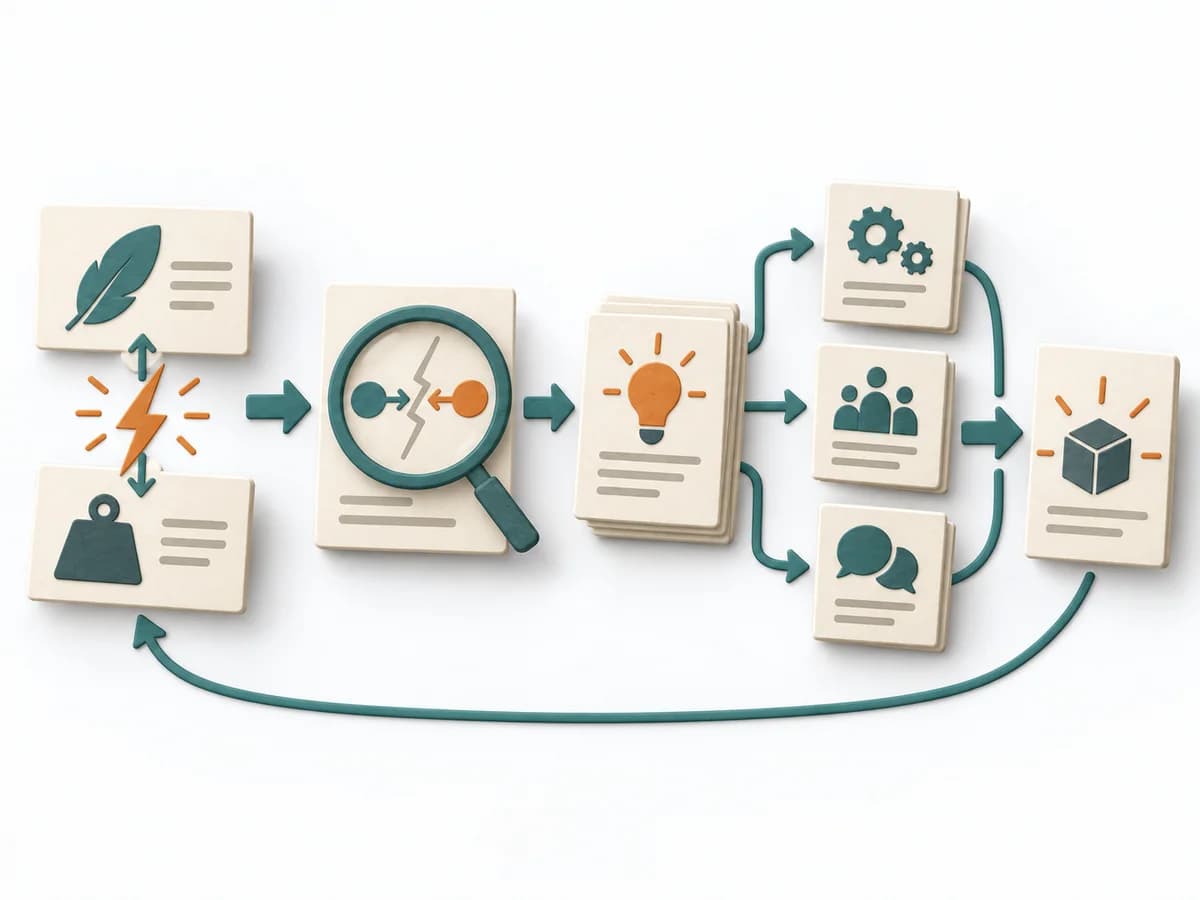 Innovation Contradiction Analysis |
|---|---|---|---|
Purposedifferent | When a product is built but people get stuck on tasks, usability testing shows the friction at concrete points. Observed use instead of self-report makes visible where orientation, understanding, or interaction breaks down. | When content only makes sense internally and users can't find the structure again, card sorting exposes their mental order. Terms, groups, and naming are then aligned with the target group's expectations. | When a system should improve while another measure suffers as a result, the method makes the underlying conflict precisely formulable. It separates the desired effect from its side effect. This makes solutions possible that address the contradiction deliberately instead of half-heartedly. |
Complexitydifferent | Medium | Low | Medium |
Timedifferent | 1-2 h je Session | 20-45 min | 60-120 min |
Participantsdifferent | Based on research question | Based on research question | 2-8 |
Formatdifferent | Workshop + async | Workshop + async | Workshop |
Outputdifferent | Usability Issues, Severity List, Recommendations | Content groups, Label set, IA hypotheses | Contradiction Statement, Abstraction Notes, Solution Principles, Concept Ideas |
Tagsno overlap | ValidationUXPrototype | Information architectureNavigationStructure | ContradictionsInnovationProblem solving |
Often compared together
Methods with strong topical overlap with the current selection, not yet in the comparison.