View methods side by side.
Choose up to four methods. Add them using the search and share the comparison by copying its link.
| Criterion |  Facilitation Stakeholder Salience Model |  Facilitation Power Interest Grid |  Innovation Contradiction Analysis |
|---|---|---|---|
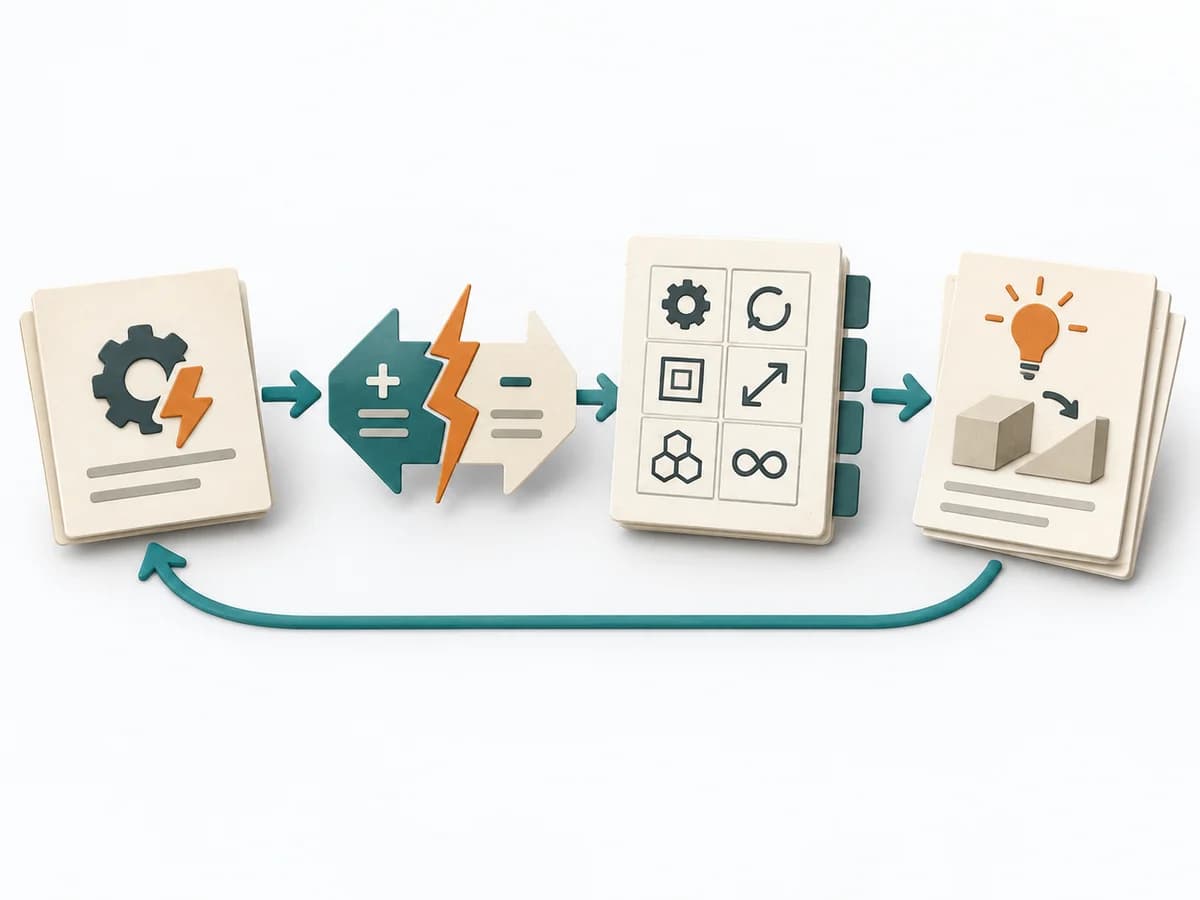
Purposedifferent | When stakeholders appear to matter very differently, the Stakeholder Salience Model rates their actual priority through power, legitimacy, and urgency. It turns individual contributions into a visible selection. The result is captured as a Salience diagram and a class-based strategy. | When many stakeholders compete for attention at once, the Power Interest Grid sorts them by influence and stake. It turns individual contributions into a visible selection. The result is captured as a Power Interest Grid and a stakeholder-specific strategy. | When a system should improve while another measure suffers as a result, the method makes the underlying conflict precisely formulable. It separates the desired effect from its side effect. This makes solutions possible that address the contradiction deliberately instead of half-heartedly. |
Complexitydifferent | Medium | Low | Medium |
Timedifferent | 60-90 min | 30-60 min | 60-120 min |
Participantsdifferent | 3-6 | 2-8 | 2-8 |
Formatsame | Workshop | Workshop | Workshop |
Outputdifferent | Salience Diagram, Strategy per Class | Power Interest Grid, Strategy per Stakeholder | Contradiction Statement, Abstraction Notes, Solution Principles, Concept Ideas |
Tagsno overlap | StakeholdersFacilitationAlignmentGovernance | StakeholdersFacilitationAlignmentPlanning | ContradictionsInnovationProblem solving |
Often compared together
Methods with strong topical overlap with the current selection, not yet in the comparison.