View methods side by side.
Choose up to four methods. Add them using the search and share the comparison by copying its link.
| Criterion |  Decision Making RAPID | 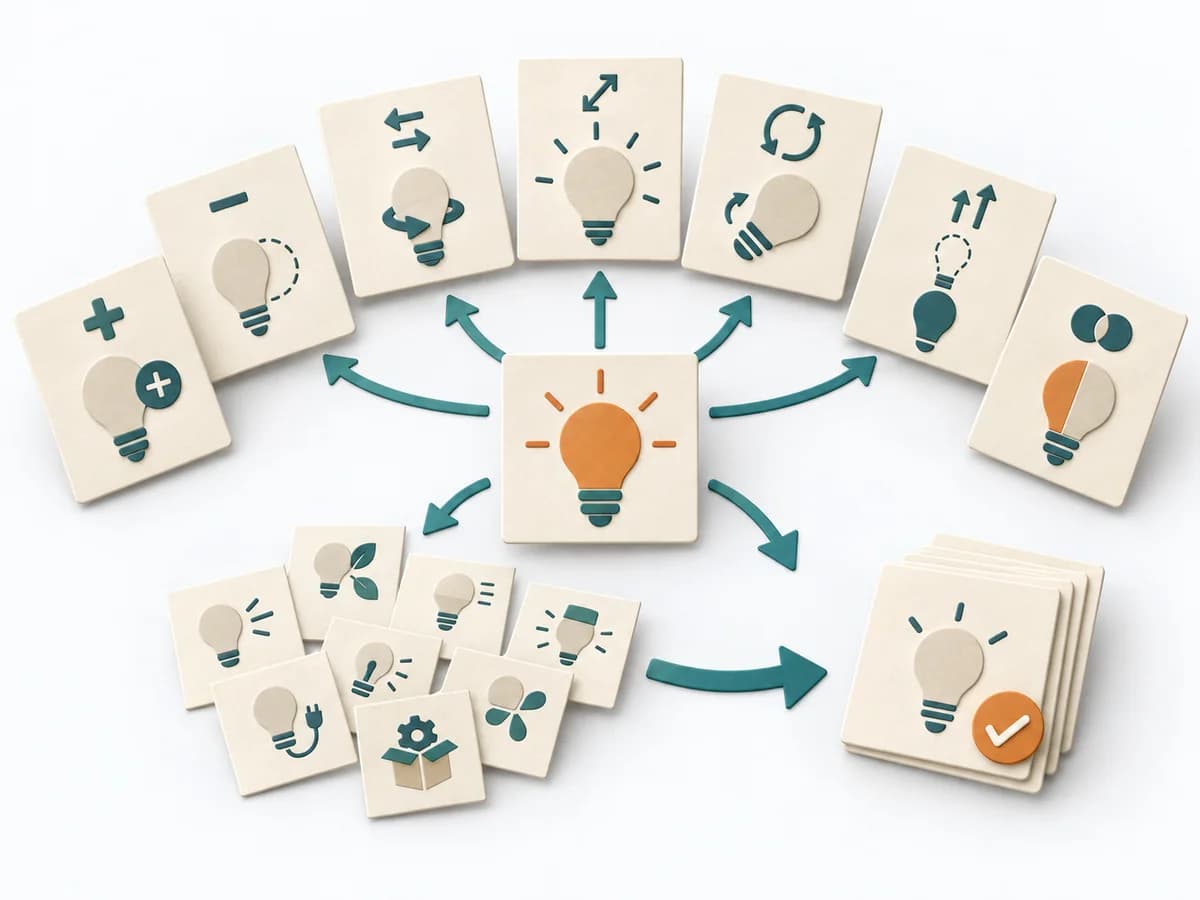 Innovation SCAMPER |  Decision Making Decision Rights Mapping |
|---|---|---|---|
Purposedifferent | In complex management decisions, clarity is often missing about who recommends, who agrees, and who makes the decision. RAPID creates this assignment and stabilizes decisions across several levels. | For an existing solution under pressure to change, the method deliberately opens space for systematic variants. It directs attention to rebuilding, combining, and repurposing rather than only new basic ideas. This produces concrete evolution paths for products, offerings, or workflows. | In organizations with many stakeholders, it often blurs who actually decides and who is merely consulted. It separates options, evaluation criteria, and open risks. The result is captured as a Decision Rights matrix and an agreement. |
Complexitydifferent | Medium | Low | Medium |
Timedifferent | 45-90 min | 30-60 min | 90-180 min |
Participantsdifferent | 3-12 | 2-10 | 4-12 |
Formatdifferent | Workshop + async | Workshop | Workshop |
Outputdifferent | RAPID Role Map, Recommendation, Decision Log | SCAMPER Idea List, Concept Shortlist, Variation Notes | Decision Rights Matrix, Agreement |
Tagsno overlap | DecisionRolesGovernance | BrainstormingIdeationCreativityReframingInnovation | DecisionGovernanceAlignmentResponsibility |
Often compared together
Methods with strong topical overlap with the current selection, not yet in the comparison.