View methods side by side.
Choose up to four methods. Add them using the search and share the comparison by copying its link.
| Criterion |  Knowledge Modeling PARA Method | 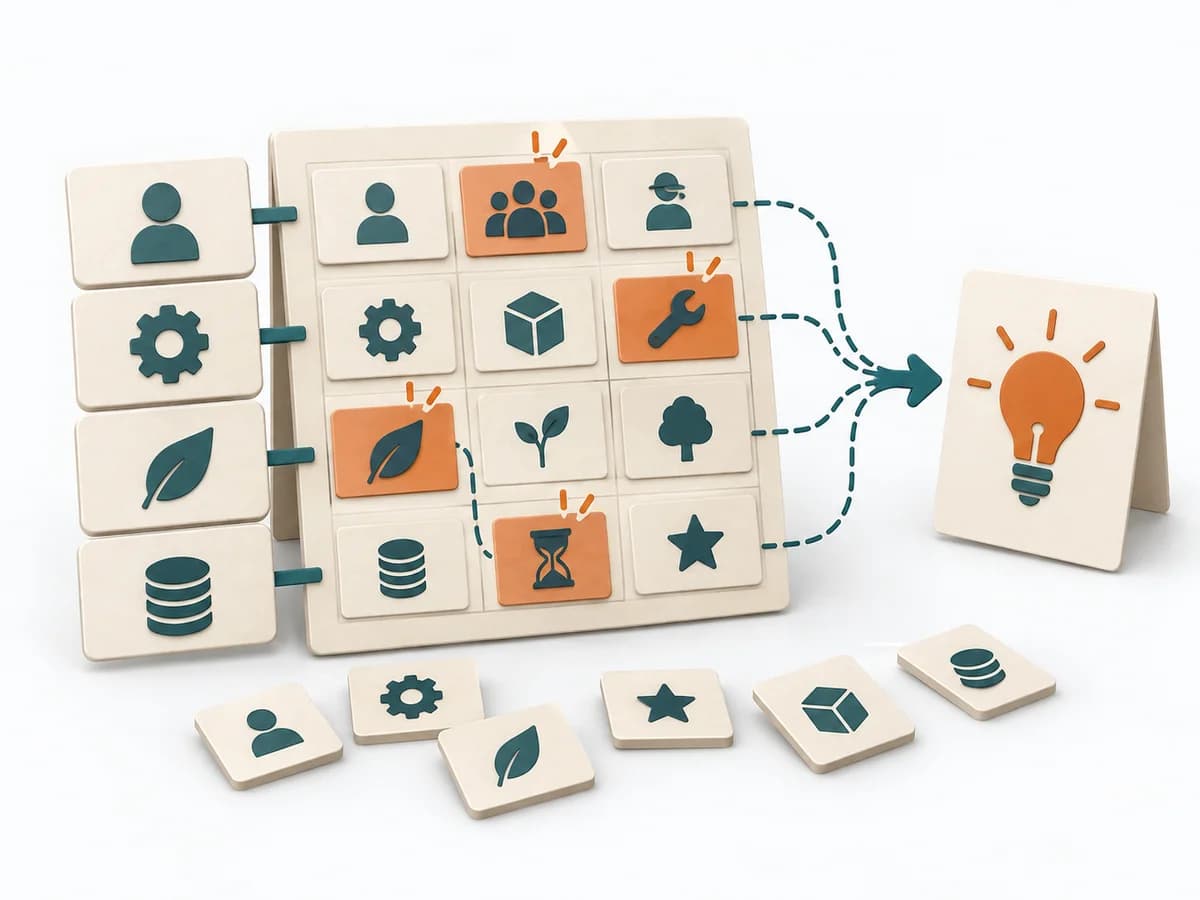 Innovation Morphological Analysis |  Innovation Lotus Blossom |
|---|---|---|---|
Purposedifferent | The PARA Method organizes knowledge into Projects, Areas, Resources, and Archives. It creates order when digital notes, files, and tasks no longer cleanly fit current work. | For a search for solutions with many degrees of freedom, a grid emerges for systematic combinations. The method separates features, variants, and exclusion criteria, so the space gets explored deliberately. | When a central question feels too large, the method breaks it into neighboring topic fields with their own depth of ideation. It holds structure and openness at the same time, so adjacent perspectives don't get lost. This grows an idea space out of a core problem. |
Complexitydifferent | Medium | Medium | Low |
Timedifferent | 1-3 h Setup, laufend | 1-3 h | 45-90 min |
Participantsdifferent | 1 | 2-8 | 3-10 |
Formatdifferent | Async | Workshop + async | Workshop |
Outputdifferent | PARA Structure, Project Notes, Knowledge Archive | Morphological Box, Concept Combinations, Idea Shortlist | Lotus Diagram, Idea Themes, Shortlist |
Tagsno overlap | KnowledgeProductivityOrganization | IdeationInnovationCreativity | BrainstormingIdeationCreativityDivergenceWorkshop |
Often compared together
Methods with strong topical overlap with the current selection, not yet in the comparison.