View methods side by side.
Choose up to four methods. Add them using the search and share the comparison by copying its link.
| Criterion |  Engineering Hypothesis-Driven Troubleshooting |  Innovation Rapid Ideation | 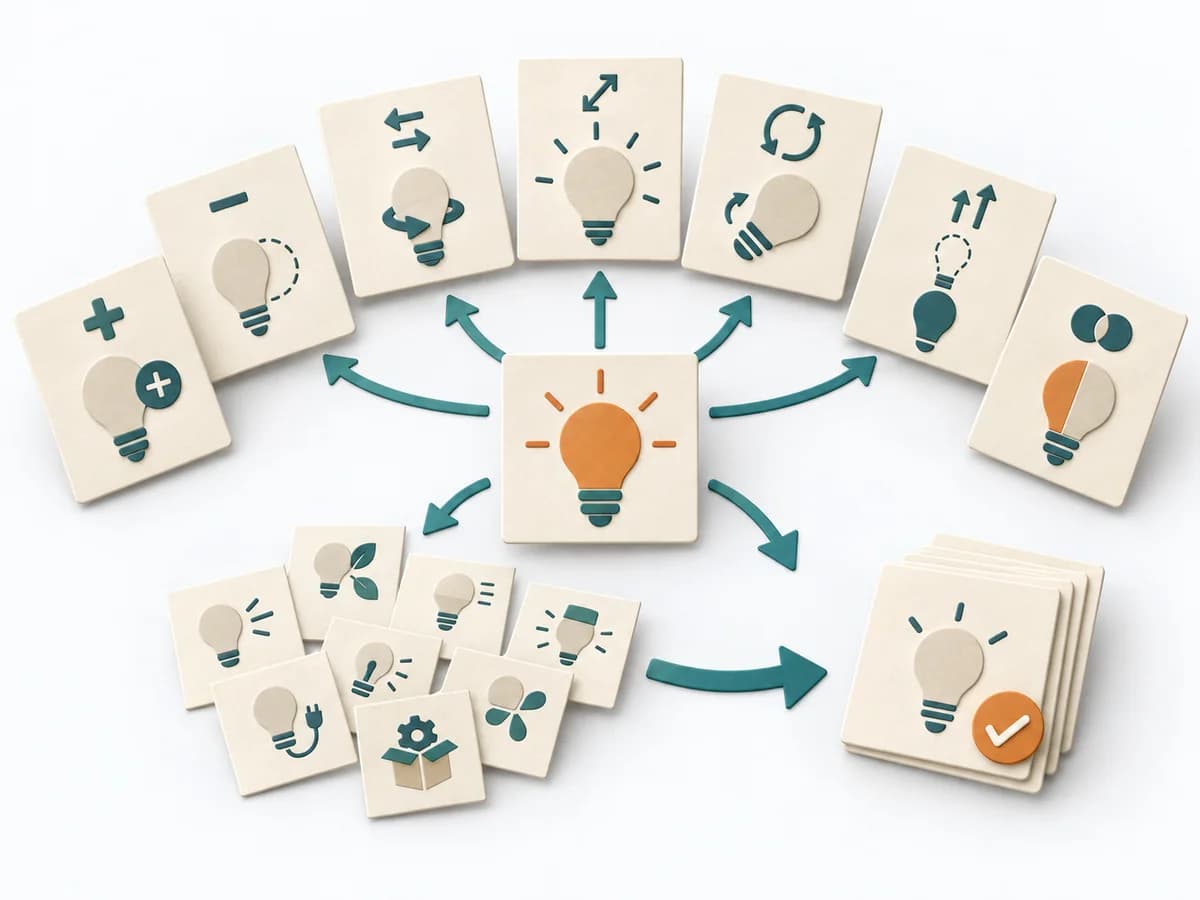 Innovation SCAMPER |
|---|---|---|---|
Purposedifferent | When systems fail unexpectedly, spontaneous attempts often produce more noise than insight. Hypothesis-driven Troubleshooting translates symptoms into testable assumptions and makes troubleshooting learnable. | When a decision needs to be prepared quickly, the method generates many solution-close variants in a short time. It deliberately relies on pace to undercut self-censorship and perfectionism. This quickly produces a usable field for prioritization and further work. | For an existing solution under pressure to change, the method deliberately opens space for systematic variants. It directs attention to rebuilding, combining, and repurposing rather than only new basic ideas. This produces concrete evolution paths for products, offerings, or workflows. |
Complexitydifferent | Medium | Low | Low |
Timedifferent | 30-240 min | 5-20 min | 30-60 min |
Participantsdifferent | 1-6 | 1-20 | 2-10 |
Formatdifferent | Workshop + async | Workshop + async | Workshop |
Outputdifferent | Hypothesis Log, Test Plan, Evidence Notes, Diagnosis Summary | Ideenpool, Roh-Shortlist, Cluster | SCAMPER Idea List, Concept Shortlist, Variation Notes |
Tagsno overlap | TroubleshootingProblem solvingDiagnosis | BrainstormingIdeationDivergenceSpeed | BrainstormingIdeationCreativityReframingInnovation |
Often compared together
Methods with strong topical overlap with the current selection, not yet in the comparison.