View methods side by side.
Choose up to four methods. Add them using the search and share the comparison by copying its link.
| Criterion |  UX Research Card Sorting |  Product Discovery Assumption Mapping | 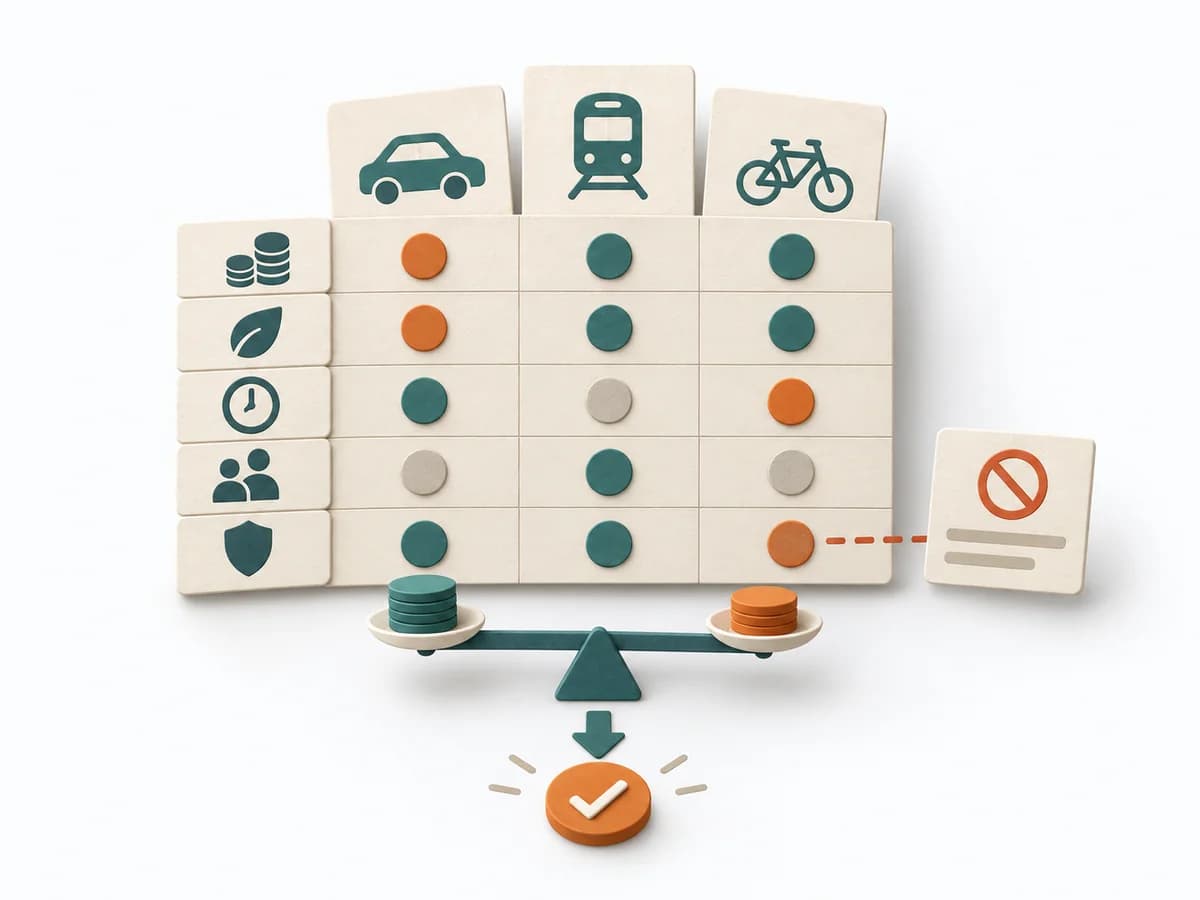 Decision Making Trade-off Analysis |
|---|---|---|---|
Purposedifferent | When content only makes sense internally and users can't find the structure again, card sorting exposes their mental order. Terms, groups, and naming are then aligned with the target group's expectations. | When assumptions still sit unordered in the room, it weighs uncertainty against leverage. It makes visible which hypotheses should be checked first. | With limited resources, quality, speed, cost, and risk almost always compete with each other. Trade-off Analysis makes these tensions explicit and prevents decisions from producing hidden side effects. |
Complexitydifferent | Low | Medium | Medium |
Timedifferent | 20-45 min | 45-60 min | 45-120 min |
Participantsdifferent | Based on research question | 2-8 | 2-8 |
Formatsame | Workshop + async | Workshop + async | Workshop + async |
Outputdifferent | Content groups, Label set, IA hypotheses | Assumption map, Test backlog, Risk ranking | Trade-off Matrix, Criteria List, Decision Rationale, Accepted Downsides |
Tagsno overlap | Information architectureNavigationStructure | AssumptionsRiskExperimentsValidation | TradeoffsDecisionCriteriaOptions |
Often compared together
Methods with strong topical overlap with the current selection, not yet in the comparison.