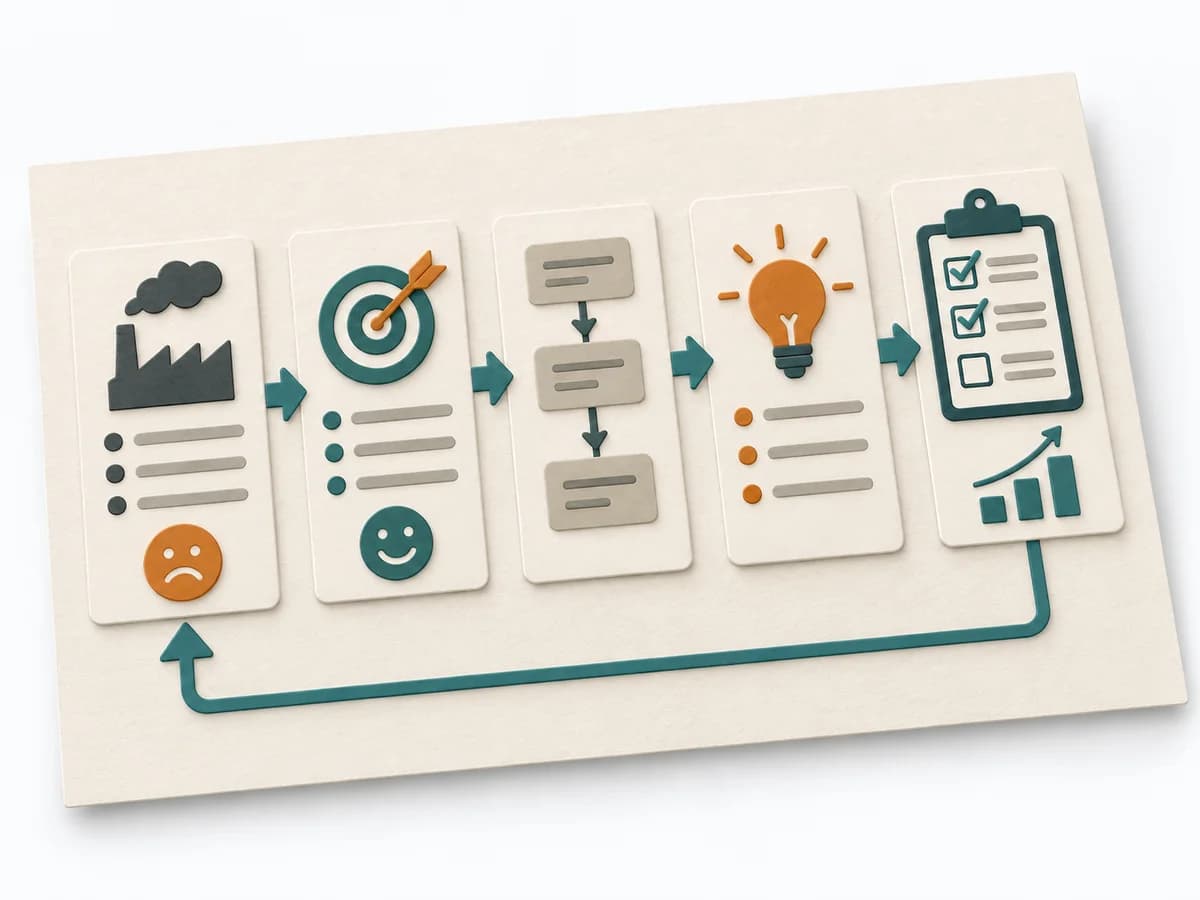
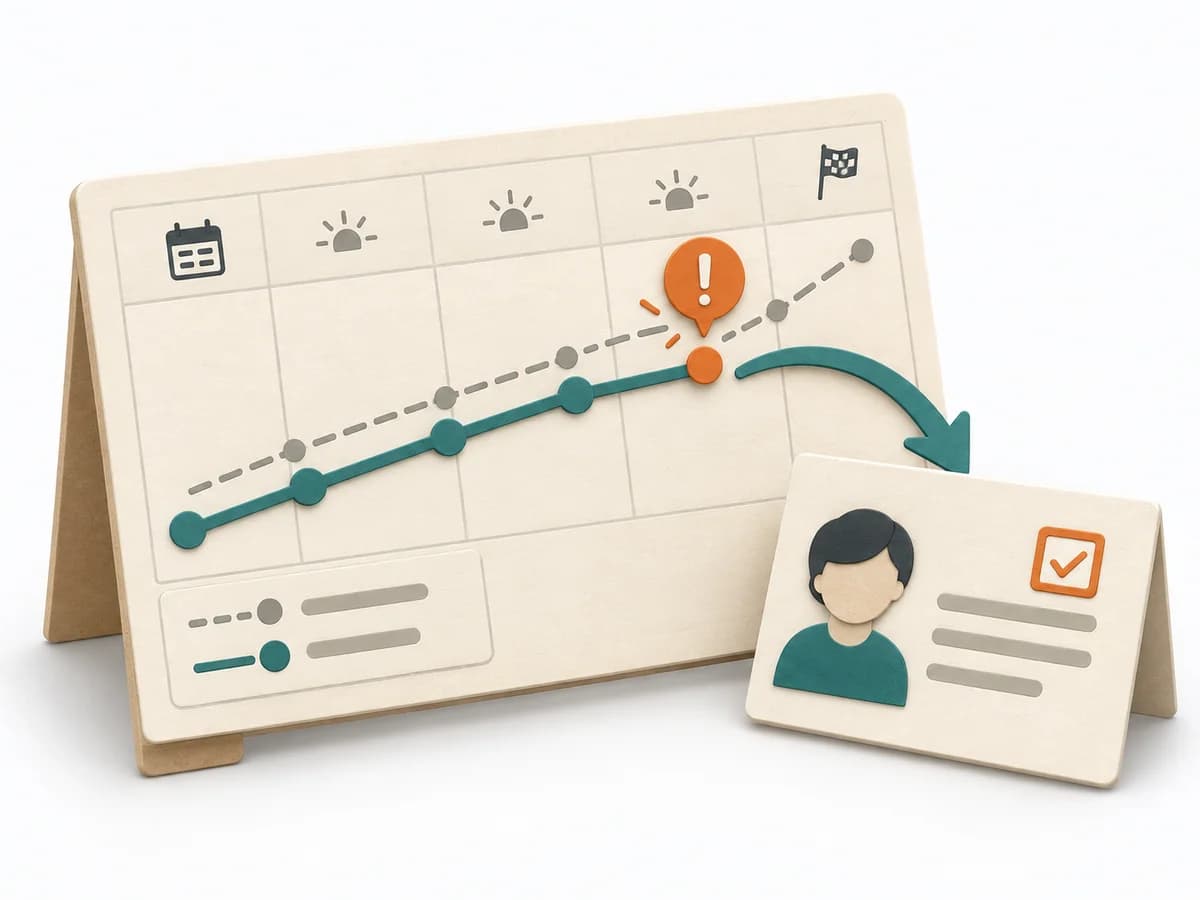
Plan my session
Plan a concrete work block with agenda, roles, preparation, and a copyable result artifact.
Session: Value Stream Mapping
The plan translates the method into a concrete facilitated work block. Your inputs flow directly into the session brief and work artifact.
Method session with 4-10. The plan uses the existing method logic and the runsheet.
RunsheetUse the session for shared understanding. Contributions are collected visibly, assumptions are aligned, and open differences remain traceable in the artifact.
The session works directly toward Current-state map. After the session, the artifact should be shareable, reviewable, or reusable.
- 1
Phase 1: Customer and takt
30 minDefine customer requirement: what is expected how often. Write end event and trigger. Compare current lead time and SLA. Hint: If takt is unknown, the whole map is uncalibrated. At least use rough estimate with date and source.
FacilitatorCurrent-state map - 2
Phase 2: Current-state map
3-4 hStep by step left to right: process step, operators, cycle time, first-pass yield, waiting time to next step. Information flow as arrows above. Hint: Waiting times are the most important data. If only cycle time is captured, the main share of lead time is missing.
FacilitatorFuture-state map - 3
Phase 3: Mark waste
60 minPlace Kaizen bursts on waste points. Walk through seven wastes: waiting, transport, motion, overproduction, inventory, rework, overprocessing. Hint: If 30 bursts emerge, that is normal. This phase collects; prioritization comes in Future State.
FacilitatorBottleneck list - 4
Phase 4: Future-state map
3-4 hDraw future-state map from current state and bursts: merged steps, eliminated waits, pull instead of push where possible. Quantify lead-time target. Hint: Future State is not a 5-year wish but reachable in 6-12 months. If target is unrealistic, plan several iterations.
FacilitatorCurrent-state map - 5
Phase 5: Implementation plan
60 minTop-3 interventions from Future State with owner, deadline, success indicator. Kaizen bursts become backlog. Define review cadence. Hint: If everything is tackled at once, nothing moves. Focus on three interventions and park the others.
OwnerFuture-state map - 6
Publish artifact
10 minCheck the artifact for completeness, define location, set version or status, and name review recipients.
OwnerCurrent-state map
Session Brief
For invitations, boards, tickets, PR descriptions, or workshop notes.
session-brief.md
Session Brief: Value Stream Mapping
Goal
Artifact: Current-state map
Working Question
Where do waiting time, rework, and waste emerge between trigger and delivery, and which two or three interventions improve lead time most?
Context
List of steps and owners; current lead time, cycle time, waiting times, first-pass yield per step; customer requirements; IT systems along the flow.
Setup
- Format: Method session
- Duration: 1-2 days workshop for current state, plus 0.5-1 day for future state
- Mode: Workshop
- Participants: One VSM facilitator; process owner; employees from every stream step; customer or customer representative; data person for metrics.
- Owner: One VSM facilitator
- Participation mode: Team round, shared work and alignment
- Outcome logic: Finish artifact
Participation Logic
Use the session for shared understanding. Contributions are collected visibly, assumptions are aligned, and open differences remain traceable in the artifact.
Outcome Logic
The session works directly toward Current-state map. After the session, the artifact should be shareable, reviewable, or reusable.
Input
Long wall or digital board with horizontal flow; VSM symbol set; stickies for times; stopwatch or data export for cycle times.
Preparation
Wall with trigger left, customer right. Data box below each step for cycle time, waiting time, operators, availability. Information flow above, material flow below. Rule: data comes from observation, not wishful thinking.
Agenda
-
Phase 1: Customer and takt (30 min) Owner: Facilitator Action: Define customer requirement: what is expected how often. Write end event and trigger. Compare current lead time and SLA. Hint: If takt is unknown, the whole map is uncalibrated. At least use rough estimate with date and source. Output: Current-state map
-
Phase 2: Current-state map (3-4 h) Owner: Facilitator Action: Step by step left to right: process step, operators, cycle time, first-pass yield, waiting time to next step. Information flow as arrows above. Hint: Waiting times are the most important data. If only cycle time is captured, the main share of lead time is missing. Output: Future-state map
-
Phase 3: Mark waste (60 min) Owner: Facilitator Action: Place Kaizen bursts on waste points. Walk through seven wastes: waiting, transport, motion, overproduction, inventory, rework, overprocessing. Hint: If 30 bursts emerge, that is normal. This phase collects; prioritization comes in Future State. Output: Bottleneck list
-
Phase 4: Future-state map (3-4 h) Owner: Facilitator Action: Draw future-state map from current state and bursts: merged steps, eliminated waits, pull instead of push where possible. Quantify lead-time target. Hint: Future State is not a 5-year wish but reachable in 6-12 months. If target is unrealistic, plan several iterations. Output: Current-state map
-
Phase 5: Implementation plan (60 min) Owner: Owner Action: Top-3 interventions from Future State with owner, deadline, success indicator. Kaizen bursts become backlog. Define review cadence. Hint: If everything is tackled at once, nothing moves. Focus on three interventions and park the others. Output: Future-state map
-
Publish artifact (10 min) Owner: Owner Action: Check the artifact for completeness, define location, set version or status, and name review recipients. Output: Current-state map
Closeout
- Update result artifact: Current-state map
- Define location, version, and review recipients.
- Define owner, next step, and review date.
Work artifact
Pre-filled starting point based on the matching template.
work-artifact.md
Current-state map: Value Stream Mapping
Working Question
Where do waiting time, rework, and waste emerge between trigger and delivery, and which two or three interventions improve lead time most?
Context
List of steps and owners; current lead time, cycle time, waiting times, first-pass yield per step; customer requirements; IT systems along the flow.
Participants
- Owner: One VSM facilitator
- Participants: One VSM facilitator; process owner; employees from every stream step; customer or customer representative; data person for metrics.
Input
Long wall or digital board with horizontal flow; VSM symbol set; stickies for times; stopwatch or data export for cycle times.
Template
Value Stream Mapping Canvas
Context
What is this method used for?
Core question
Which question should be answered at the end?
Input
Which data, observations, or materials are available?
Working area
- Area 1:
- Area 2:
- Area 3:
- Relationships / patterns:
Output artifacts
- Current-state Map:
- Future-state Map:
- Bottleneck List:
Open questions
- ...
Next step
Owner, date, success signal.
Completion Check
- Current-state map is complete enough for review:
- Location:
- Version / status:
- Review by:
- Next step:
Next Step
- Review result
- Mark open questions
- Schedule review or decision
Value Stream Mapping Working Template
View templateCompact working template for Value Stream Mapping with context, input, output artifacts, and next step.canvas
value-stream-mapping-working-template.md
Compact working template for Value Stream Mapping with context, input, output artifacts, and next step.
Value Stream Mapping Canvas
Context
What is this method used for?
Core question
Which question should be answered at the end?
Input
Which data, observations, or materials are available?
Working area
- Area 1:
- Area 2:
- Area 3:
- Relationships / patterns:
Output artifacts
- Current-state Map:
- Future-state Map:
- Bottleneck List:
Open questions
- ...
Next step
Owner, date, success signal.
- Working question, owner, and target artifact are visible.
- The result fits Current-state map.
- Each iteration as own version with date. Previous current state becomes previous future state plus real data. Change log with interventions and their effect.
- Open questions are noted as follow-ups.
- The next review or decision point is scheduled.