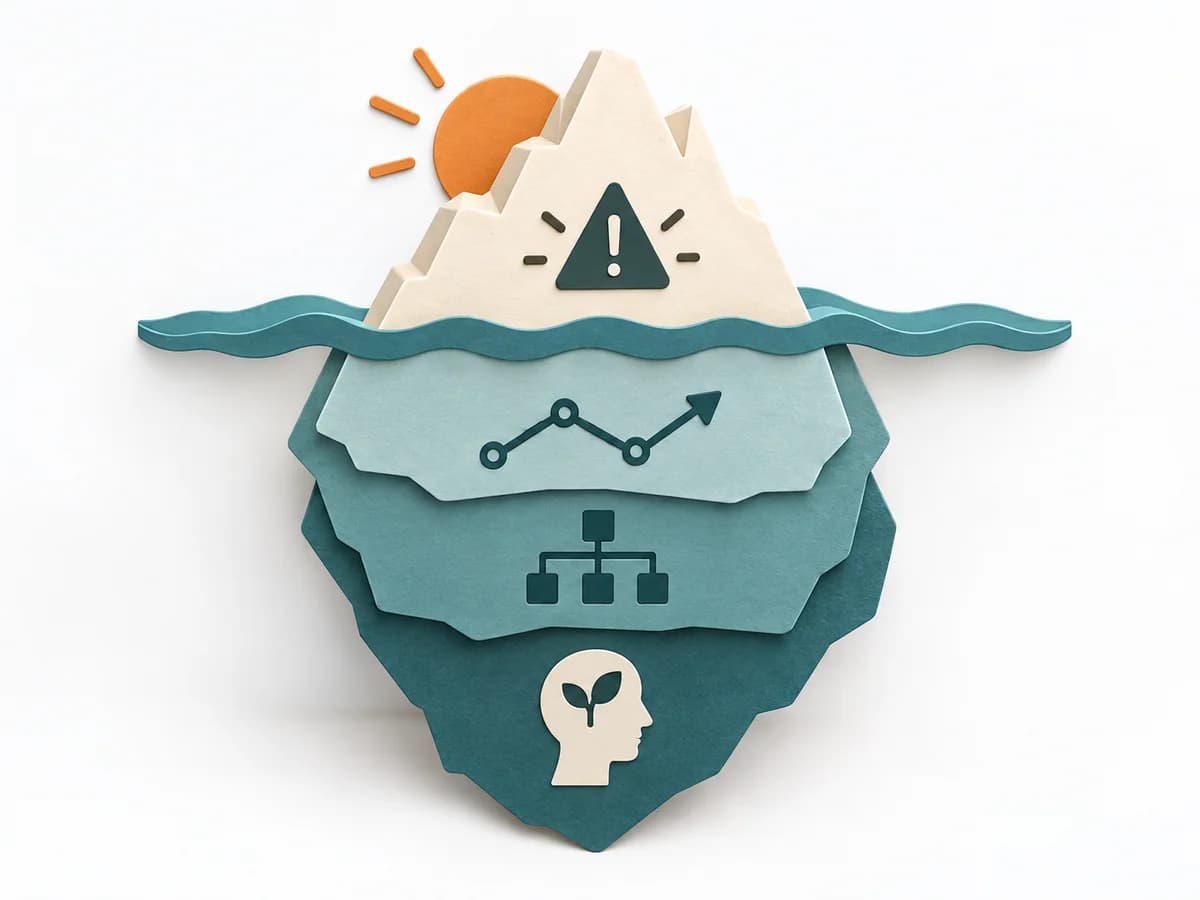
Complete firstBounded period
Start, end and reason are named.
Without a boundary, collection becomes arbitrary.
A practical method guide: clarify prerequisites and materials, understand the complete process, and look up outputs, pitfalls, and stop criteria.
What needs to be finished first
Start, end and reason are named.
At least one dated source and direct participants are available.
What needs to be ready before start
Long paper strip or digital board, cards, markers and access to dated sources.
Facilitator, timekeeper, scribe and participants with different viewpoints.
Gather calendar entries, tickets, releases, incident events, decisions and key metrics.
30–90 minutes depending on period and evidence.
Lay out time horizontally and prepare parallel lanes for work, signals and decisions. Define notation for fact, perception, hypothesis and gap.
The one question this method answers
Which supported events and turning points explain how the situation developed during the reviewed period?
Phases with goal, actions, output and pitfall
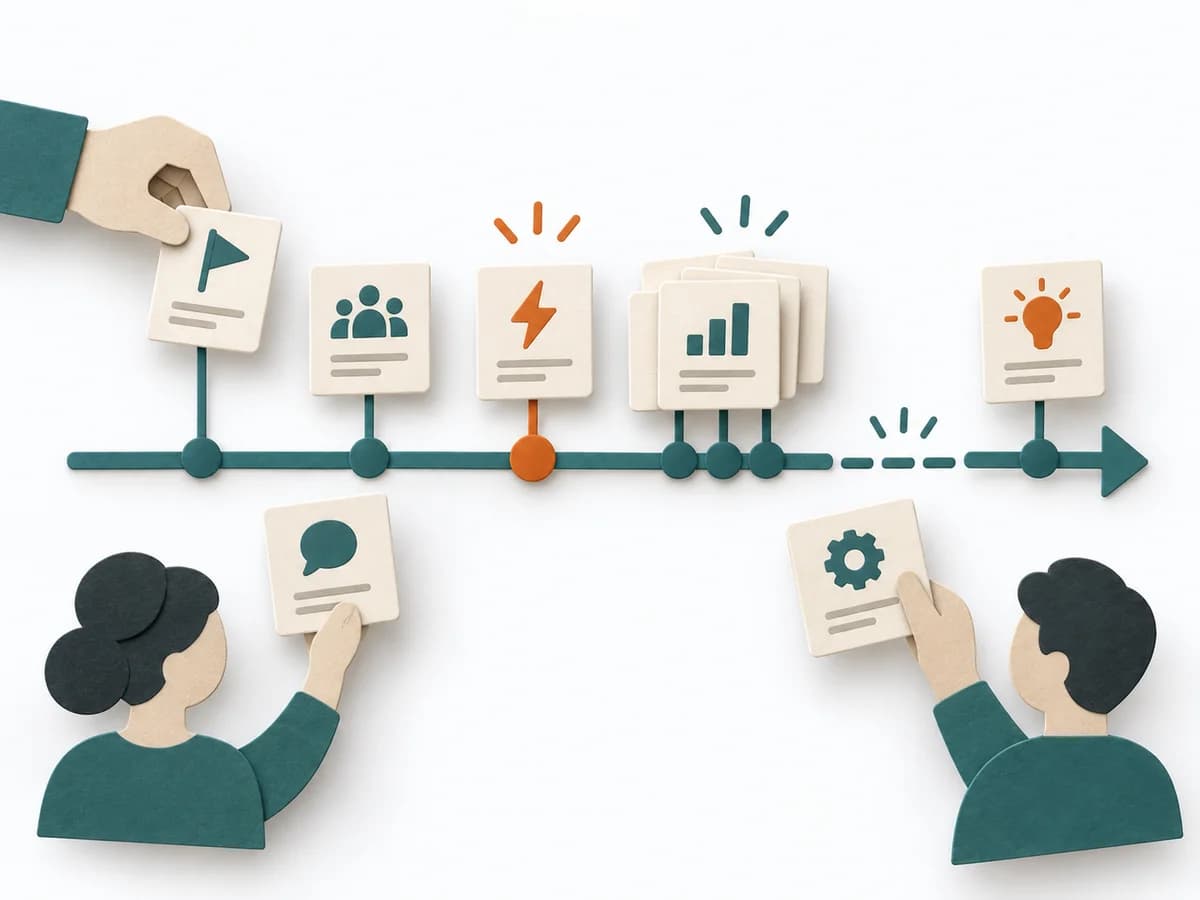
A timeline reconstruction connects dated events, decisions and perceptions across a bounded period. It supports shared recall and learning without treating temporal proximity as causation.
Fictional example
Fictional review of a course portal launch. Temporal sequence is separated from supported dependency.
| Lane | May 6 | May 13 | May 20 |
|---|---|---|---|
| WorkWhat was delivered or changed? | Import enabled | Support note added | Import limited |
| SignalsWhat data or observations are available? | 2 test accounts, no errors | 9 drop-offs in tickets | Drop-offs fall to 2 |
| DecisionsWhich decision changed the course? | Broad rollout | Measure failure pattern | Keep limit, review June 3 |
The link between broad rollout and drop-offs is a hypothesis to test.
Scope
Goal
Create one shared temporal and topical boundary.
Inputs for this step
Actions
Output
Timeline boundary
Question · start · end · viewpoints
Quality check
Would an event outside the period be excluded unambiguously?
Pitfall
The group retells the entire project history without a clear boundary. Post the start, end and question visibly and park out-of-scope contributions.
Timing: 5–10 minutes
Events
Goal
Build a broad and checkable event base.
Inputs for this step
Actions
Output
Event cards
Time · event · source · type · confidence
Quality check
Does every card include time and a traceable source or label?
Pitfall
General judgements replace concrete events and points in time. Ask for the date, observable change and origin of the statement.
Timing: 10–20 minutes
Sequence
Goal
Create a readable course with turning points and gaps.
Inputs for this step
Actions
Output
Evidence-based timeline
Lanes · turning points · links · gaps
Quality check
Are sequence and claimed dependency visibly distinct?
Pitfall
Proximity on the timeline is treated as causality without evidence. Use separate notation for temporal sequence and supported dependency.
Timing: 10–25 minutes
Learn
Goal
Derive a checkable learning question and next action.
Inputs for this step
Actions
Output
Learning and action record
Pattern · hypothesis · gap · action · review
Quality check
Does the action follow supported evidence or an explicitly labeled hypothesis?
Pitfall
The review ends with interesting stories but no checkable follow-through. Schedule one learning question and bounded action with an owner and review.
Timing: 10–20 minutes
What comes out at the end
Sketch: what the artifact looks like
Timeline with dated events, sources, turning points, gaps, learning questions and agreed actions.
Record period, creation date and evidence version. Add later evidence and label changed interpretations.
Chronological template for incident reconstruction with sources and uncertainty.
Incident: ... Period: ... Sources: logs, alerts, chat, tickets
| Time | Event | Source | Confidence | Note |
|---|---|---|---|---|
| HH:MM | high/medium/low |
Prepare the whole flow or one selected phase with real inputs.
To be confirmed
To be confirmed
Complete timeline Time: 30–90 minutes plus evidence gathering
Complete this worksheet on paper or in your own document during the work.
| Lane | Time 1 | Time 2 | Time 3 |
|---|---|---|---|
| Work | |||
| Signals | |||
| Decisions |
Enter your own dates, sources and decisions. Label links as supported or assumed.
Agile Retrospectives · Timeline activity
Expected artifact: Timeline boundary
Question · start · end · viewpoints
Entry:
...
Expected artifact: Event cards
Time · event · source · type · confidence
Entry:
...
Expected artifact: Evidence-based timeline
Lanes · turning points · links · gaps
Entry:
...
Expected artifact: Learning and action record
Pattern · hypothesis · gap · action · review
Entry:
...
...
Method guide: https://methodatlas.meierhoff-systems.de/en/methods/timeline/run-sheet
Concrete filled scenario, fictional example
Fictional example for orientation. Counts and timings describe this case and are not universal requirements.
Concrete filled scenario, fictional example
May 6: Import enabled for all accounts; two test accounts showed no errors. May 13: Nine support tickets report drop-offs; decision: measure the failure pattern. May 20: Parallel imports limited; drop-offs fall to two.
Hypothesis: The broad rollout increased parallel imports. Logs still need to confirm this. Next step: Operations checks concurrency by May 27; review on June 3.
Recognize symptoms and steer against them
Quick overview, the full text is in the matching phase in the flow
The group retells the entire project history without a clear boundary.
Post the start, end and question visibly and park out-of-scope contributions.
General judgements replace concrete events and points in time.
Ask for the date, observable change and origin of the statement.
Proximity on the timeline is treated as causality without evidence.
Use separate notation for temporal sequence and supported dependency.
The review ends with interesting stories but no checkable follow-through.
Schedule one learning question and bounded action with an owner and review.
When to pause, resolve prerequisites, or choose another approach
Go to the profile for purpose, similar methods, and sources or continue to the next method in the catalog.