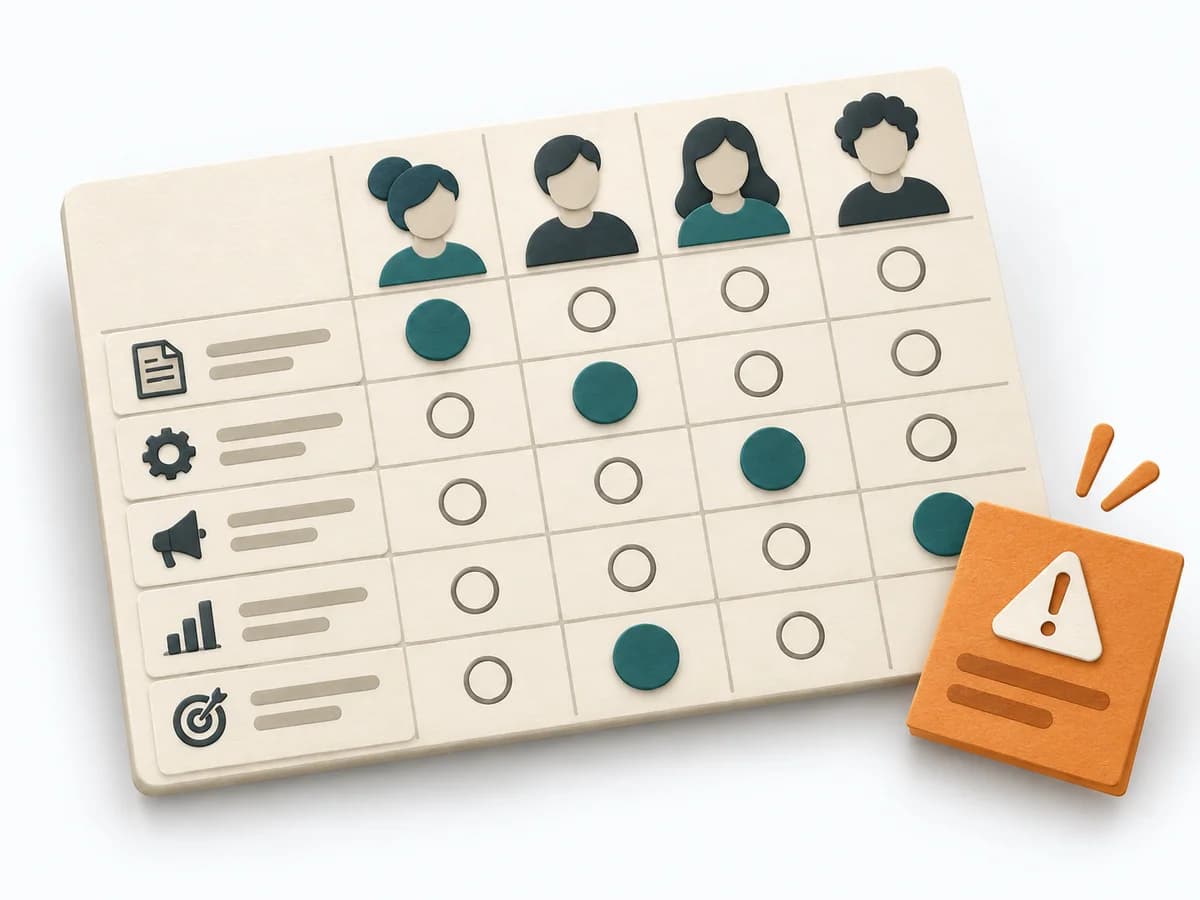
Establish practice
Define cadence, owner, participation, and success signals for a recurring team practice.
Establish the practice
Define cadence, owner, participation, and success signals so the method works as a recurring team practice.
Variant for Operating practice. The plan is derived from method form, method steps, and runsheet.
RunsheetAn operating practice works through repetition. The cadence should be small enough to hold reliably.
The steps describe one repetition and are adjusted after review.
- 1
Section 1: Purpose and stakeholders
30-45 minSponsor or stakeholder describes mission and expectations in 10 min. Team formulates own purpose sentence. Stakeholder list with expectations per stakeholder.
OwnerIf sponsor expectation and team understanding diverge strongly, clarify immediately. Charter without shared purpose is theater. - 2
Section 2: Goals and success measures
30-45 minConcrete goals for next 6-12 months. Success measure per goal (for example North Star Metric, OKR hint). Define quarterly review cadence for goals.
TeamGoals are not activities. "We develop feature X" is activity, "Time-to-First-Value falls from 6 to 3 weeks" is goal. - 3
Section 3: Roles and responsibilities
30-45 minFor each role (PM, Tech Lead, Designer, etc.) clarify: what is responsibility, what authority, what interface to other roles? Sketch RACI or DACI per key decision.
TeamRole conflicts are more common than people conflicts. Work through concrete examples per interface (for example PM <-> Tech Lead). - 4
Section 4: Working Agreements
30-45 minWork rules for communication, meetings, async work, decision making. Maximum 7-10 rules. Every rule with concrete behavior expectation.
TeamRules must be checkable. "We communicate respectfully" is not checkable, "We respond to pings during working hours in under 4 h" is. - 5
Section 5: Cadence and review
15-30 minDefine recurring appointments (standup, planning, retro, review). Charter review cadence (for example quarterly). Ownership for charter maintenance.
TeamCharter will be revised in first quarterly review anyway. First version does not need to be perfect, only honest.
Practice Charter
Copyable charter with purpose, cadence, owner, participation, flow, success signals, and review.
practice-charter.md
Practice Charter: Team Charter
Purpose
The method helps clarify group input, selection, and decision concretely. It turns individual contributions into a visible selection. The result is captured as a team charter, working norms, and role notes.
Cadence
weekly
Owner and Participation
- Owner: open
- Participants: 3-12
- Mode: synchronous
Flow per Iteration
- Section 1: Purpose and stakeholders (30-45 min) Sponsor or stakeholder describes mission and expectations in 10 min. Team formulates own purpose sentence. Stakeholder list with expectations per stakeholder.
- Section 2: Goals and success measures (30-45 min) Concrete goals for next 6-12 months. Success measure per goal (for example North Star Metric, OKR hint). Define quarterly review cadence for goals.
- Section 3: Roles and responsibilities (30-45 min) For each role (PM, Tech Lead, Designer, etc.) clarify: what is responsibility, what authority, what interface to other roles? Sketch RACI or DACI per key decision.
- Section 4: Working Agreements (30-45 min) Work rules for communication, meetings, async work, decision making. Maximum 7-10 rules. Every rule with concrete behavior expectation.
- Section 5: Cadence and review (15-30 min) Define recurring appointments (standup, planning, retro, review). Charter review cadence (for example quarterly). Ownership for charter maintenance.
Success Signals
Team Charter, Working Norms, Role Notes
Review
4 weeks