Complete firstBounded subject
The scope and purpose of Starbursting are stated as a concrete question.
Without scope, starburst question map becomes arbitrary.
A practical method guide: clarify prerequisites and materials, understand the complete process, and look up outputs, pitfalls, and stop criteria.
What needs to be finished first
The scope and purpose of Starbursting are stated as a concrete question.
One-sentence idea, known context, decision horizon and domain decision makers are available.
What needs to be ready before start
One-sentence idea, known context, decision horizon, shared workspace, source links, and decision log.
Idea owner · cross-functional participants · facilitator
Collect One-sentence idea, known context, decision horizon in advance and mark open assumptions.
45–60 minutes
Prepare six question families around a clearly stated idea visibly and calibrate assessment terms before starting.
The one question this method answers
Which decision-relevant questions about this idea still need answers?
Phases with goal, actions, output and pitfall
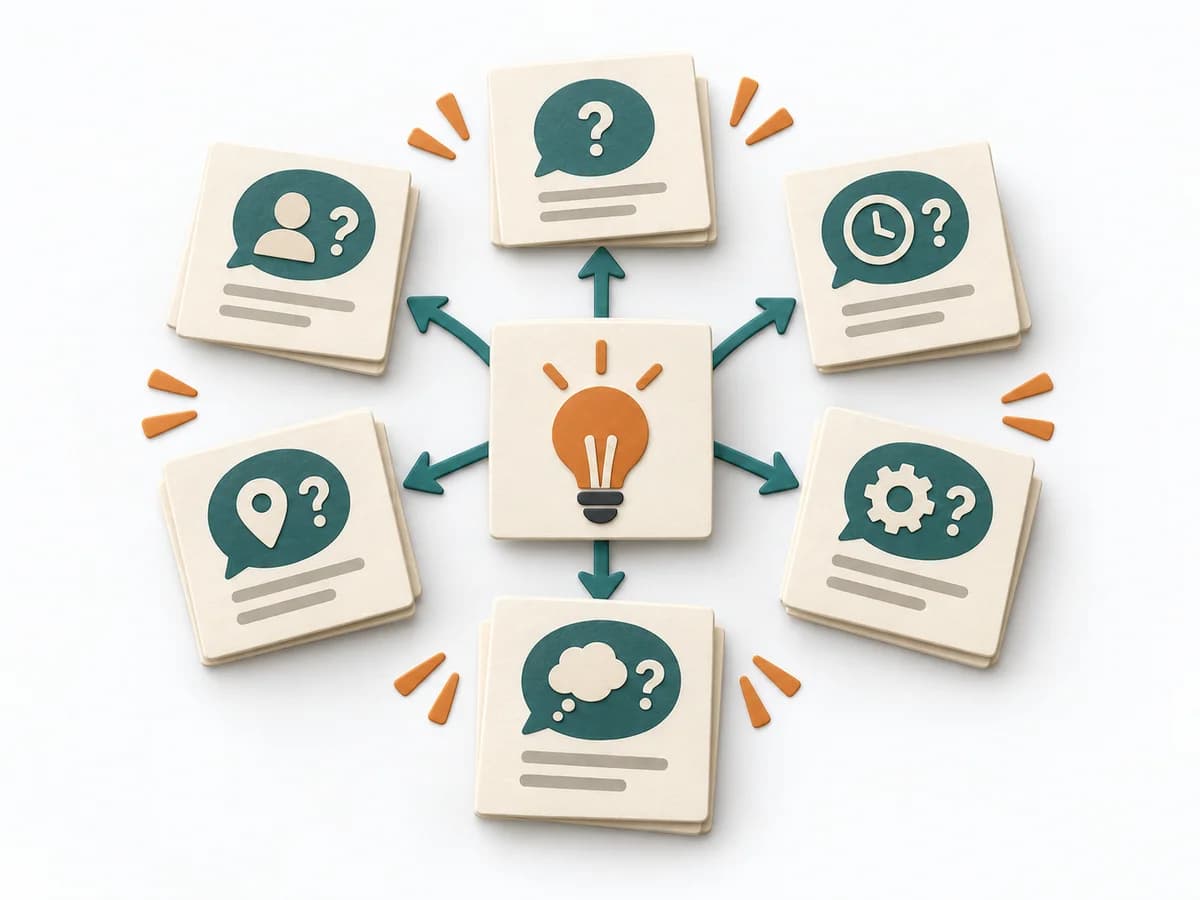
Starbursting generates questions first and answers them only afterwards. Six question families cover actors, subject, context, timing, purpose, and mechanism.
Fictional worked example
six question families around a clearly stated idea as a precise working structure with a fictional example.
Actors and decision rights
Who may change recipients and escalation routes?
Subject, content, and boundary
Which deadline types trigger alerts?
Usage context and channel
Where must the alert appear in the workflow?
Timing, lead time, and recurrence
When is the deadline source authoritative?
Purpose and desired effect
Which current omission should be prevented?
Mechanism, test, and risk
How do we detect and correct false alerts?
Focus idea
Goal
Produce idea statement so the core question “Which decision-relevant questions about this idea still need answers?” can be answered with stronger support.
Inputs for this step
Actions
Output
idea statement
idea statement · source · uncertainty · next decision
Quality check
Are subject and audience clear?
Pitfall
Questions are answered immediately or remain rhetorical and unrelated to a decision. Separate question generation, cluster duplicates, and link each top question to a decision.
Timing: 10–20 minutes
Generate questions
Goal
Produce question star so the core question “Which decision-relevant questions about this idea still need answers?” can be answered with stronger support.
Inputs for this step
Actions
Output
question star
question star · source · uncertainty · next decision
Quality check
Are all six families populated?
Pitfall
Questions are answered immediately or remain rhetorical and unrelated to a decision. Separate question generation, cluster duplicates, and link each top question to a decision.
Timing: 10–20 minutes
Cluster
Goal
Produce question clusters so the core question “Which decision-relevant questions about this idea still need answers?” can be answered with stronger support.
Inputs for this step
Actions
Output
question clusters
question clusters · source · uncertainty · next decision
Quality check
Do distinct assumptions remain separate?
Pitfall
Questions are answered immediately or remain rhetorical and unrelated to a decision. Separate question generation, cluster duplicates, and link each top question to a decision.
Timing: 10–20 minutes
Prioritise
Goal
Produce research plan so the core question “Which decision-relevant questions about this idea still need answers?” can be answered with stronger support.
Inputs for this step
Actions
Output
research plan
research plan · source · uncertainty · next decision
Quality check
Does every top question have an owner and answer route?
Pitfall
Questions are answered immediately or remain rhetorical and unrelated to a decision. Separate question generation, cluster duplicates, and link each top question to a decision.
Timing: 10–20 minutes
What comes out at the end
Sketch: what the artifact looks like
Versioned starburst question map with date, sources, owners, and next review.
Retain date, source, assumption state, and decision for every version of starburst question map.
Plan Starbursting around its domain steps and the concrete decision question.
To be confirmed
To be confirmed
Full workshop Time: 45–60 minutes
Complete this worksheet on paper or in your own document during the work.
Actors and decision rights
...
Subject, content, and boundary
...
Usage context and channel
...
Timing, lead time, and recurrence
...
Purpose and desired effect
...
Mechanism, test, and risk
...
Expected artifact: idea statement
idea statement · source · uncertainty · next decision
Entry:
...
Expected artifact: question star
question star · source · uncertainty · next decision
Entry:
...
Expected artifact: question clusters
question clusters · source · uncertainty · next decision
Entry:
...
Expected artifact: research plan
research plan · source · uncertainty · next decision
Entry:
...
...
Method guide: https://methodatlas.meierhoff-systems.de/en/methods/starbursting/run-sheet
Concrete filled scenario, fictional example
Fictional example for orientation. Counts and timings describe this case and are not universal requirements.
Concrete filled scenario, fictional example
Why: which current omission should the alert prevent? Who: who may change recipients and escalation? When: which deadline source is authoritative? How: how is a false alert detected? Priority: clarify deadline source before prototyping.
Recognize symptoms and steer against them
Quick overview, the full text is in the matching phase in the flow
Questions are answered immediately or remain rhetorical and unrelated to a decision.
Separate question generation, cluster duplicates, and link each top question to a decision.
Questions are answered immediately or remain rhetorical and unrelated to a decision.
Separate question generation, cluster duplicates, and link each top question to a decision.
Questions are answered immediately or remain rhetorical and unrelated to a decision.
Separate question generation, cluster duplicates, and link each top question to a decision.
Questions are answered immediately or remain rhetorical and unrelated to a decision.
Separate question generation, cluster duplicates, and link each top question to a decision.
When to pause, resolve prerequisites, or choose another approach
Go to the profile for purpose, similar methods, and sources or continue to the next method in the catalog.

