Complete firstBounded subject
The scope and purpose of Scrum are stated as a concrete question.
Without scope, Scrum operating agreement becomes arbitrary.
A practical method guide: clarify prerequisites and materials, understand the complete process, and look up outputs, pitfalls, and stop criteria.
What needs to be finished first
The scope and purpose of Scrum are stated as a concrete question.
Product Goal and Product Backlog, Definition of Done, empowered Scrum Team and domain decision makers are available.
What needs to be ready before start
Product Goal and Product Backlog, Definition of Done, empowered Scrum Team, shared workspace, source links, and decision log.
Product Owner · Scrum Master · Developers
Collect Product Goal and Product Backlog, Definition of Done, empowered Scrum Team in advance and mark open assumptions.
Continuous; Sprint no longer than one month
Prepare Sprints with Planning, Daily Scrum, Review, and Retrospective around three artefacts and commitments visibly and calibrate assessment terms before starting.
The one question this method answers
How does the Scrum Team create a usable Increment every Sprint and learn from outcome and ways of working?
Phases with goal, actions, output and pitfall
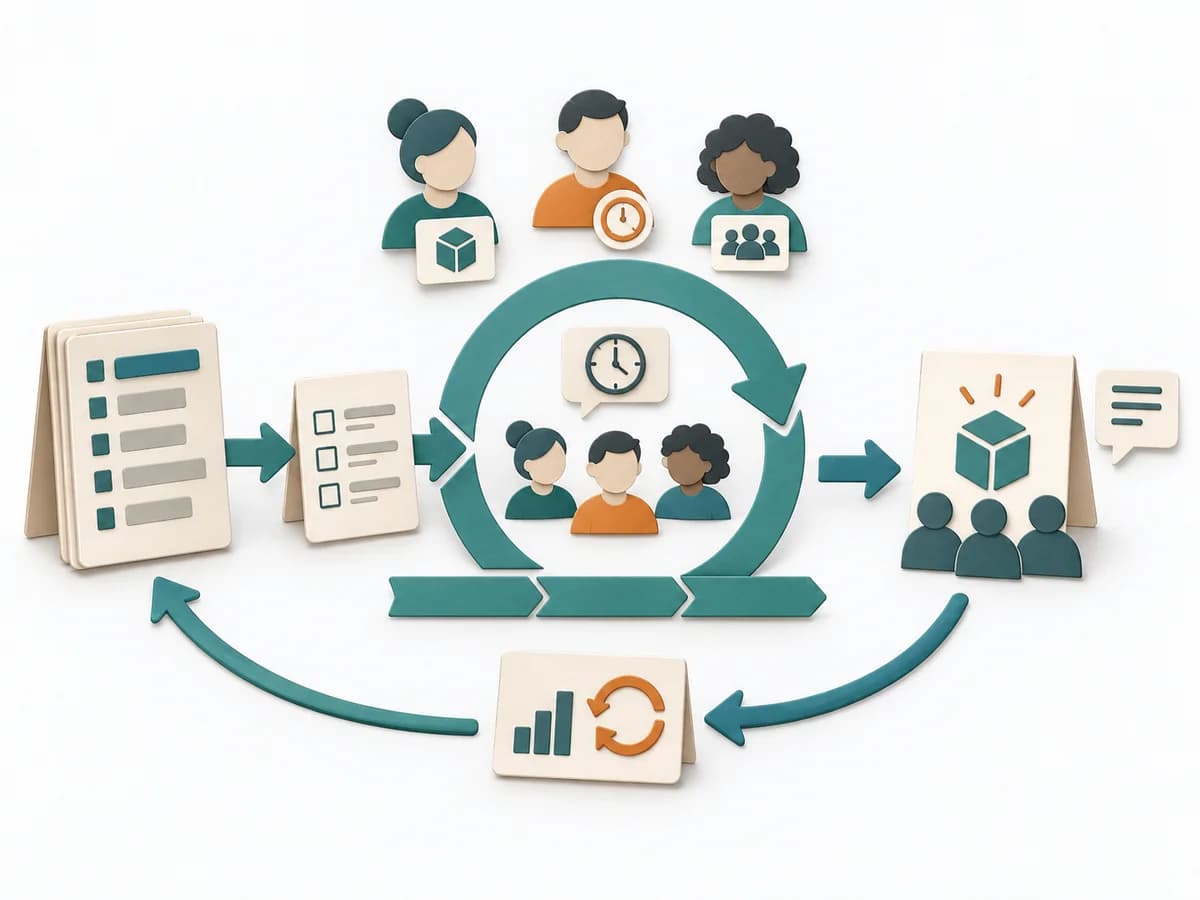
Scrum defines the Scrum Team, five events, three artefacts, and their commitments. Product Goal, Sprint Goal, and Definition of Done create focus and transparency; the framework does not prescribe Kanban WIP limits.
Fictional worked example
Sprints with Planning, Daily Scrum, Review, and Retrospective around three artefacts and commitments as a precise working structure with a fictional example.
Record concrete Accountabilities information for this Scrum instance.
Product Owner Lea orders the Product Backlog toward the Product Goal; Scrum Master Amir coaches Scrum use; Developers Kim, Noor, Eva, and Luis create the Increment.
Record concrete Events information for this Scrum instance.
Two-week Sprint: Planning Monday 09:00; Daily Scrum 09:15; Review Friday 13:00 with Support and Compliance; Retrospective 14:30.
Record concrete Artefacts/commitments information for this Scrum instance.
Product Goal: find a review decision with evidence in under 30 seconds. Sprint Goal: search by project, owner, and status. Definition of Done: integrated, tested, WCAG 2.2 AA, audit log, and production-ready.
Record concrete Empirical inspection information for this Scrum instance.
Review: seven of eight stakeholder tasks under 30 seconds; status filter unclear. Product Backlog receives a terminology test. Retrospective: prepare anonymised test data before Planning.
The example demonstrates the domain logic of Scrum; worksheets remain blank.
Product Goal
Goal
Produce product backlog so the core question “How does the Scrum Team create a usable Increment every Sprint and learn from outcome and ways of working?” can be answered with stronger support.
Inputs for this step
Actions
Output
product backlog
product backlog · source · uncertainty · next decision
Quality check
Does each item support the Product Goal?
Pitfall
Events become status meetings or unfinished work is called an Increment despite the Definition of Done. Realign event purposes, accountabilities, and artefact commitments with the Scrum Guide.
Timing: 10–20 minutes
Sprint
Goal
Produce sprint backlog so the core question “How does the Scrum Team create a usable Increment every Sprint and learn from outcome and ways of working?” can be answered with stronger support.
Inputs for this step
Actions
Output
sprint backlog
sprint backlog · source · uncertainty · next decision
Quality check
Does the Sprint Goal remain stable while the plan adapts?
Pitfall
Events become status meetings or unfinished work is called an Increment despite the Definition of Done. Realign event purposes, accountabilities, and artefact commitments with the Scrum Guide.
Timing: 10–20 minutes
Increment
Goal
Produce Done Increment so the core question “How does the Scrum Team create a usable Increment every Sprint and learn from outcome and ways of working?” can be answered with stronger support.
Inputs for this step
Actions
Output
Done Increment
Done Increment · source · uncertainty · next decision
Quality check
Does the Increment fully meet the Definition of Done?
Pitfall
Events become status meetings or unfinished work is called an Increment despite the Definition of Done. Realign event purposes, accountabilities, and artefact commitments with the Scrum Guide.
Timing: 10–20 minutes
Adapt
Goal
Produce adaptations so the core question “How does the Scrum Team create a usable Increment every Sprint and learn from outcome and ways of working?” can be answered with stronger support.
Inputs for this step
Actions
Output
adaptations
adaptations · source · uncertainty · next decision
Quality check
Does adaptation follow observed evidence?
Pitfall
Events become status meetings or unfinished work is called an Increment despite the Definition of Done. Realign event purposes, accountabilities, and artefact commitments with the Scrum Guide.
Timing: 10–20 minutes
What comes out at the end
Sketch: what the artifact looks like
Versioned Scrum operating agreement with date, sources, owners, and next review.
Retain date, source, assumption state, and decision for every version of Scrum operating agreement.
Plan Scrum around its domain steps and the concrete decision question.
To be confirmed
To be confirmed
Establish and review the practice Time: Continuous; Sprint no longer than one month
Complete this worksheet on paper or in your own document during the work.
Record concrete Accountabilities information for this Scrum instance.
...
Record concrete Events information for this Scrum instance.
...
Record concrete Artefacts/commitments information for this Scrum instance.
...
Record concrete Empirical inspection information for this Scrum instance.
...
Enter only real input, sources, and decisions.
Expected artifact: product backlog
product backlog · source · uncertainty · next decision
Entry:
...
Expected artifact: sprint backlog
sprint backlog · source · uncertainty · next decision
Entry:
...
Expected artifact: Done Increment
Done Increment · source · uncertainty · next decision
Entry:
...
Expected artifact: adaptations
adaptations · source · uncertainty · next decision
Entry:
...
...
Method guide: https://methodatlas.meierhoff-systems.de/en/methods/scrum/run-sheet
Concrete filled scenario, fictional example
Fictional example for orientation. Counts and timings describe this case and are not universal requirements.
Concrete filled scenario, fictional example
Product Goal: teams can retrieve decisions with evidence. Sprint Goal: find a saved decision in under 30 seconds. Increment meets the Definition of Done including accessibility and audit log. Review inspects usage with stakeholders; Retrospective improves test-data flow.
Recognize symptoms and steer against them
Quick overview, the full text is in the matching phase in the flow
Events become status meetings or unfinished work is called an Increment despite the Definition of Done.
Realign event purposes, accountabilities, and artefact commitments with the Scrum Guide.
Events become status meetings or unfinished work is called an Increment despite the Definition of Done.
Realign event purposes, accountabilities, and artefact commitments with the Scrum Guide.
Events become status meetings or unfinished work is called an Increment despite the Definition of Done.
Realign event purposes, accountabilities, and artefact commitments with the Scrum Guide.
Events become status meetings or unfinished work is called an Increment despite the Definition of Done.
Realign event purposes, accountabilities, and artefact commitments with the Scrum Guide.
When to pause, resolve prerequisites, or choose another approach
Go to the profile for purpose, similar methods, and sources or continue to the next method in the catalog.