Complete firstConcrete risks
Risks are written as uncertain events with consequences.
Vague concerns cannot be ROAMed meaningfully.
A practical method guide: clarify prerequisites and materials, understand the complete process, and look up outputs, pitfalls, and stop criteria.
What needs to be finished first
Risks are written as uncertain events with consequences.
Owners and risk acceptors are available or named.
What needs to be ready before start
Four-column board, prioritised risk list, planning objectives, owner directory, and review calendar.
Facilitator or RTE, risk owners, affected teams, subject experts, and authorised risk acceptor.
Prepare risks with consequences, current assessment, and existing treatments.
20–40 minutes initially; 10–20 minutes per review.
Display column criteria and required fields for owners, dates, treatments, and acceptance.
The one question this method answers
How will each relevant risk be treated, and what must happen before the next review?
Phases with goal, actions, output and pitfall
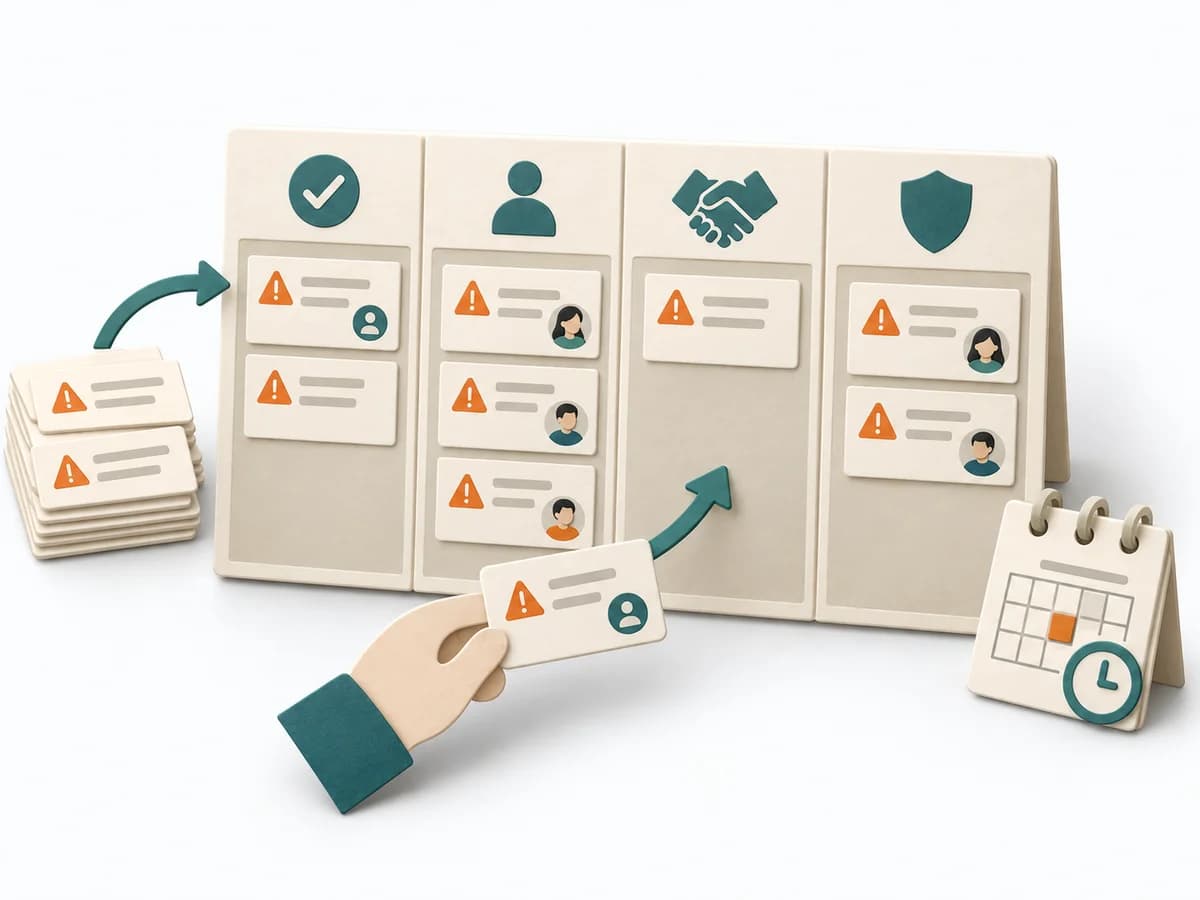
ROAM is a collaborative risk-treatment practice for planning and review. Owned is an interim state with accountability, Accepted requires an authorised decision, Mitigated requires a concrete plan, and Resolved requires evidence that the concern has ended.
Fictional worked example
Four treatment states with status-specific required information.
Test environment capacity
Additional capacity confirmed; risk ended on 14 June.
Certificate approval delayed
Clarification blocked
Owner Security; escalation by 21 June; treatment still undecided.
One-day shipping delay
Business owner accepted on 12 June; reconsider at >1 day or >5% of orders.
Identity provider outage
Fallback tested; residual switch-over risk up to five minutes; review 30 September.
Prepare
Goal
Provide a bounded, understandable list of relevant risks with consequence and context.
Inputs for this step
Actions
Output
Qualified risk list
Risk scenario · consequence · context · urgency
Quality check
Is every item a risk rather than a task or issue? Is the affected objective clear?
Pitfall
The board fills with vague worries and operational tasks that cannot support a ROAM decision. Rewrite items as risk scenarios or move them to issue and action lists.
Timing: 5–10 minutes
Decide
Goal
Choose the appropriate treatment and record the decision rationale.
Inputs for this step
Actions
Output
ROAM assignment
Category · rationale · residual uncertainty
Quality check
Can the category be traced to a criterion? Is Owned kept distinct from Mitigated and Resolved?
Pitfall
Risks are placed in the most convenient column without rationale or residual uncertainty. Apply the exit criterion for each column and treat doubtful cards as Owned with an investigation action.
Timing: 10–20 minutes
Commit
Goal
Make open risks actionable with owners, actions, acceptance authority, and the next review.
Inputs for this step
Actions
Output
Actionable board
Owner · action · date · evidence · acceptance
Quality check
Can every open card be actively tracked to the next review? Is acceptance documented by an authorised person?
Pitfall
Owned cards contain a name but no next action; Accepted becomes a parking place for uncomfortable risks. Complete status-specific fields and escalate unauthorised acceptance.
Timing: 10–15 minutes
Review
Goal
Review risks regularly, justify transitions, and close completed cards traceably.
Inputs for this step
Actions
Output
Versioned risk picture
Status history · new evidence · escalations
Quality check
Does every status change have a clear trigger? Are overdue Owned risks visibly escalated?
Pitfall
The board remains unchanged after planning and months later only reflects the original discussion. Establish a review cadence with an owner and escalate overdue cards.
Timing: 10–20 minutes per review
What comes out at the end
Sketch: what the artifact looks like
Versioned ROAM board with rationale, owners, treatments, dates, and review triggers.
Log transitions with date, author, rationale, and evidence; archive Resolved cards.
Set up the board once and establish a recurring review practice.
To be confirmed
To be confirmed
Establish ROAM practice Time: Ongoing practice with 10–20 minutes per review
Complete this worksheet on paper or in your own document during the work.
...
...
...
...
Resolved ...
Owned ...
Accepted ...
Mitigated ...
U.S. Department of Commerce Agile Framework
Expected artifact: Qualified risk list
Risk scenario · consequence · context · urgency
Entry:
...
Expected artifact: ROAM assignment
Category · rationale · residual uncertainty
Entry:
...
Expected artifact: Actionable board
Owner · action · date · evidence · acceptance
Entry:
...
Expected artifact: Versioned risk picture
Status history · new evidence · escalations
Entry:
...
...
Method guide: https://methodatlas.meierhoff-systems.de/en/methods/roam-board/run-sheet
Concrete filled scenario, fictional example
Fictional example for orientation. Counts and timings describe this case and are not universal requirements.
Concrete filled scenario, fictional example
Fictional example: an external identity provider might fail during a PI objective. Status Mitigated because an automatic fallback was implemented and proven in a load test on 18 June. Owner: Operations. Residual risk: switch-over may take up to five minutes. Review after the first production failover or by 30 September.
Recognize symptoms and steer against them
Quick overview, the full text is in the matching phase in the flow
The board fills with vague worries and operational tasks that cannot support a ROAM decision.
Rewrite items as risk scenarios or move them to issue and action lists.
Risks are placed in the most convenient column without rationale or residual uncertainty.
Apply the exit criterion for each column and treat doubtful cards as Owned with an investigation action.
Owned cards contain a name but no next action; Accepted becomes a parking place for uncomfortable risks.
Complete status-specific fields and escalate unauthorised acceptance.
The board remains unchanged after planning and months later only reflects the original discussion.
Establish a review cadence with an owner and escalate overdue cards.
When to pause, resolve prerequisites, or choose another approach
Go to the profile for purpose, similar methods, and sources or continue to the next method in the catalog.