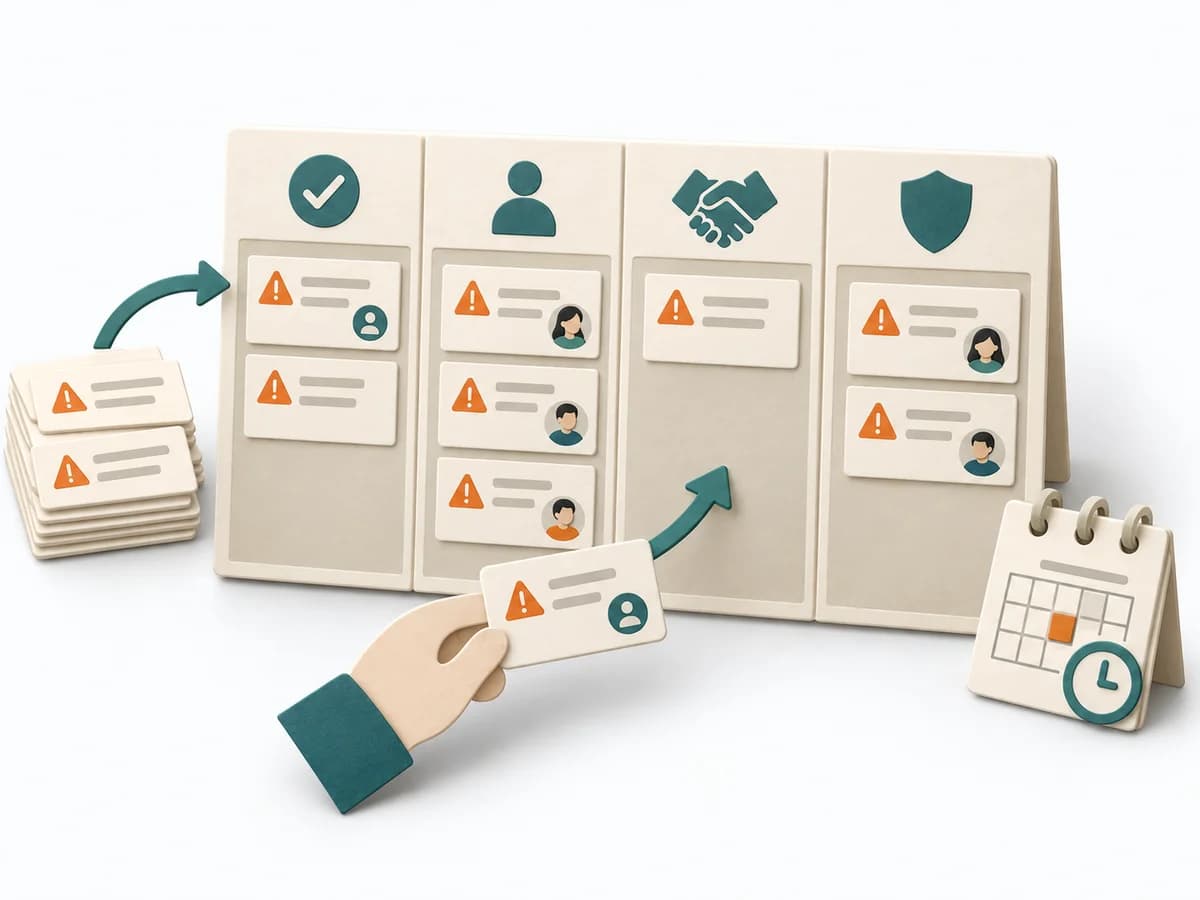
Complete firstBounded scope
Objective, horizon, and process are named.
Without a boundary, ratings are not comparable.
A practical method guide: clarify prerequisites and materials, understand the complete process, and look up outputs, pitfalls, and stop criteria.
What needs to be finished first
Objective, horizon, and process are named.
Likelihood and impact have observable anchors.
What needs to be ready before start
5×5 workspace, risk list, incident history, control evidence, scale anchors, and decision log.
Facilitator, risk owner, likelihood and impact experts, and a person authorised to accept or escalate risk.
Prepare scope, horizon, tolerance, current controls, and reference cases.
45–60 minutes for 8–12 risks; data collection and treatment work are additional.
Label axes 1–5 with concrete anchors and display the extreme-outcome and uncertainty rules.
The one question this method answers
Which risks exceed our tolerance in the agreed horizon, and which response reduces them credibly?
Phases with goal, actions, output and pitfall
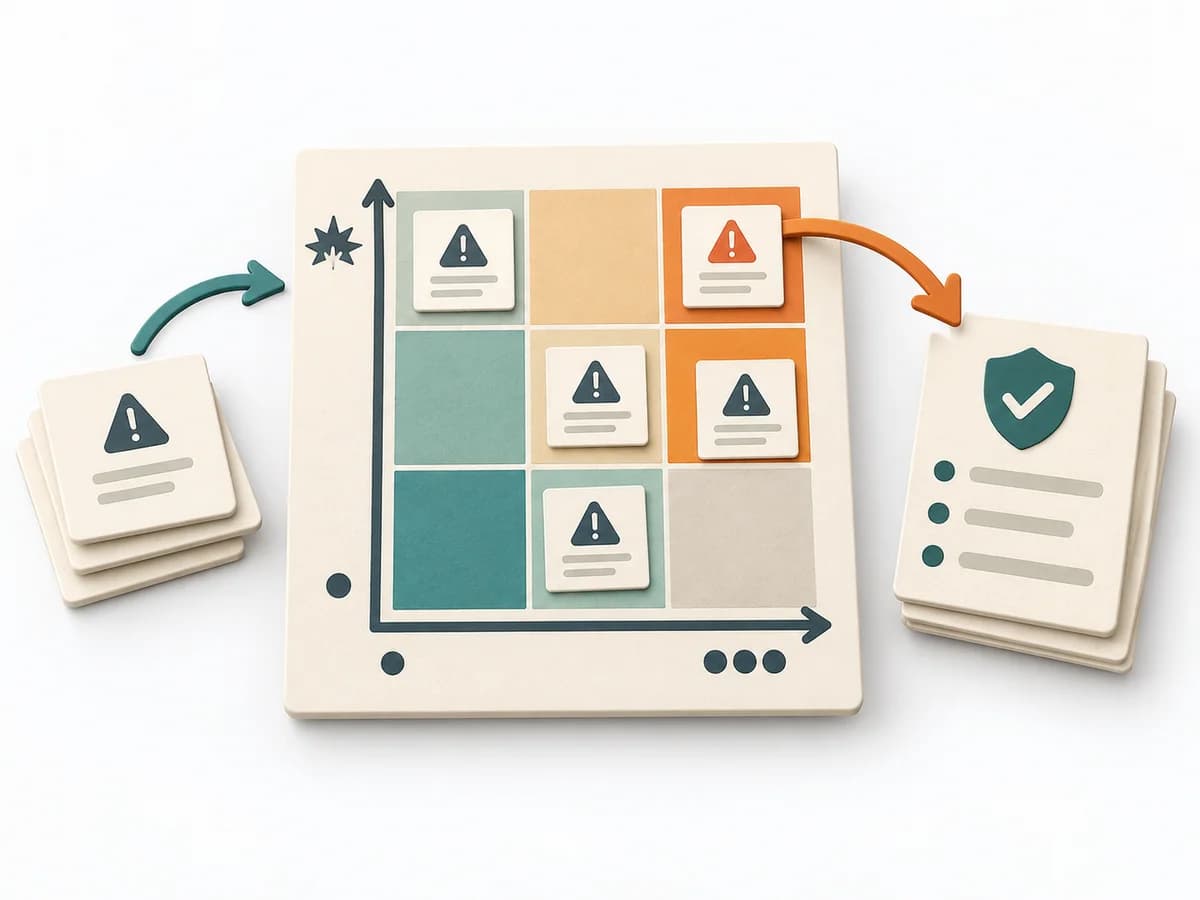
A Risk Matrix supports comparison when scope, time horizon, and scale anchors are explicit. Ordinal scores are conversation aids rather than precise mathematics; rare catastrophic outcomes and uncertain estimates require separate attention.
Fictional worked example
Connect each scenario to calibrated ratings, controls, and a decision; this is not a quantitative risk model.
| Risk | Risk scenario | Likelihood | Impact | Controls and residual risk | Response |
|---|---|---|---|---|---|
| Checkout loginIdentity-provider outage | If the identity provider is unavailable for more than 30 minutes, customers cannot sign in or purchase. | 3/5: about once per quarter in 12 months of status history. | 5/5: complete login and purchase stop, with revenue and support impact. | Manual fallback exists but is untested; residual risk 3×5=15. | Mitigate: Operations tests by 30 June; switch-over <5 minutes, no data loss; then reassess. |
The number is an ordinal sorting aid. Anchors, uncertainty, extreme outcomes, and residual risk remain decision-relevant.
Calibrate
Goal
Define a scope-specific 5×5 scale with observable anchors and escalation rules.
Inputs for this step
Actions
Output
Calibrated scales
5 likelihood anchors · 5 impact anchors · thresholds · extreme-outcome rule
Quality check
Can two people place the same reference case within one level? Does a catastrophic risk remain visible even when likelihood is low?
Pitfall
The group assigns numbers without explaining the real frequency or consequence behind each level. Anchor every level with a range and reference case; mark uncertainty separately where data is missing.
Timing: 10–15 minutes
Describe
Goal
Describe each risk as a possible event with cause, consequence, affected objective, and existing controls.
Inputs for this step
Actions
Output
Assessable risk list
Event · cause · consequence · objective · control · evidence status
Quality check
Is each item an uncertain event rather than an issue that has already occurred? Is the assessed consequence explicit?
Pitfall
Entries such as 'security' or 'supplier' name a topic but no assessable event or consequence. Rewrite the entry as an if-then statement with an affected objective.
Timing: 10–15 minutes
Assess
Goal
Assess likelihood and impact consistently while preserving disagreement and uncertainty.
Inputs for this step
Actions
Output
Justified matrix
L · I · category · rationale · residual risk · uncertainty
Quality check
Can the cell be traced to scale anchors and evidence? Was the ordinal score kept separate from precise loss probability?
Pitfall
The team multiplies two ordinal numbers and treats the result as objective precision or the only ranking. Review anchors, rationale, uncertainty, and extreme outcomes next to the score; discuss ties substantively.
Timing: 15–20 minutes
Respond
Goal
Agree a concrete treatment, owner, and review trigger for risks above tolerance.
Inputs for this step
Actions
Output
Risk treatment plan
Response · action · owner · date · indicator · residual risk
Quality check
Does every high risk have a decision rather than only a colour? Is it clear when the assessment becomes stale?
Pitfall
The matrix ends with red cells but no decision, owner, indicator, or review date. Add a response and measurable review trigger for every risk above threshold.
Timing: 10–15 minutes
What comes out at the end
Sketch: what the artifact looks like
Versioned matrix plus register containing rationale, response, owner, date, and residual risk.
Retain assessment date, scale version, and changed controls for each revision; do not overwrite prior positions.
Plan calibration, assessment, and treatment for a bounded risk set.
To be confirmed
To be confirmed
Full risk review Time: 45–60 minutes
Complete this worksheet on paper or in your own document during the work.
| Risk | If …, then … | L 1–5 + anchor | I 1–5 + anchor | Controls · residual risk | Response · owner · date |
|---|---|---|---|---|---|
| Checkout login |
For each risk, complete scenario, L/I anchors, controls, residual risk, and response.
Expected artifact: Calibrated scales
5 likelihood anchors · 5 impact anchors · thresholds · extreme-outcome rule
Entry:
...
Expected artifact: Assessable risk list
Event · cause · consequence · objective · control · evidence status
Entry:
...
Expected artifact: Justified matrix
L · I · category · rationale · residual risk · uncertainty
Entry:
...
Expected artifact: Risk treatment plan
Response · action · owner · date · indicator · residual risk
Entry:
...
...
Method guide: https://methodatlas.meierhoff-systems.de/en/methods/risk-matrix/run-sheet
Concrete filled scenario, fictional example
Fictional example for orientation. Counts and timings describe this case and are not universal requirements.
Concrete filled scenario, fictional example
Fictional example: checkout depends on an identity provider. Event: provider unavailable for more than 30 minutes. L=3 (about one outage per quarter from status history), I=5 (login and purchase stop, with revenue and support impact). Inherent score 15. The manual fallback is untested, so residual risk remains 15. Decision: mitigate; Operations tests the fallback by 30 June. Success means switch-over under five minutes with no data loss, followed by reassessment.
Recognize symptoms and steer against them
Quick overview, the full text is in the matching phase in the flow
The group assigns numbers without explaining the real frequency or consequence behind each level.
Anchor every level with a range and reference case; mark uncertainty separately where data is missing.
Entries such as 'security' or 'supplier' name a topic but no assessable event or consequence.
Rewrite the entry as an if-then statement with an affected objective.
The team multiplies two ordinal numbers and treats the result as objective precision or the only ranking.
Review anchors, rationale, uncertainty, and extreme outcomes next to the score; discuss ties substantively.
The matrix ends with red cells but no decision, owner, indicator, or review date.
Add a response and measurable review trigger for every risk above threshold.
When to pause, resolve prerequisites, or choose another approach
Go to the profile for purpose, similar methods, and sources or continue to the next method in the catalog.